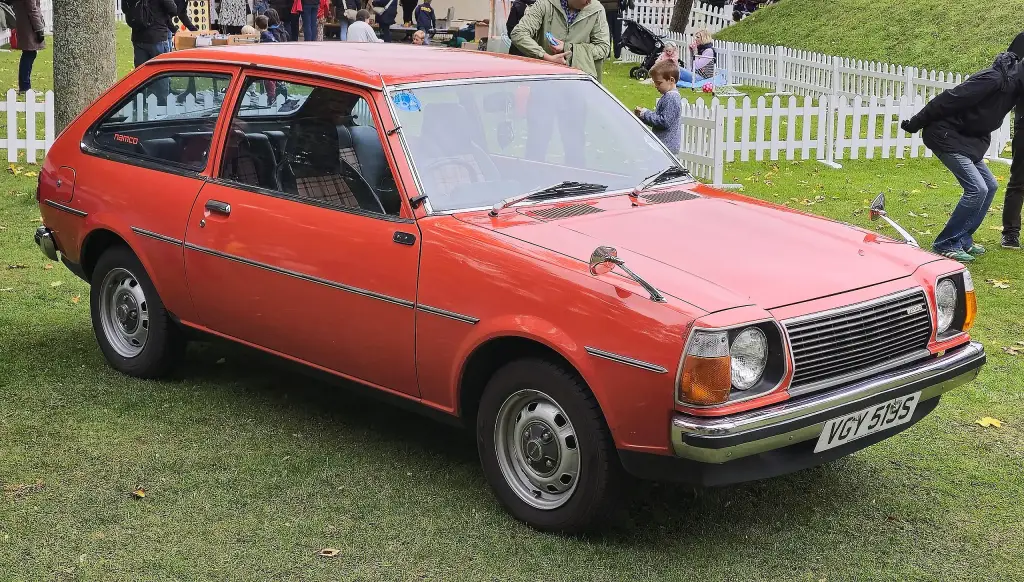
The Mazda 323 is the export name of the Familia, Mazda’s small family car. The 323 itself was built from early 1977 to autumn 2003 in six generations, replacing the previous Familia and being replaced in turn by the Mazda 3. In Japan the car was always the Familia, and in North America the early cars were sold as the Mazda GLC and the later ones as the Protegé.
Mazda 323 at a glance
| Built | early 1977 – autumn 2003, six generations |
|---|---|
| Names | Familia (Japan), 323 (Europe), GLC, Protegé, Allegro (Colombia) |
| First generation | FA4, 1977–1980, rear-wheel drive |
| Second generation | BD, November 1980, first front-wheel drive |
| Third generation | BF, July 1985, including the turbo four-wheel-drive |
| Fourth generation | BG, September 1989, with the 323F and Protegé |
| Fifth and sixth | BH from 1994 and BJ from 1998 |
| Ford versions | Ford Laser and Ford Meteor |
| Replaced by | Mazda 3, from late October 2003 |
This page covers the 323/Familia line from 1977 to 2003, including the GLC, Protegé, Astina, Lantis and Étude records merged into it.
History of the Mazda 323
The first front-wheel-drive 323 arrived in January 1977, replacing the Mazda 1000/1300. The FA4 had a hatchback body with three or five doors, and a 323 Variabel estate joined in September 1977. Engines ran from 1.0 to 1.4 litres, driving the rear wheels, and in Germany the car was introduced in February 1977 at prices from 8,490 DM; the sporty SP came only as a three-door with a 1.4-litre 70 PS engine. A facelift in summer 1979 brought rectangular headlights, and in the United States the car was sold as the GLC, for Great Little Car.
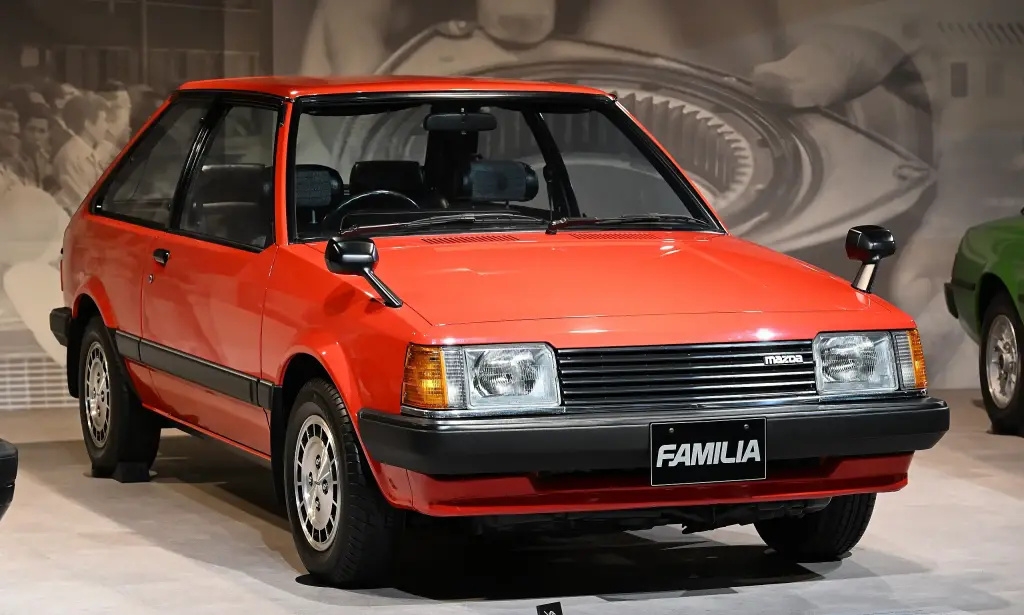
The second generation, the BD, appeared in November 1980 with a saloon following in October 1981 and, for a while, the estate still built in the old FA4V form. It was squarer and more modern than its predecessor and, for the first time, front-wheel drive. German engines ran from a 1.1 with 40 kW to a 1.5 with 65 kW, and the car became the best-selling Japanese model in Germany. Around 10,000 were delivered to East Germany, where it was one of the few Western cars sold for East German marks rather than through Genex. Production ended in June 1985.
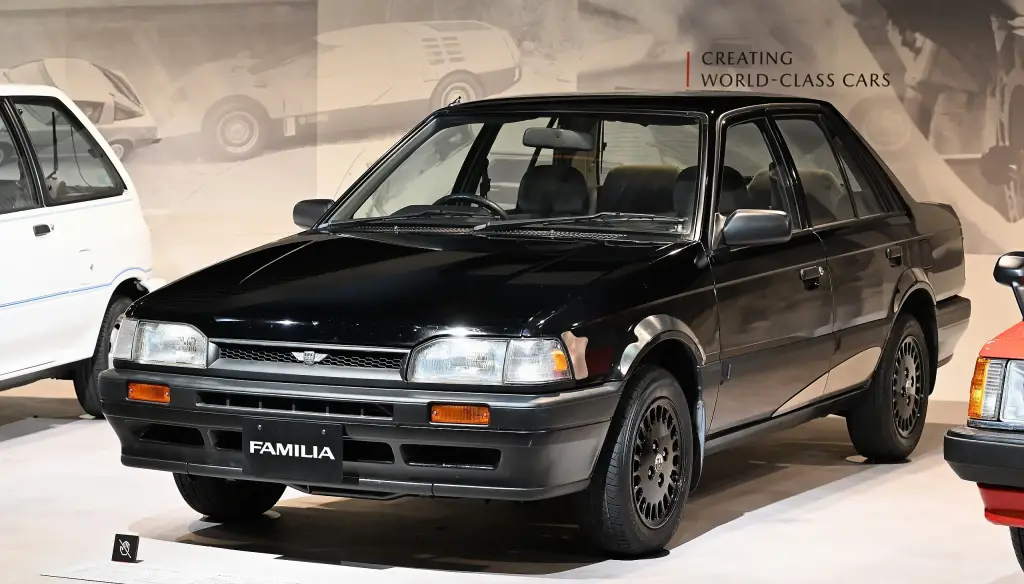
The BF generation began in July 1985 and carried the design forward with a flatter line and narrower headlights. A 1.7-litre diesel with 40 kW arrived, and in early 1987 Mazda entered rallying with a three-door four-wheel-drive 323 using a 1.6-litre twin-cam turbo of 110 kW (150 PS). A facelift in August 1987 brought fuel injection and catalytic converters across the petrol range. From 1987 to 1989 Japan also had the Étude, a three-door coupé on the same base, and in South Africa the generation was built into the 1990s as the Sting and Ford Laser, with the Rustler pickup.
The BG of September 1989 added the five-door 323F coupé with pop-up headlights, a four-wheel-drive three-door with a 1.8-litre 76 kW engine, and in North America the saloon was renamed Protegé; in Japan the same car was sold as the Eunos 100. Later generations, the BH from 1994 and BJ from 1998, continued until the Mazda 3 took over in 2003.
Design and features
- Rear- to front-wheel drive: the switch came with the second generation in 1980.
- GLC: the North American name stood for Great Little Car.
- 323F: the 1989 five-door coupé with pop-up headlights.
- Rally car: a 1.6 turbo four-wheel-drive three-door with 150 PS from 1987.
Mazda 323 versions
- FA4 (1977–1980): rear-wheel drive, hatchback and Variabel estate.
- BD (1980–1985): first front-wheel-drive 323, hatchback and saloon.
- BF (1985–1989): diesel and, from 1987, the turbo four-wheel-drive.
- BG (1989–1994): 323F coupé, Protegé saloon and Eunos 100.
- BH and BJ (1994–2003): the last two generations.
The 323 replaced the Mazda 1000/1300 and was itself replaced by the Mazda 3. More Mazdas are in the Mazda collection.
Sources
- Mazda Familia, English Wikipedia: name history, generations, Ford versions
- Mazda 323, German Wikipedia: generations FA4–BG, German prices and engines
- マツダ・ファミリア, Japanese Wikipedia: Japanese names and models