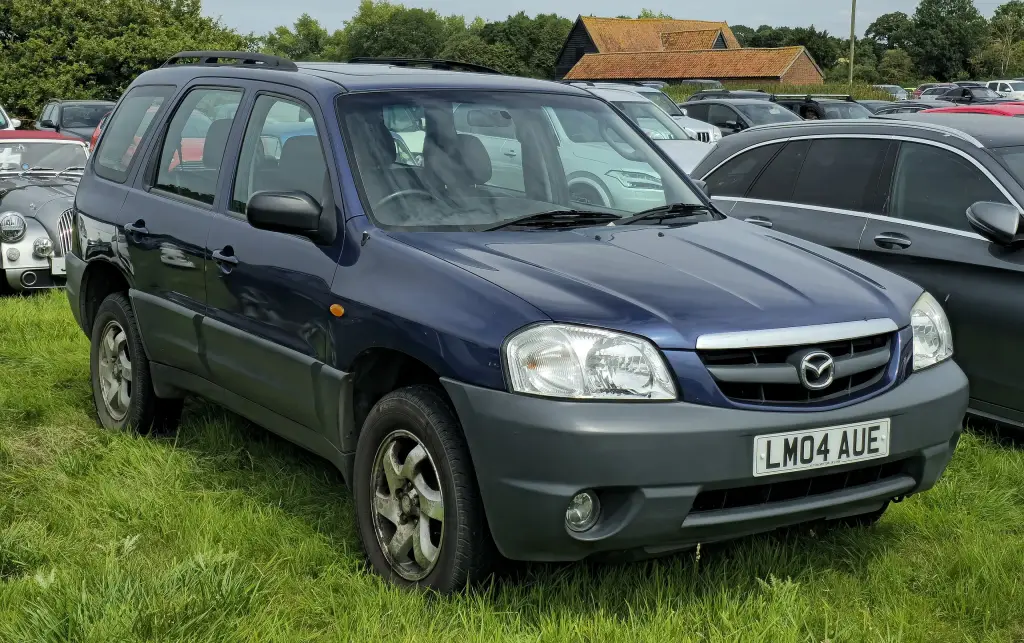
The Mazda Tribute is a compact SUV that Mazda built from 2000 to 2011, developed jointly with Ford and based on the front-wheel-drive Mazda 626 platform that also underpinned the Ford Escape. It was Mazda’s first original SUV and was replaced by the in-house designed CX-5.
Mazda Tribute at a glance
| Built | 2000–2011 |
|---|---|
| Developed with | Ford, on the Mazda 626 platform and Ford CD2 |
| Related to | Ford Escape and Mercury Mariner |
| Debut | 2000 Los Angeles Auto Show |
| European debut | October 2000, Paris Salon |
| Drive | front- or all-wheel drive |
| Engines at launch | 2.0 Ford Zetec four and 3.0 Ford Duratec V6 |
| Power | 130 PS (2.0) and 200 PS (3.0) |
| Built in | Claycomo, Missouri; Hofu, Japan; Ford Lio Ho, Taiwan |
| Replaced by | Mazda CX-5 |
History of the Mazda Tribute
The Tribute made its debut at the 2000 Los Angeles Auto Show as a compact crossover SUV, a segment the Toyota RAV4 had pioneered in 1994. Its conservative styling resembled the Mazda Navajo, the rebadged two-door Ford Explorer retired in 1994. In Japan Mazda had already been selling a rebadged Suzuki Escudo as the Mazda Proceed Levante by 1995, but the Tribute was Mazda’s first original SUV. It made its European debut at the Paris Salon in October 2000. The Ford plant in Claycomo, Missouri, assembled it for North America alongside the Ford Escape, and Mazda’s Hofu plant in Japan and Ford Lio Ho in Taiwan also assembled it for their markets.
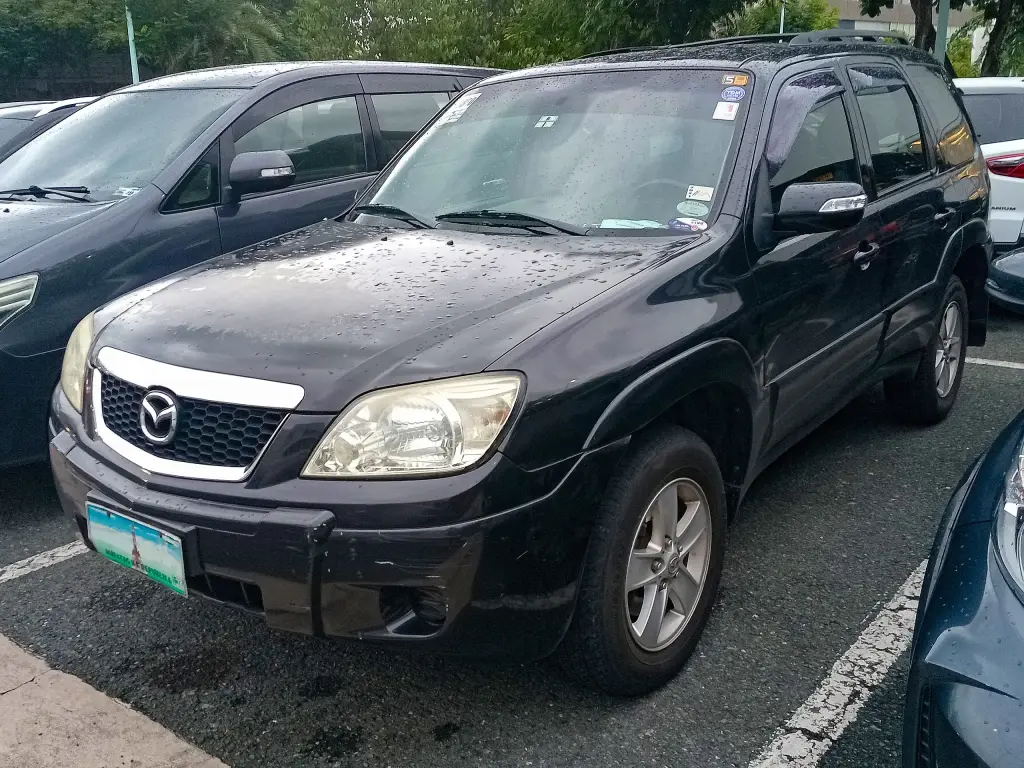
The Tribute and Escape offered front- or all-wheel drive and a choice of a transversely mounted 2.0-litre Ford Zetec four or a 3.0-litre Ford Duratec V6, priced below the Ford Escape and Mercury Mariner. One main difference from the Escape and Maverick was that the Tribute’s suspension was tuned for a firmer ride to match Mazda’s sporty image. In Japan, where sales began in November 2001, the line-up came only with a column-shifted four-speed automatic, with a 2.0 LX in two- or four-wheel drive and a four-wheel-drive 3.0 V6 in LX or the well-equipped GL-X, plus a G package with aluminium wheels, side airbags and tinted glass. A front-wheel-drive V6 LX and an L package with leather seats followed in 2001, and in October 2001 Mazda added the leisure-oriented Field Break special edition with water-repellent seat fabric and a front push bar.
In Japan the 2.0-litre four produced 130 PS and 183 N·m and used a timing belt, while the 3.0-litre V6 produced 200 PS and 265 N·m with a maintenance-free timing chain. The Tribute and Escape were refreshed in 2004 for the 2005 model year, in Japan from December 2003, when the base engine became Mazda’s own 2.3-litre MZR four while the 3.0 V6 stayed. The utilitarian Tribute was eventually replaced by the more aggressively styled, in-house-designed Mazda CX-5 in North America.
Design and features
- Ford partnership: developed with the Ford Escape on the CD2 platform.
- Firmer suspension: tuned for a sportier feel than the Escape and Maverick.
- V6 option: a 3.0 Duratec with 200 PS and a timing chain.
- First original SUV: earlier Mazda SUVs had been rebadged Fords or Suzukis.
Mazda Tribute versions
- 2.0 (2000–2004): Ford Zetec four with 130 PS.
- 3.0 V6 (2000–2011): Ford Duratec V6 with 200 PS.
- 2004 facelift: 2.3 MZR four as the base engine from the 2005 model year.
- Field Break (2001): Japanese leisure edition with water-repellent seats.
The Tribute followed the Mazda Navajo as Mazda’s SUV and was replaced by the Mazda CX-5. More Mazdas are in the Mazda collection.
Sources
- Mazda Tribute, English Wikipedia: development, engines, Japanese line-up, facelift
- Mazda Tribute, German Wikipedia: European market
- マツダ・トリビュート, Japanese Wikipedia: Japanese grades