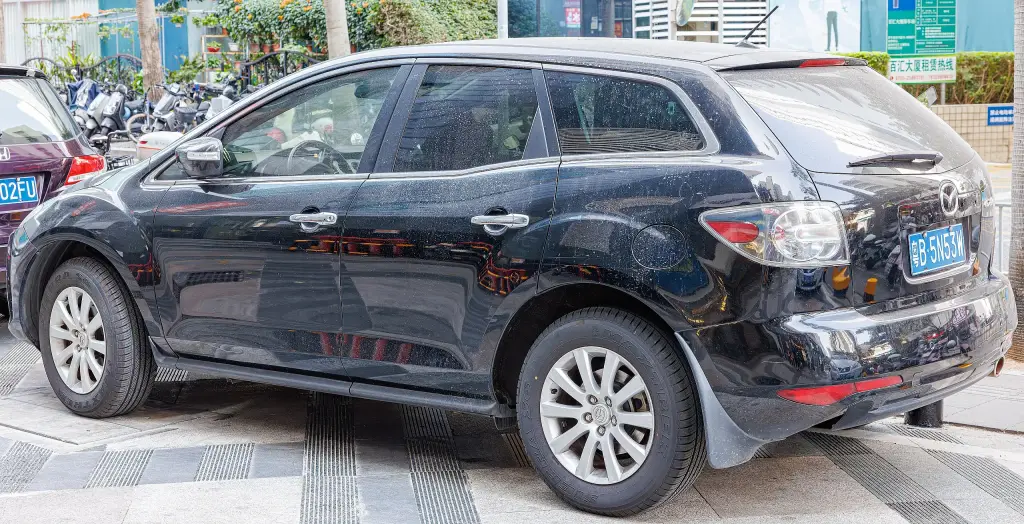
The Mazda CX-7 is a mid-size crossover introduced in 2006 as the production version of the MX-Crossport concept. It was Mazda’s first mid-size SUV since the Navajo went out of production in 1994, and it used the Ford C1 platform of the Mazda 3 with the turbocharged 2.3 engine of the Mazdaspeed models.
Mazda CX-7 at a glance
| Production | 20 February 2006 – August 2012 |
|---|---|
| Built at | Mazda’s Ujina No.2 plant in Hiroshima |
| On sale | April 2006, as a 2007 model |
| First shown | Los Angeles Auto Show, January 2006 |
| Platform | Ford C1, shared with the Ford Focus and Mazda 3 |
| Engine | 2.3 MZR DISI turbo, 244 hp (182 kW) and 350 N·m |
| Gearbox | six-speed Aisin F21 automatic |
| Drive | front-wheel drive or Active Torque Split all-wheel drive |
| Later engine | 2.5 MZR naturally aspirated on lower trims |
| Replaced by | Mazda CX-5 |
History of the Mazda CX-7
The CX-7 was shown publicly for the first time at the Los Angeles Auto Show in January 2006, production began on 20 February 2006 at the Ujina No.2 factory in Hiroshima, and the car went on sale in April 2006 as a 2007 model. It was positioned below the larger three-row CX-9, with which it did not share a platform; instead it used the Ford C1 platform that underpinned the Ford Focus and the Mazda 3.
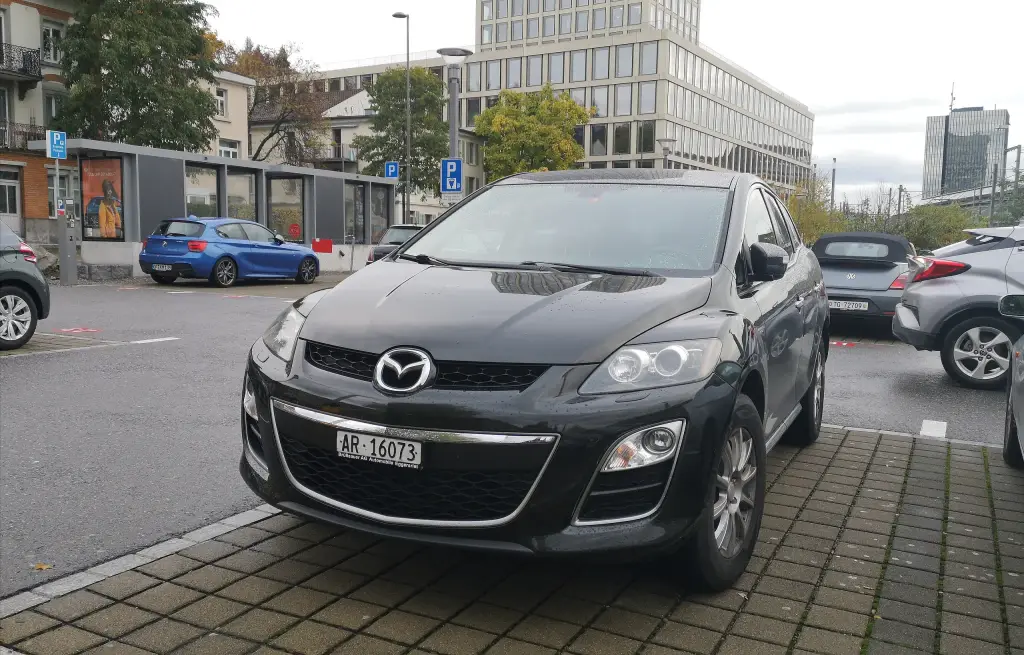
Power came from the same 2.3-litre MZR L3-VDT DISI engine as the Mazdaspeed3 and Mazdaspeed6, with 244 hp (182 kW, 175 kW in Australia) at 5,000 rpm and 350 N·m at 2,500 rpm, 99 percent of which was available up to 5,000 rpm. The North American version was retuned with a smaller K04 turbocharger for torque lower down at the cost of power, while the British cars used the larger K04 of the Mazdaspeed line. The gearbox was a six-speed Aisin F21 automatic. The front suspension came from the Mazda MPV and the rear from the Mazda 5, and the car had four-wheel ventilated disc brakes, stability and traction control, and a choice of front- or all-wheel drive. The Active Torque Split system used two computer-controlled magnetic clutches to send up to 50 percent of the torque to the rear wheels.
A facelift unveiled at the February 2009 Canadian International AutoShow brought new front and rear fascias with a larger five-point grille, revised instruments with a multi-information display, Bluetooth and blind spot monitoring. From 2010 there were four US trim levels, with the 2.5-litre naturally aspirated MZR engine on the cheaper i SV and i Sport, and the 2.3 turbo on the Touring and Grand Touring. A 2.2 diesel with a manual gearbox was sold in Europe from 2009 to 2012. The CX-7 was discontinued in August 2012 in favour of the CX-5, which offered similar interior space in a more compact package.
Design and features
- Turbocharged 2.3: the same DISI engine as the Mazdaspeed3 and Mazdaspeed6.
- Ford C1 platform: shared with the Focus and Mazda 3, not with the CX-9.
- Active Torque Split: all-wheel drive sending up to half the torque to the rear.
- 2.2 diesel: a European option from 2009 to 2012.
Mazda CX-7 versions
- 2.3 turbo (2006–2012): the original engine, front- or all-wheel drive.
- 2.5 MZR: naturally aspirated engine on the cheaper 2010 US trims.
- 2.2 diesel (2009–2012): European version with a manual gearbox.
The CX-7 was replaced by the Mazda CX-5 and sat below the Mazda CX-9 in the range. More Mazdas are in the Mazda collection.
Sources
- Mazda CX-7, English Wikipedia: engine, platform, facelift, end of production
- Mazda CX-7, German Wikipedia: European versions
- マツダ・CX-7, Japanese Wikipedia: Japanese production