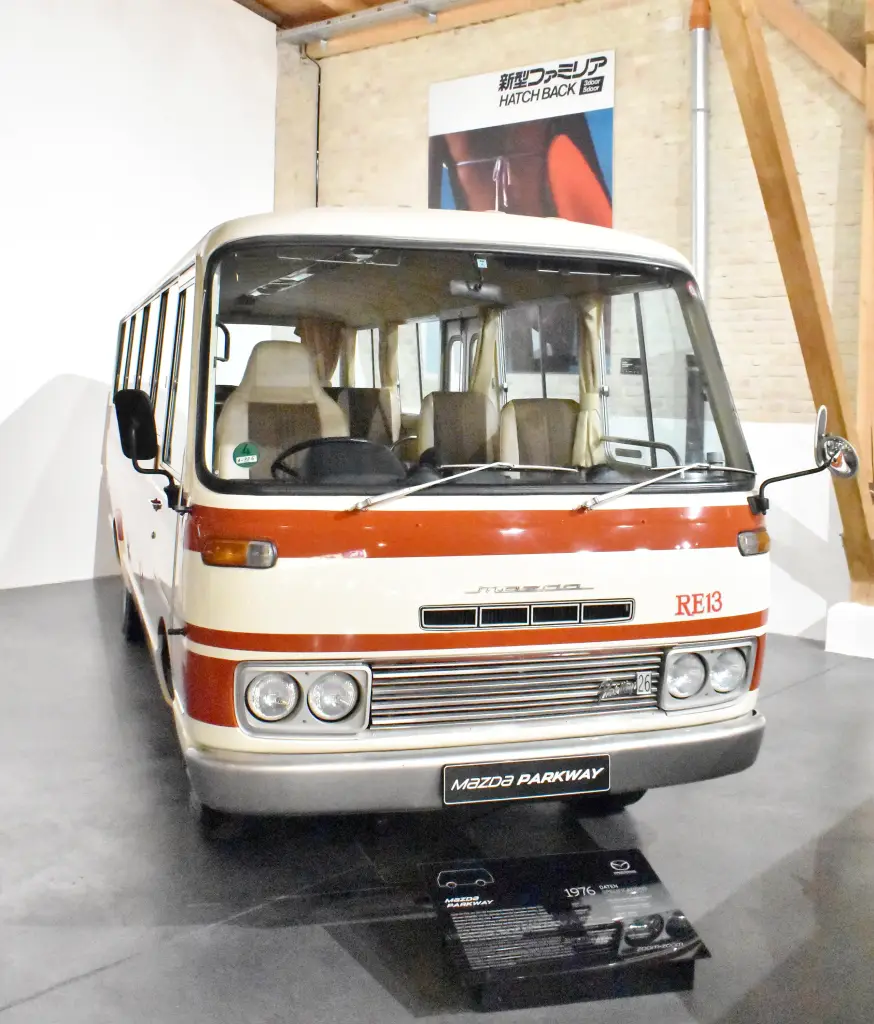
The Mazda Parkway is a minibus that Mazda built at Hiroshima exclusively for the Japanese market. Based on the Mazda Titan truck platform, it came in two generations, from 1972 to 1982 and as the WVL type from 1982 to 1997. It replaced the Mazda Light Bus and was a familiar sight in public transport in southern Japan.
Mazda Parkway at a glance
| Built | 1972–1997, at Hiroshima |
|---|---|
| Market | Japan only |
| Based on | Mazda Titan truck platform |
| First generation | AE/VE, 1972–1982 |
| Second generation | WVL, 1982–1997 |
| Replaced | Mazda Light Bus, built 1965–1972 |
| Engines | 2.0 petrol, 2,522 cc Perkins diesel, and a 13B rotary |
| Rotary version | Parkway Rotary 26, July 1974 – 1977, 44 built |
| Rotary performance | 26 passengers, 2,835 kg, 120 km/h |
| Other versions | Kia Combi; T3500 in India from 1986 |
The «bus» record is merged here.
History of the Mazda Parkway
The Parkway replaced the Mazda Light Bus, which had been shown at the 1964 Tokyo Motor Show and built from May 1965 to April 1972. The Light Bus was based on the E2000 truck and used its 2-litre petrol engine with 81 PS; in 1967 a diesel version was added as a result of a technical collaboration with the British diesel specialist Perkins, using a Perkins-developed XA 2.5-litre unit of 77 PS. The Light Bus Type A’s curved laminated-glass windscreen gave it what was described as a spaceship-like body, made from a mixture of aluminium and steel by Kawasaki Aircraft Industries, while the more conventional pressed-steel Type C body of 1966 was built by Nishinippon Industries.
The first Parkway of 1972 was popular with public transport operators in southern Japan, such as Hiroshima and Hamamatsu, and competed with the Toyota Coaster, Nissan Civilian, Isuzu Journey and Mitsubishi Fuso Rosa. In 1974 it could be ordered with the 13B rotary engine as well as the 2,000 cc petrol VA engine and the 2,522 cc XA diesel. It also had an unusual transmission arrangement, with a sub-transmission added to the manual gearbox to cope with loads and a fluid coupling to prevent stalling, knocking and oscillation. The rotary minibus was called the Parkway Rotary 26 and could carry 26 passengers; it weighed 2,835 kg and reached 120 km/h but suffered from low torque and high fuel consumption. Introduced on 22 July 1974 and discontinued in 1977 in favour of the better-selling diesels, it was built in only 44 examples and sold only in Japan.
The rebodied second-generation Parkway was introduced in January 1982 and based on the second-generation Mazda Titan of October 1980, using that model’s chassis, engines, front clip and doors. The WVL bus reached the Indian market in 1986, introduced by SML Isuzu (then Swaraj Mazda) and badged as the T3500. The Parkway was also available as the Kia Combi through Mazda’s partnership with Kia.
Design and features
- Rotary bus: the Parkway Rotary 26 was one of very few rotary-engined minibuses.
- Titan base: the second generation used the Titan’s chassis, engines and front end.
- Sub-transmission: an extra gearbox range and a fluid coupling handled heavy loads.
- Light Bus heritage: its predecessor had aluminium and steel bodywork by Kawasaki Aircraft.
Mazda Parkway versions
- Parkway AE/VE (1972–1982): first generation, petrol, diesel and rotary engines.
- Parkway Rotary 26 (1974–1977): 13B rotary, 26 seats, 44 built.
- Parkway WVL (1982–1997): second generation on the Titan base.
- T3500: Indian version by SML Isuzu from 1986.
The Parkway shares its platform with the Mazda T-series trucks and its rotary engine with the Cosmo. More Mazdas are in the Mazda collection.
Sources
- Mazda Parkway, English Wikipedia: generations, engines, rotary version
- マツダ・パークウェイ, Japanese Wikipedia: Japanese market and Light Bus