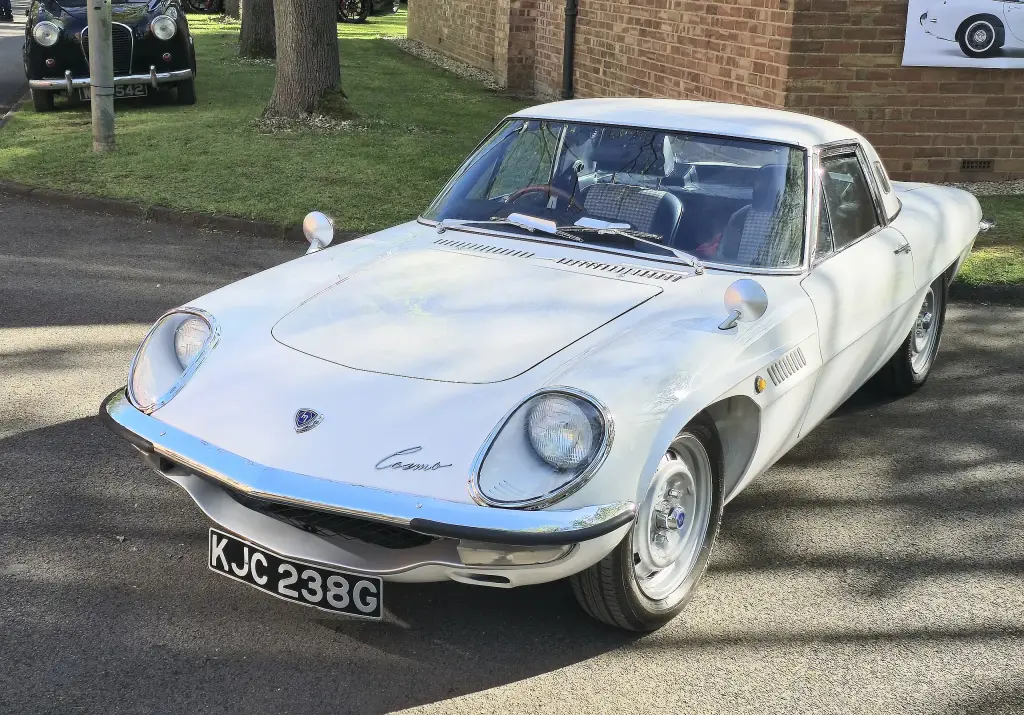
The Mazda Cosmo was the car that introduced Mazda’s Wankel engine to the world. Introduced in 1967 and sold abroad as the 110S, it was one of the first production cars with a two-rotor rotary engine, and it served as Mazda’s halo model throughout its life.
Mazda Cosmo/RX-5 at a glance
| Cosmo line | 1967–1995 |
|---|---|
| First generation | L10A/L10B, 1967–1972 |
| Export name | Mazda 110S |
| Engine | two-rotor Wankel, 982 cc in the Series I |
| Series I power | about 110 hp |
| Series II | from July 1968, 128 hp and 140 N·m |
| Gearbox | four-speed manual |
| Top speed | about 185 km/h |
| Built | 1,176: 343 Series I and 833 Series II |
| Price in Japan | 1.48 million yen |
The RX-5 record is merged here: the RX-5 name was used for piston-engined versions of the Cosmo in some markets.
History of the Mazda Cosmo/RX-5
The first Mazda to carry the Cosmo name, called the 110S in export markets, was one of the first production cars with a two-rotor Wankel engine, alongside the NSU Ro80. A prototype was shown at the 1964 Tokyo Motor Show, a month before the 1964 Summer Olympics, and 80 pre-production cars were built between 1965 and 1966, 20 for Mazda’s test department and 60 for dealer testing. Full production began in May 1967 and lasted until 1972, with the cars hand-built at a rate of about one a day for a total of 1,176: 343 Series I cars and 833 Series II cars. Mazda chose the name Cosmo to reflect the era’s fascination with the Space Race and to present the rotary engine as forward-looking technology.
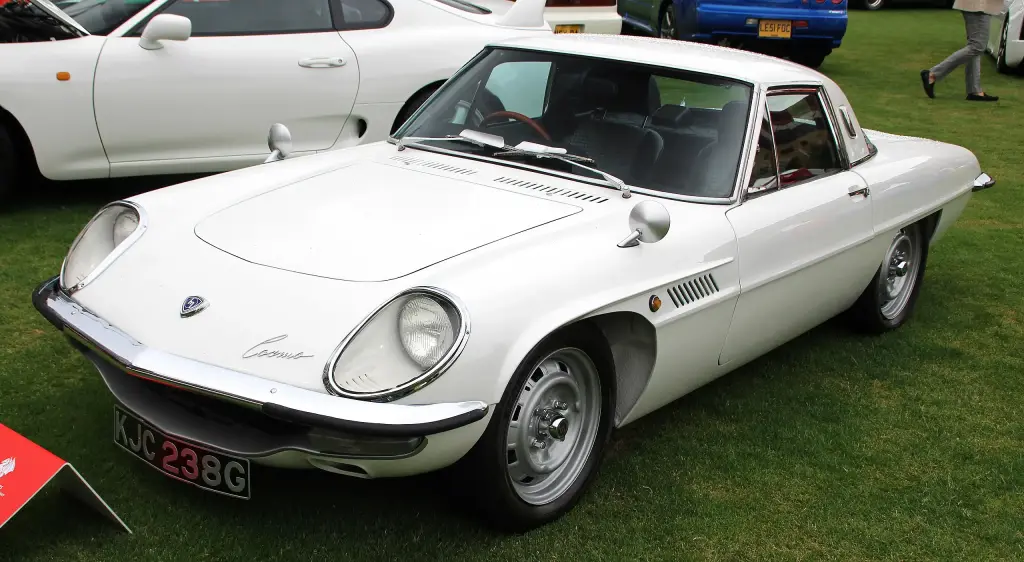
The Series I L10A used an 0810 two-rotor engine of 982 cc producing about 110 hp, with a Hitachi four-barrel carburettor and an unusual ignition system with two spark plugs per chamber and dual distributors. A four-speed manual and 14-inch wheels were standard. The front suspension was a coil-sprung double wishbone with an anti-roll bar, the rear a leaf-sprung de Dion tube, with unassisted 10-inch disc brakes in front and drum brakes at the rear. The quarter-mile took 16.4 seconds and top speed was about 185 km/h. At 1.48 million yen it undercut the Toyota 2000GT. In Japan the rotary engine also brought a tax advantage, because a small-displacement rotary was taxed below the 1.5-litre bracket despite its power.
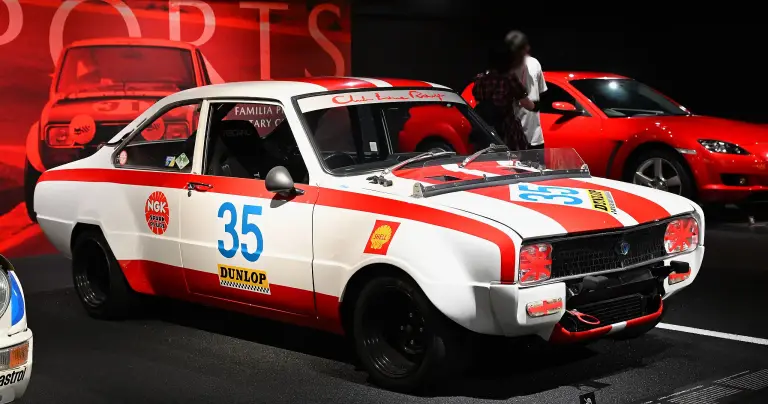
The Series II L10B arrived in July 1968 with a more powerful 0813 engine of 128 hp and 140 N·m. In 1968 Mazda took the Cosmo racing at the 84-hour Marathon de la Route at the Nürburgring to prove the rotary’s reliability. Two mostly standard cars were entered among 58 starters; both ran in fourth and fifth for much of the race, one retired with axle damage in the 82nd hour, and the other, driven by Belgians, finished fourth overall. It was the Cosmo’s only racing outing; Mazda’s next racer was the Familia Rotary, exported as the R100. The Cosmo name continued on later Mazda coupés until 1995, the last generation being the Eunos Cosmo flagship.
Design and features
- First rotary: one of the first production cars with a two-rotor Wankel engine.
- Hand-built: about one car a day, with only 1,176 made.
- Racing proof: a fourth place at the 1968 Marathon de la Route.
- De Dion rear: a leaf-sprung de Dion tube behind the live rear axle was unusual for a Japanese coupé.
Mazda Cosmo/RX-5 versions
- Series I / L10A (1967): 982 cc, about 110 hp, the 110S for export.
- Series II / L10B (1968): 128 hp and 140 N·m.
- Later Cosmos: the name continued on Mazda coupés until 1995, ending with the Eunos Cosmo.
The Cosmo’s engine belongs to the Mazda Wankel engine story, and its rotary relatives include the RX-7. More Mazdas are in the Mazda collection.
Sources
- Mazda Cosmo, English Wikipedia: Series I and II, production, racing
- Mazda Cosmo, German Wikipedia: model data
- マツダ・コスモ, Japanese Wikipedia: Japanese market and later generations