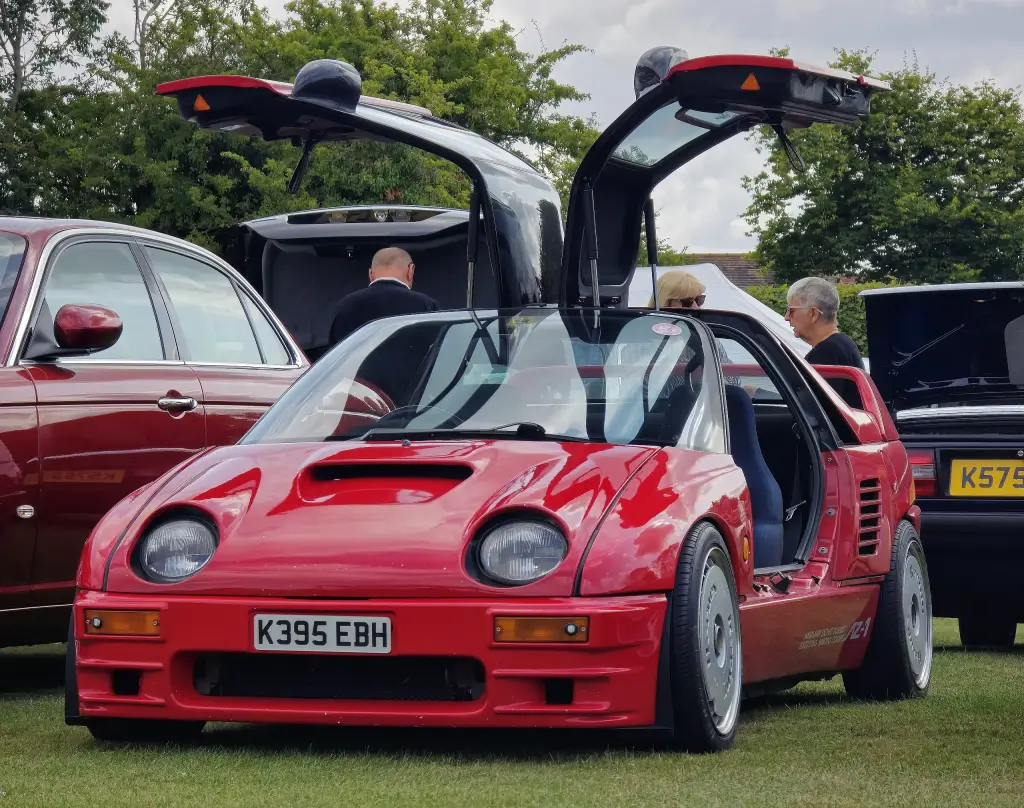
The Autozam AZ-1 is a two-seat sports car that Mazda built from October 1992 to October 1994 and sold through its Autozam dealer network. It is a kei car with a rear mid-mounted Suzuki turbo engine, rear-wheel drive and gullwing doors – a layout no other kei car of its time offered.
Autozam AZ-1 at a glance
| Maker | Mazda, sold as Autozam |
|---|---|
| Production | October 1992 – October 1994 |
| Frame code | PG6SA |
| Class | kei car, two-seat sports coupé |
| Layout | rear mid-engine, rear-wheel drive |
| Engine | 657 cc turbocharged Suzuki three-cylinder |
| Power | 64 PS (47 kW) at 6,500 rpm |
| Torque | 85 N·m at 4,000 rpm |
| Top speed | 140 km/h, electronically governed |
| Doors | gullwing |
| Sister model | Suzuki Cara (PG6SS), badge-engineered |
History of the Autozam AZ-1
The AZ-1 began as a Suzuki project. In 1985 Suzuki built the RS/1, a mid-engined sports car study with a 45:55 front-to-rear weight distribution and a 1.3-litre G13B engine from the Cultus GTi. The Tatsumi Fukunaga-designed RS/3 followed at the 1987 Tokyo Motor Show, reworked to meet Japanese safety rules and to be more practical, but Suzuki dropped the idea in favour of the roadster that became the Cappuccino.
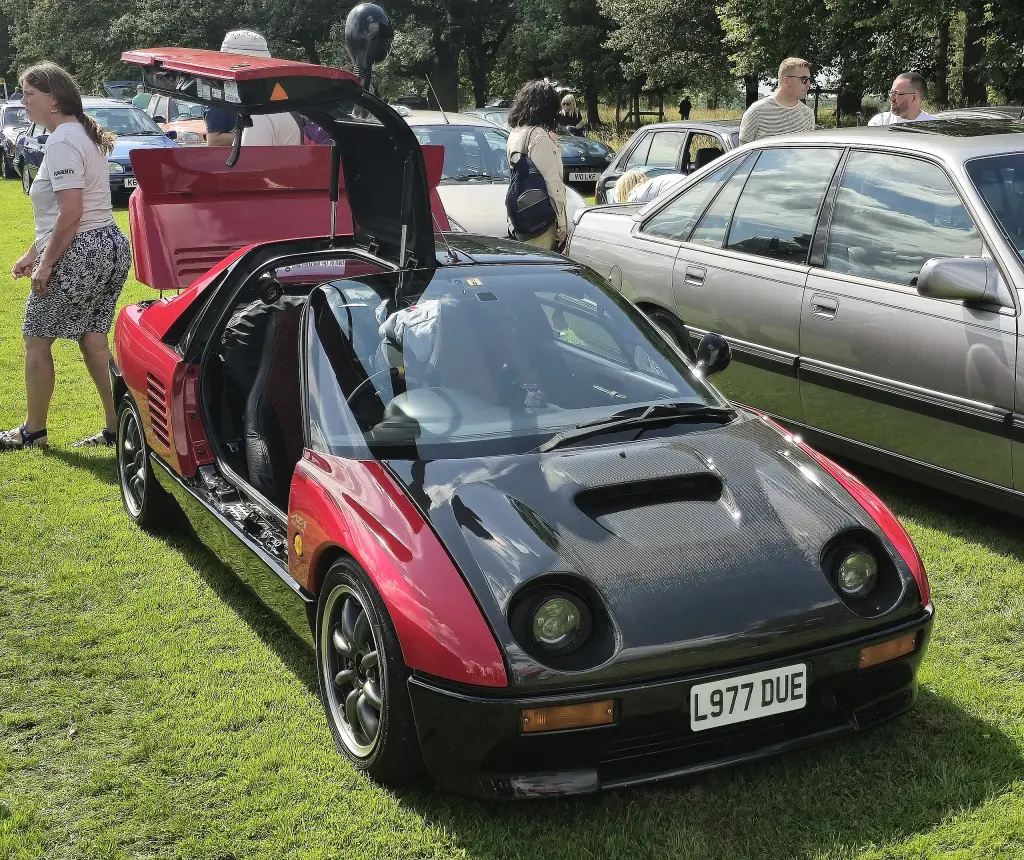
Mazda’s design team under Toshihiko Hirai, the man also responsible for the MX-5, took the project over on a limited budget. At the 1989 Tokyo Motor Show Mazda showed the AZ-550 in three forms: the Type A with pop-up headlights, a front air vent and gullwing doors; the Type B with a pyramid roof and a racing-style interior; and the Type C in the blue-on-white colours of Mazda’s Group C racers. The Type C was the better received, but Mazda chose the Type A as the most commercial, dropping the pop-up headlights for fixed units for structural rigidity and altering the front air vent.
Production took another three years, because the internal skeleton was changed to steel for stiffness and the dashboard was redesigned to a less futuristic look. Much of the development was done in Britain, with testing at Lotus’s Millbrook proving ground, although the car was never intended for sale outside Japan. It went on sale in January 1992 in Siberia blue and classic red, both with Venetian grey lower panels, through Autozam dealers.
Suzuki later sold its own badge-engineered version as the Suzuki Cara. The AZ-1 stayed in production for only two years, and its plastic body panels over a steel spaceframe made it expensive to build for a kei car.
Design and features
- Gullwing doors: a rarity in a kei car, opening upwards instead of outwards.
- Mid-mounted engine: the 657 cc Suzuki turbo unit sat behind the seats, driving the rear wheels.
- Lightweight structure: a steel spaceframe with aluminium honeycomb floors and bulkheads, clad in fibreglass panels.
- Kei dimensions: designed around the 3,200 mm length and 550 cc limits of the time, which then changed to 660 cc.
Autozam AZ-1 versions
- AZ-550 Type A, B and C (1989): show cars at the Tokyo Motor Show, only the Type A reaching production.
- AZ-1 (1992–1994): the production car, in Siberia blue or classic red.
- Suzuki Cara: Suzuki’s badge-engineered version with the PG6SS frame code.
The AZ-1 sits alongside Mazda’s other small cars in the Mazda kei cars story, and it shares its designer with the MX-5. More Mazdas are in the Mazda collection.
Sources
- Autozam AZ-1, English Wikipedia: development, Suzuki prototypes, production
- マツダ・オートザムAZ-1, Japanese Wikipedia: Japanese market detail