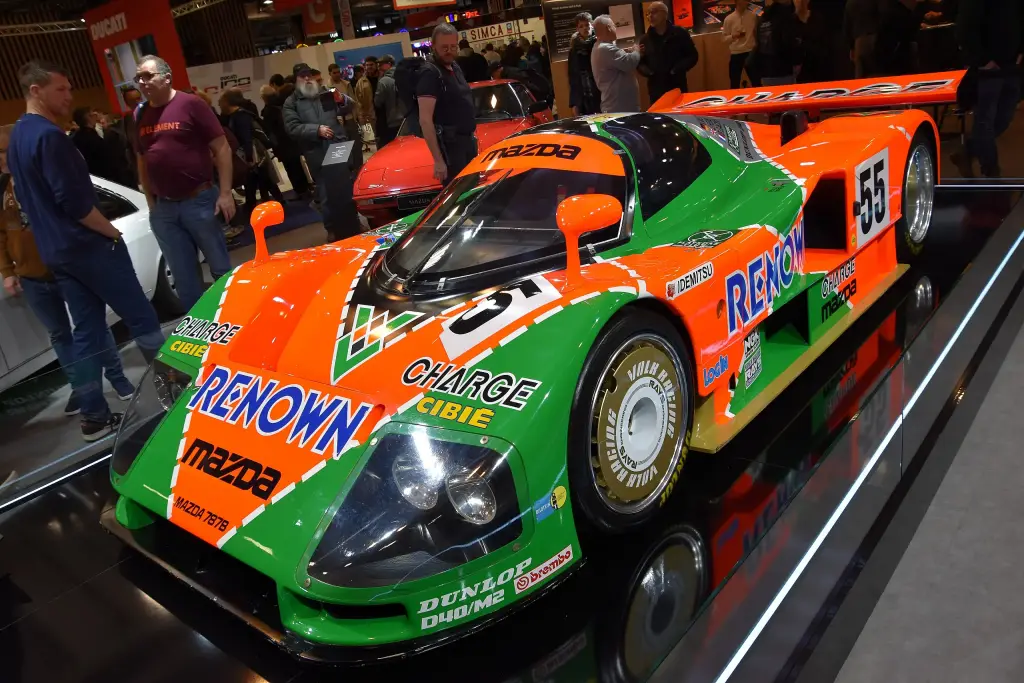
The Mazda 757 and 787B were the sports prototypes with which Mazdaspeed took on Le Mans in the late 1980s and 1990. The 787B’s victory in 1991 remains the only outright win at Le Mans by a car without a reciprocating engine, and the first by a Japanese manufacturer.
Mazda 757 and 787B at a glance
| 757 | Group C/IMSA GTP prototype, 1986–1990 |
|---|---|
| 757 engine | three-rotor 13G Wankel |
| 757 chassis | four built (-001, -002, -003 and -104) |
| 787 | Group C prototype, 1990; two built |
| 787B | updated car, 1991; three built |
| 787B engine | four-rotor R26B, 2.6 litres |
| R26B output | 900 hp at 10,000 rpm; about 700 hp at 9,000 rpm for Le Mans |
| Le Mans 1991 | overall win for Herbert, Weidler and Gachot |
| Gearbox | five-speed, built by Porsche |
| Weight | 830 kg (787B, Group C2 rules) |
The page covers both prototypes because the 787B was the direct development of the 787, itself an evolution of the 757 line.
History of the Mazda 757 and 787B
The 757 replaced Mazda’s earlier Group C2 cars, ending with the 737C, and was the first chassis designed entirely by Nigel Stroud and built by Mazdaspeed. It used a new three-rotor 13G Wankel engine. Four chassis were built, numbered -001, -002, -003 and -104, and they contested 34 races between 1986 and 1990. At Le Mans in 1986 both 757s retired with gearbox problems, the first time a Mazdaspeed car had failed to finish there; in 1987 one car finished seventh overall and the other retired with engine damage. A single 757 ran at Le Mans in 1988 alongside two newer 767s and finished 15th, ahead of both.
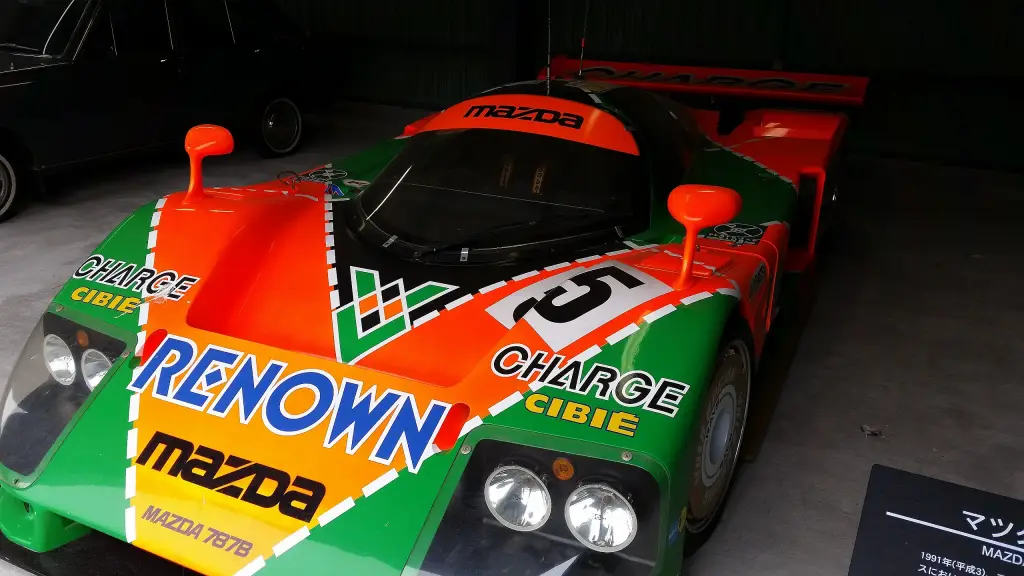
The 787 was developed for 1990 from the 767 and 767B. The name skipped 777 to mark a two-step improvement. Nigel Stroud’s design kept much of the 767 but replaced its 13J engine with the new R26B, which had three spark plugs per rotor instead of two, ceramic apex seals and variable-length intake trumpets, producing 900 hp at 10,000 rpm – limited in the 1991 race to about 700 hp at 9,000 rpm for reliability. The radiators moved from beside the cockpit to a single unit in the nose, which also smoothed the doors and bodywork. The carbon and Kevlar monocoque was built by Advanced Composite Technology in Britain, and the five-speed gearbox came from Porsche.
For 1991 the 787B gained a continuously variable intake system, raising torque to 608 N·m at 6,500 rpm. The cars were never the fastest over a lap against Mercedes-Benz, Jaguar, Porsche, Nissan and Toyota, but they were reliable, and at the 1991 24 Hours of Le Mans the 787B of Johnny Herbert, Volker Weidler and Bertrand Gachot won outright. It was the first win by a Japanese manufacturer, and remained the only one until Toyota in 2018; it is still the only Le Mans victory by a car without a reciprocating engine.
Design and features
- Rotary power: the 757 used a three-rotor 13G, the 787B a four-rotor R26B.
- R26B details: three spark plugs per rotor, ceramic apex seals and variable intake trumpets.
- Nose radiator: the 787 moved its radiator into the nose for better cooling and cleaner bodywork.
- Light monocoque: carbon and Kevlar construction by Advanced Composite Technology.
Mazda 757 and 787B versions
- 757 (1986–1990): three-rotor prototype, four chassis, 34 races.
- 787 (1990): two cars with the R26B engine.
- 787B (1991): three cars with continuously variable intakes; Le Mans winner.
The 787B’s engine belongs to the story of the Mazda Wankel engine, and Mazda’s road-going rotary cars include the RX-7. More Mazdas are in the Mazda collection.
Sources
- Mazda 787B, English Wikipedia: R26B, 787B development, 1991 win
- Mazda 757, German Wikipedia: 757 chassis, races and results
- Mazda 787B, German Wikipedia: technical data, weight, engine