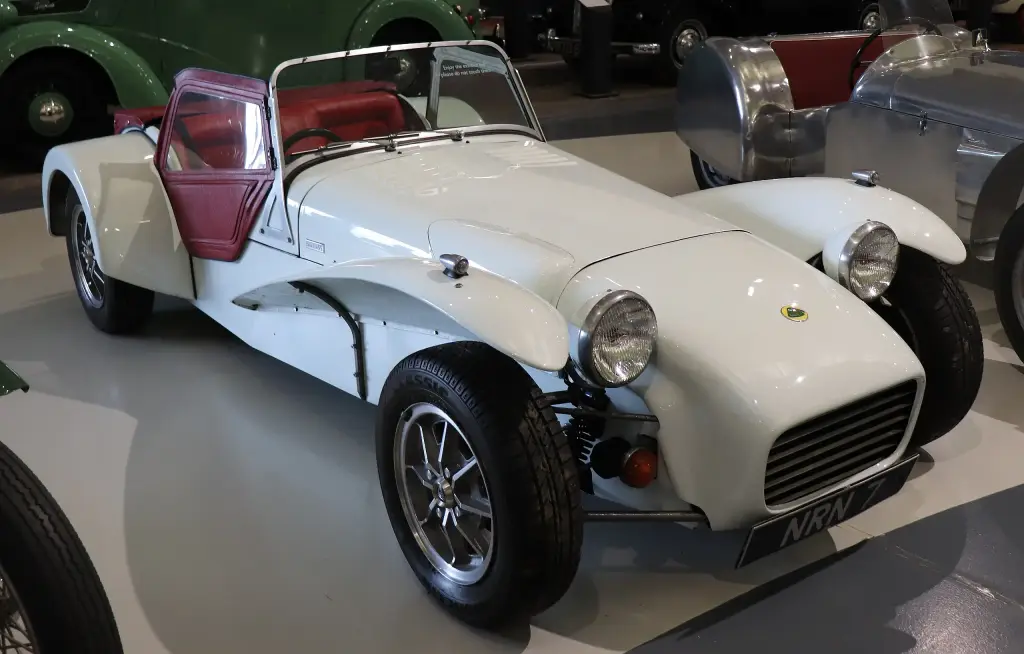
The Lotus Seven is a sports car produced by Lotus between 1957 and 1973. It is an open two-seater designed by Colin Chapman and considered the embodiment of his philosophy of performance through low weight and simplicity. More than 2,500 were sold, thanks to its appeal as a road-legal car that could be used for clubman racing.
Lotus Seven at a glance
| Built | 1957–1973 |
|---|---|
| Designer | Colin Chapman |
| Type | open two-seater |
| Series 1 engine | 1,172 cc Ford Sidevalve, 36 bhp |
| Series 1 options | BMC A-series and Coventry Climax FWA engines |
| Series 2 engines | Ford Kent 1,340 or 1,499 cc |
| Super Seven | 85 bhp Cosworth 1,340, later 105 bhp 1,500 |
| Series 2 built | 1,310 |
| Series 4 | squarer fibreglass body from 1970 |
| Successor | Caterham 7, rights sold in 1973 |
Based on one source (English Wikipedia).
History of the Lotus Seven
The Seven was launched in 1957 to replace the Mark VI as the entry-level Lotus. Its name came from a model Lotus had abandoned, which would have been a Riley-engined single-seater for Formula Two in 1952 or 1953; the car was finished on Chapman’s chassis as a sports car by its backers and called the Clairmonte Special. Externally the Seven resembled the Mark VI but used a different tubular frame similar to the Eleven’s, and it was powered by a 1,172 cc Ford Sidevalve engine of 36 bhp, with BMC A-series and Coventry Climax FWA engines also available.
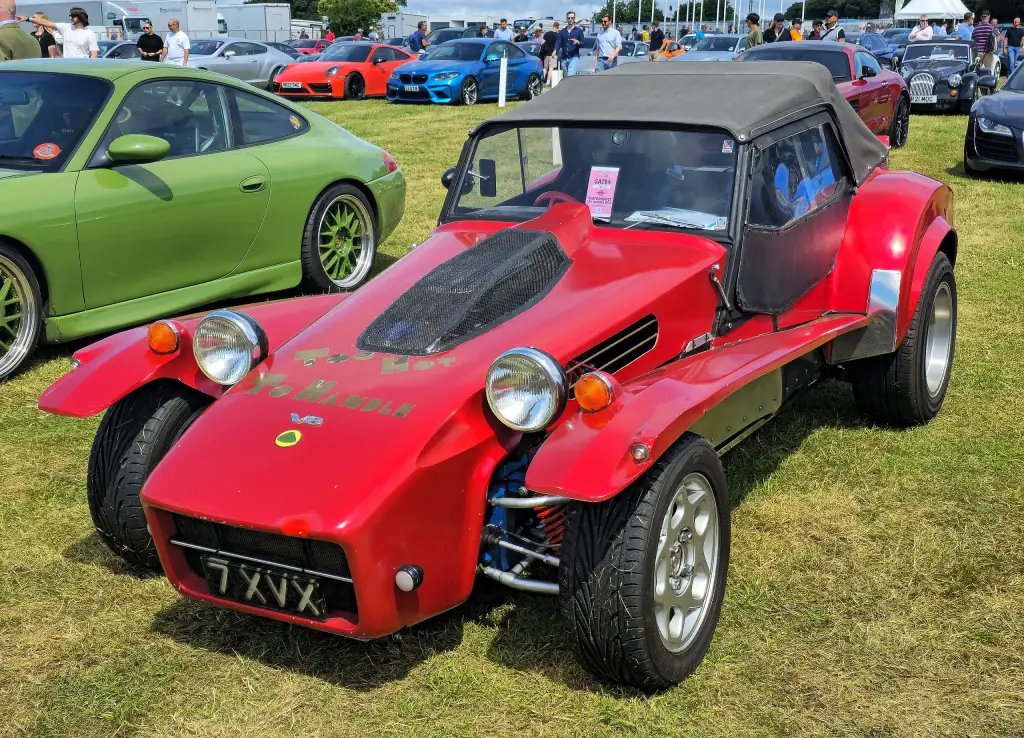
Under the Purchase Tax rules of the time, cars supplied as kits did not attract the surcharge that applied to assembled cars, but the tax rules forbade including assembly instructions. This lasted until 1973, and a large proportion of Sevens sold in Britain were delivered as kits. The Series 1 was used on the road and for club racing with the 750 Motor Club.
The Series 2 followed in June 1960, supplemented by the Super Seven S2 from 1961, both slightly more road-oriented with a simpler chassis. The aluminium nosecone became fibreglass, and cycle fenders were standard at first, with clamshell fenders standard on the 1500, Super Seven and America. The 1,172 cc sidevalve lasted until 1962, but the Series 2 usually used Ford Kent engines of 1,340 or 1,499 cc from the Consul Classic, with Cosworth modifications giving 85 bhp in the Super Seven and 105 bhp in the later Super Seven 1500. Some 1968 cars, often called the Series 2½, had the 1,599 cc crossflow Kent engine. The rear axle and differential from the Standard Companion estate could not cope with the power and cornering forces, a problem solved on the Series 3 with a Ford Cortina rear end. Series 2 production ended in August 1968 after 1,310 cars.
The Series 3 arrived in 1968, usually with the 1,599 cc crossflow Kent engine. The Super Seven Twin Cam SS, shown at Earls Court in 1969, used the Lotus Twin Cam and only 13 were built. Though Lotus made the Series 3 for only about two years, it was the version Caterham revived. Between 1970 and 1975 Lotus Argentina built about 51 Sevens under licence. The Series 4 of 1970 changed the shape radically, with a squarer fibreglass shell replacing most of the aluminium and luxuries such as an internal heater, using 1,298 or 1,599 cc Kent engines or the Twin Cam.
When Britain joined the EEC on 1 January 1973 and VAT replaced Purchase Tax, the tax advantage of the kit car ended, so Lotus decided to shed that image. In 1973 it sold the rights to its remaining agents, Caterham Cars in England and Steel Brothers in New Zealand. Caterham ran out of Series 4 kits and, as agreed, introduced its own version of the Series 3 as the Caterham Seven, which is still made. Steel Brothers assembled Series 4s until March 1979, when the last of 95 kits was used, making the final Lotus-badged Seven a New Zealand car.
Design and features
- Low weight and simplicity: the purest expression of Chapman’s philosophy.
- Kit form: tax rules made kits cheaper, so most British Sevens were sold that way.
- Ford Kent engines: from 1,340 to 1,599 cc, with Cosworth tuning up to 105 bhp.
- Series 4: a squarer fibreglass body that replaced most of the aluminium.
- Caterham and Steel Brothers: licensed production that outlived the Lotus car.
Lotus Seven versions
- Series 1 (1957): 1,172 cc Ford Sidevalve, 36 bhp.
- Series 2 (1960–1968): Ford Kent engines, 1,310 built.
- Super Seven S2 (1961): Cosworth-tuned engines of 85 or 105 bhp.
- Series 3 (1968): 1,599 cc crossflow Kent, revived by Caterham.
- Super Seven Twin Cam SS (1969): Lotus Twin Cam, 13 built.
- Series 4 (1970–1973): squarer fibreglass body.
The Seven replaced the Lotus Mark VI as the entry-level Lotus and shared its frame thinking with the Lotus Eleven. More cars are in the Lotus collection.
Sources
- Lotus Seven, English Wikipedia: series, engines, kit cars, Caterham and Steel Brothers