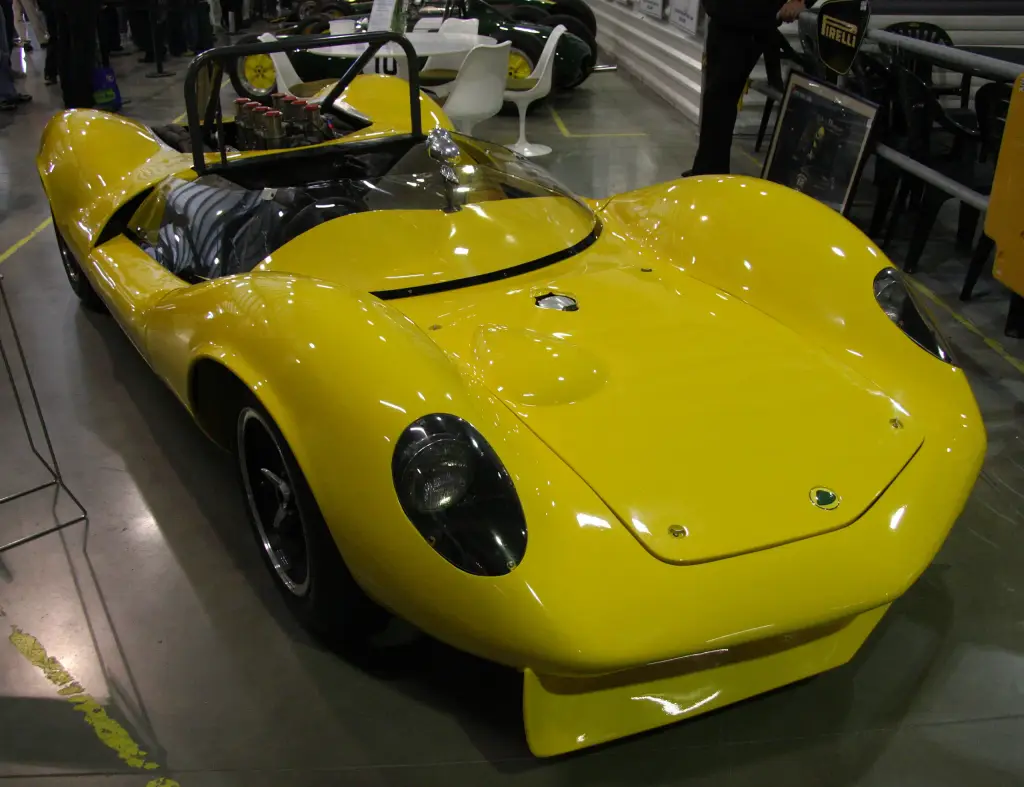
The Lotus 30 was Colin Chapman’s first attempt at a large-displacement sports racing car, after the success of the tube-frame Lotus 19 and 23. Designed by Chapman with Martin Wade and built in 1964, it used a curvilinear fibreglass body over the backbone chassis first seen in the front-engined Elan, reversed to put the engine behind the driver.
Lotus 30 at a glance
| Built | 1964 |
|---|---|
| Designers | Colin Chapman, Martin Wade |
| Category | Group 4 sports cars, Can-Am |
| Chassis | backbone, reversed from the Elan layout |
| Body | fibreglass |
| Engine | 4.7-litre (289 cu in) Ford V8 |
| Gearbox | ZF 5DS20 five-speed transaxle |
| Wheels | 13 inch |
| Brakes | solid discs on all four wheels |
| Successor | Lotus 40 |
Based on one source (English Wikipedia).
History of the Lotus 30
The 30 raced in British events such as the Guards Trophy, in international meetings such as Nassau Speed Week that admitted FIA Group 4 sports cars, and above all in the Can-Am series. These events came before the FIA created Groups 5, 6 and 7 in 1966, which is why the 30 and the later Lotus 40 were originally fitted with headlights, tail lights and a windscreen wiper.
The engine was a 4.7-litre Ford V8 of the type used in the Ford GT40, mated to a five-speed ZF 5DS20 transaxle that proved far more reliable than the Colotti unit used in the 19B against the torque of a V8. The car ran on 13-inch wheels with solid disc brakes. Lotus engineer Len Terry was asked to comment on the concept and considered it so flawed that he refused to have anything to do with it.
The design’s weaknesses became clear as power and tyre technology advanced beyond what it was meant for. The problems centred on the torsional rigidity of the backbone chassis and the materials available, and they led to chassis and suspension failures. The 30 was regarded as unsuccessful and dangerous, though when nothing broke it was extremely fast. Jim Clark worked hard with the car and extracted some promising results before it was replaced by the Lotus 40, which added 15-inch wheels, vented discs and a larger engine but was just as difficult. Richie Ginther summed it up: the 40 was “the same as the 30 but with ten more mistakes”.
The effort was not wasted. The backbone chassis proved well suited to the lower-powered Lotus Europa and was developed further for the Esprit.
Design and features
- Backbone chassis: the Elan layout reversed, with the engine behind the driver.
- Ford V8 power: the 4.7-litre engine used in the GT40.
- ZF transaxle: a five-speed unit strong enough for V8 torque.
- Fibreglass body: curvilinear panels in the Lotus tradition.
- Fast but fragile: quick when it held together, prone to chassis and suspension failures.
Lotus 30 versions
- Lotus 30 (1964): the original car with 13-inch wheels and solid discs.
- Lotus 40 (1965): 15-inch wheels, vented discs and a larger engine.
The 30 followed the smaller Lotus 23 and was replaced by the Lotus 40. Its chassis ideas lived on in the Lotus Europa. More cars are in the Lotus collection.
Sources
- Lotus 30, English Wikipedia: design, engine, racing record, reputation