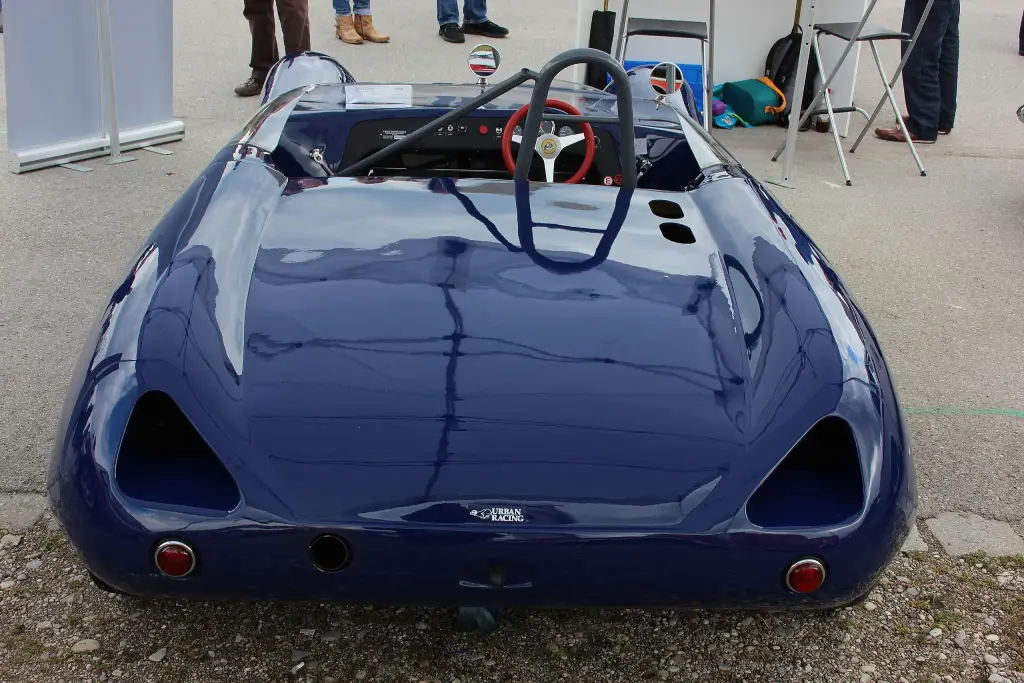
The Lotus 23 was designed by Colin Chapman as a small-displacement sports racing car, nominally a two-seater and purpose-built for FIA Group 4 racing in 1962 and 1963. Unlike the earlier Lotus 15 and 17, the engine sat behind the driver in the layout developed on the Lotus 19.
Lotus 23 at a glance
| Introduced | 1962 |
|---|---|
| Designer | Colin Chapman |
| Category | FIA Group 4 sports racing |
| Layout | mid-engined, two-seater |
| Chassis | wider version of the Lotus 22 space frame |
| Body | fibreglass |
| Intended engines | 750 to 1,300 cc |
| Gearbox | Renault four-speed or Hewland Mk.III five-speed |
| Debut | 1,000 km of the Nürburgring, 27 May 1962 |
| Variants | 23B, 23C |
| Built | about 130 in period |
Based on one source (English Wikipedia).
History of the Lotus 23
To meet the FIA rules the 23 carried a luggage space to the right-rear of the driver, a windscreen wiper, a horn, pairs of headlights and tail lights, a centre licence plate light, a cable-operated handbrake and a mount for a spare wheel under the front body. The chassis was a wider version of the Lotus 22 space frame with fibreglass bodywork. It was intended for engines of 750 to 1,300 cc with a Renault four-speed transaxle, but most production cars used a five-speed Hewland Mk.III built in an inverted Volkswagen magnesium casing.

The front suspension used double wishbones with outboard coil and damper units, Triumph uprights, Triumph Herald rack-and-pinion steering and Girling disc brakes. At the rear there were reversed lower wishbones, top and bottom radius arms, outboard disc brakes and coil springs, with Metalastic rubber doughnuts on the halfshafts. The frame used some of its tubes to carry water to and from the radiator and oil to the cooler, a layout shared with the Lotus 22 that sometimes led to over-cooling in sprints when no thermostat was fitted.
The 23B of 1963 moved the gear lever to the right of the driver and combined the radiator and oil cooler into one unit. Extra frame tubes took the torque of the 1.6-litre Cosworth Mk.XII and Mk.XIII TwinCam engines, mated to a Hewland Mk.V transaxle, while smaller engines used the Mk.IV. The 23B proved a successful giant killer against larger cars, though its narrow tyres limited grip.
The 23C answered that with wider Formula Two tyres on wider magnesium wheels and body extensions to cover them. The model’s debut came at the Nürburgring on 27 May 1962 in the 1,000 km race, where the small 100 bhp car showed its pace. Including the 23B and 23C, about 130 examples were built in period, and so many have been assembled from spare and reproduction parts since that estimates of the total range from 200 to 400. The cars remain a mainstay of historic racing in Europe and the United States.
Design and features
- Mid-engine layout: the engine sat behind the driver as on the Lotus 19.
- Light and small: a wide Lotus 22 space frame under a fibreglass body.
- Group 4 equipment: lights, horn, wiper and luggage space to satisfy the rules.
- Frame as plumbing: chassis tubes carried water and oil around the car.
- Giant killer: the 23B often beat cars of larger classes.
Lotus 23 versions
- Lotus 23 (1962): the original Group 4 car with Renault or Hewland Mk.III gearbox.
- Lotus 23B (1963): right-hand gear lever, combined radiator and oil cooler, TwinCam engines.
- Lotus 23C: wider Formula Two tyres, wider wheels and extended bodywork.
The 23 shared its frame ideas with the Lotus 20 and later gave way to the Lotus 30 in big-capacity sports racing. More cars are in the Lotus collection.
Sources
- Lotus 23, English Wikipedia: design, 23B and 23C, production, Nürburgring debut