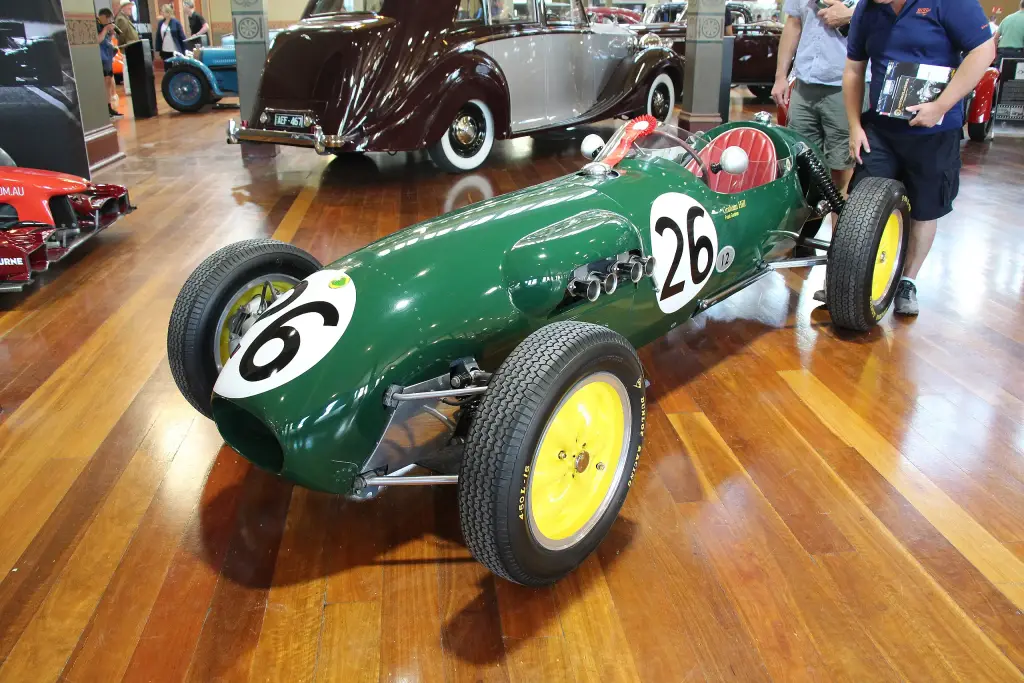
The Lotus 12 was a British racing car used in Formula Two and Formula One, and it was Colin Chapman’s first single-seat design. It appeared in 1958 and made its debut at the Monaco Grand Prix that year, bringing several ideas that Chapman would use again on later Lotuses.
Lotus 12 at a glance
| Introduced | 1958 |
|---|---|
| Designer | Colin Chapman |
| Categories | Formula Two, Formula One |
| Debut | 1958 Monaco Grand Prix |
| Engine | Coventry Climax, front-mounted |
| Chassis | space frame |
| Gearbox | five-speed sequential transaxle |
| Rear suspension | De Dion on the first two cars, then Chapman struts |
| Wheels | first Lotus with wobbly-web wheels in magnesium |
| Notable | transaxle known as the “Queerbox” |
Based on one source (English Wikipedia).
History of the Lotus 12
Chapman built the 12 for low weight and low drag, relying on a space frame. To make the most of the Coventry Climax engine, the driver sat as low as possible, and the transmission tunnel was kept small by a five-speed sequential-shift transaxle mounted at the rear. The unit was designed by Richard Ansdale and Harry Mundy, and its oil starvation problem earned it the nickname “Queerbox”.
The first two cars had De Dion rear suspension, but the 12 also introduced the arrangement that became known as the Chapman strut: a MacPherson-type strut combined with a fixed-length halfshaft with universal joints acting as a suspension arm. It was also the first Lotus to wear the distinctive wobbly-web wheels, cast in magnesium alloy so that they used the minimum of material while remaining strong.
Despite its engineering, the 12 was not a success in Formula One. In Formula Two, Cliff Allison drove it to a class win in the mixed Formula One and Formula Two 1958 BRDC International Trophy, and the car took a few podiums, but it was usually beaten by the Coopers.
Design and features
- Chapman strut: a rear suspension layout that became a Lotus trademark.
- Sequential transaxle: a compact five-speed unit that lowered the driving position.
- Wobbly-web wheels: cast magnesium wheels designed for strength with the least material.
- Space frame: light and stiff construction in place of a heavy chassis.
Lotus 12 versions
- Lotus 12 (1958): Formula Two and Formula One car, with De Dion rear suspension on the first two examples and Chapman struts thereafter.
The 12 led directly to the Lotus 16, the first Lotus built for Formula One, and to the mid-engined Lotus 18. More cars are in the Lotus collection.
Sources
- Lotus 12, English Wikipedia: design, debut, racing record