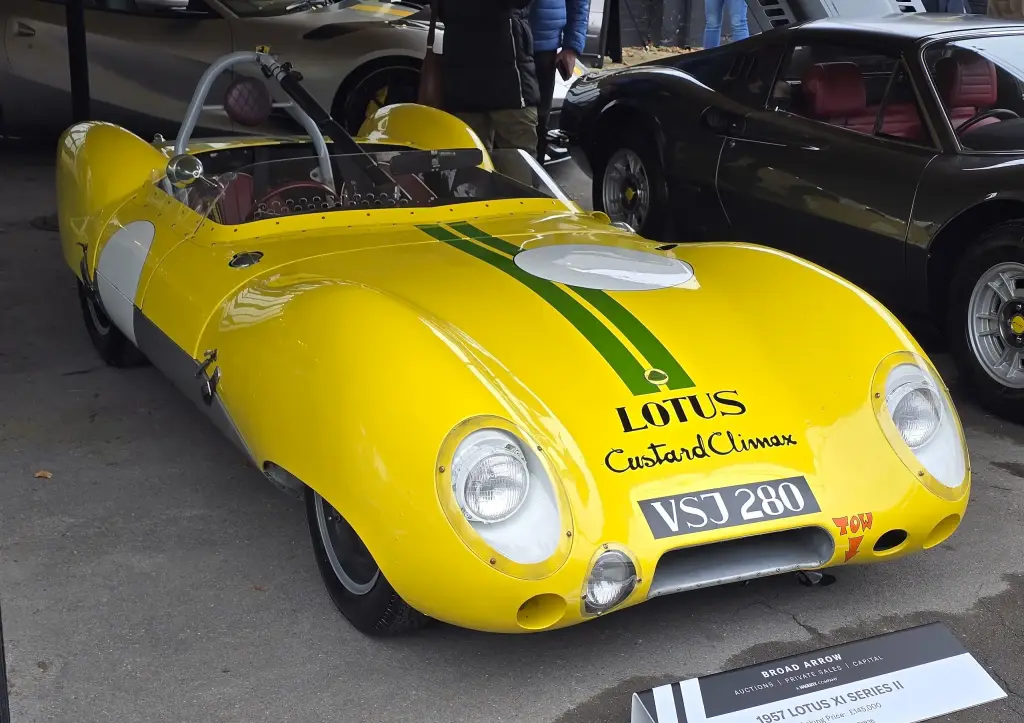
The Lotus Eleven is a sports racing car built in various versions by Lotus from 1956 until 1958. The later 1958 cars are sometimes called Lotus 13, though that was never an official designation. In total about 270 Elevens of all versions were built.
Lotus Eleven at a glance
| Built | 1956–1958 |
|---|---|
| Designers | Colin Chapman, body by Frank Costin |
| Construction | tubular space frame, sleek aluminium body |
| Top version | Le Mans, 1,100 cc Coventry Climax FWA |
| Other versions | Club with 1,100 cc Climax, Sport with 1,172 cc Ford |
| Rear suspension | De Dion tube on the Le Mans version |
| Brakes | Girling discs on the Le Mans, drums on Club and Sport |
| Weight | about 1,000 lb (450 kg) |
| Best Le Mans result | 7th overall, 1956 |
| Built | about 270 |
Based on one source (English Wikipedia).
History of the Lotus Eleven
The Eleven was designed by Colin Chapman with a sleek body by the aerodynamicist Frank Costin, whose brother Mike co-founded Cosworth. Its top version, called Le Mans, used a 1,100 cc Coventry Climax FWA engine, occasionally the 1,500 cc FWB, mounted in front of a tubular space frame, with a De Dion tube rear axle and Girling disc brakes. Fully loaded the car weighed only about 450 kg. Club versions with a 1,100 cc Climax engine and Sport versions with a 1,172 cc Ford had a live rear axle and drum brakes.
Owners fitted many alternative engines, among them Coventry Climax FWB, FPF and FWE units, a Maserati 150S, DKW, Saab and 750 cc engines. There were two main body styles, one with a headrest and one with just two small fins, and some cars later received a closed body with gullwing doors to meet GT rules.
The car’s most notable result was seventh overall at the 1956 24 Hours of Le Mans, driven by Reg Bicknell and Peter Jopp. Designed primarily for the 1,100 cc class, it was one of the most successful cars of the mid to late 1950s: in 1956 an Eleven modified by Costin with a bubble canopy was driven by Stirling Moss to a class world record of 143 mph for a lap at Monza, and class victories at Le Mans and Sebring followed. A 750 cc version won the Index of Performance at Le Mans in 1957.
In 1957 the Eleven received a major redesign with new front suspension and drivetrain improvements. Officially the Eleven Series 2, these late cars are sometimes informally called Lotus 13s because they were built between the 12 and 14 and Lotus never used the 13 designation. The Eleven has been recreated many times, by Kokopelli, Challenger, Spartak and most famously the Westfield XI, and it remains Lotus’s most successful race car design.
Design and features
- Costin body: a sleek shape from the aerodynamicist Frank Costin.
- Light weight: about 450 kg fully loaded.
- Three levels: Le Mans with Climax engine and disc brakes, Club and Sport with live axles and drums.
- Record breaker: Moss took a 143 mph class record at Monza in 1956.
- Versatile: owners fitted Climax, Maserati, DKW and Saab engines.
Lotus Eleven versions
- Le Mans: 1,100 cc Climax FWA (sometimes 1,500 cc FWB), De Dion rear axle and disc brakes.
- Club: 1,100 cc Climax, live rear axle and drum brakes.
- Sport: 1,172 cc Ford, live rear axle and drum brakes.
- Series 2 (1957): new front suspension and drivetrain changes, sometimes called Lotus 13.
The Eleven followed the Lotus Mark VI and led to the Lotus Seven and the sports racers of the 1960s such as the Lotus 23. More cars are in the Lotus collection.
Sources
- Lotus Eleven, English Wikipedia: design, versions, racing record, production