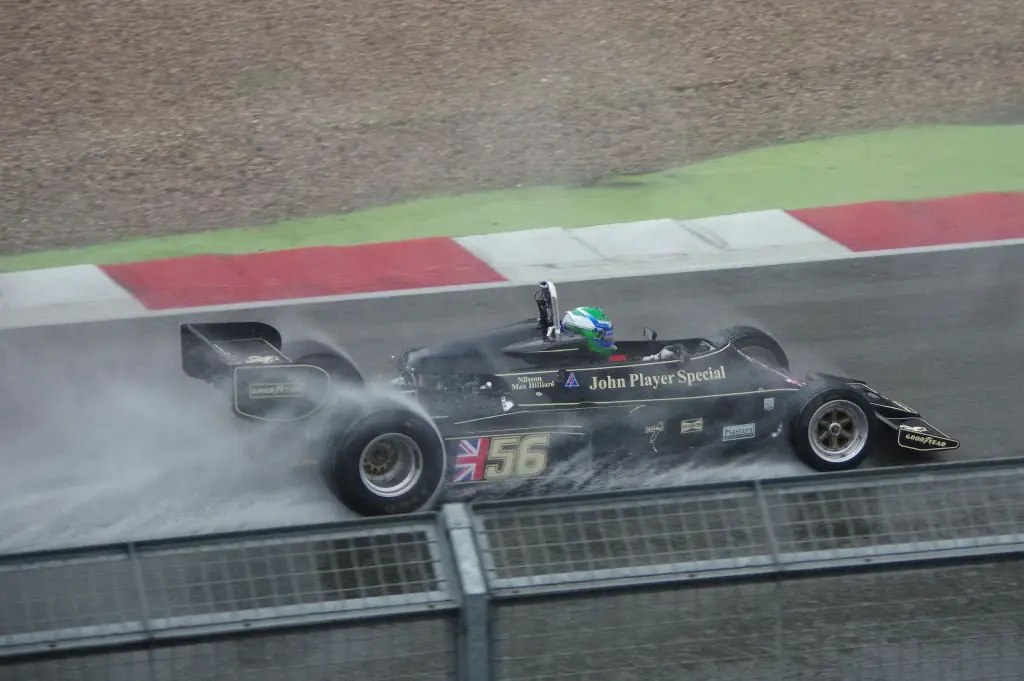
The Lotus 77 was a Formula One racing car designed by Colin Chapman, Geoff Aldridge and Martin Ogilvie for the 1976 season. It was a stop-gap for Lotus, fighting back after the failure of the Lotus 76 and the obsolescence of the Lotus 72 in 1975. Three chassis were built, and all three still exist.
Lotus 77 at a glance
| Season | 1976 Formula One |
|---|---|
| Designers | Colin Chapman, Geoff Aldridge, Martin Ogilvie |
| Chassis | slimmer, lighter monocoque than the Lotus 72 |
| Engine | Ford Cosworth DFV |
| Suspension | rocker arms, adjustable for each track |
| Nickname | “The Adjustacar” |
| Front brakes | inboard at first, outboard later |
| Built | 3 chassis, all surviving |
| Best result | win, Mario Andretti, 1976 Japanese Grand Prix |
Based on one source (English Wikipedia).
History of the Lotus 77
The 77 had a slimmer, lighter monocoque than the 72 but was powered by the same Cosworth DFV, with improved aerodynamics and repositioned radiators for better cooling. Its front brakes were inboard at first, as on its predecessors, and moved outboard part-way through the season. The suspension was built around rocker arms rather than the usual wishbones, so that it could be set up for a specific track taking in ride height and road surface — hence the nickname “The Adjustacar”. It worked after a fashion, but inexperience with a car so infinitely adjustable meant the best settings were often missed.
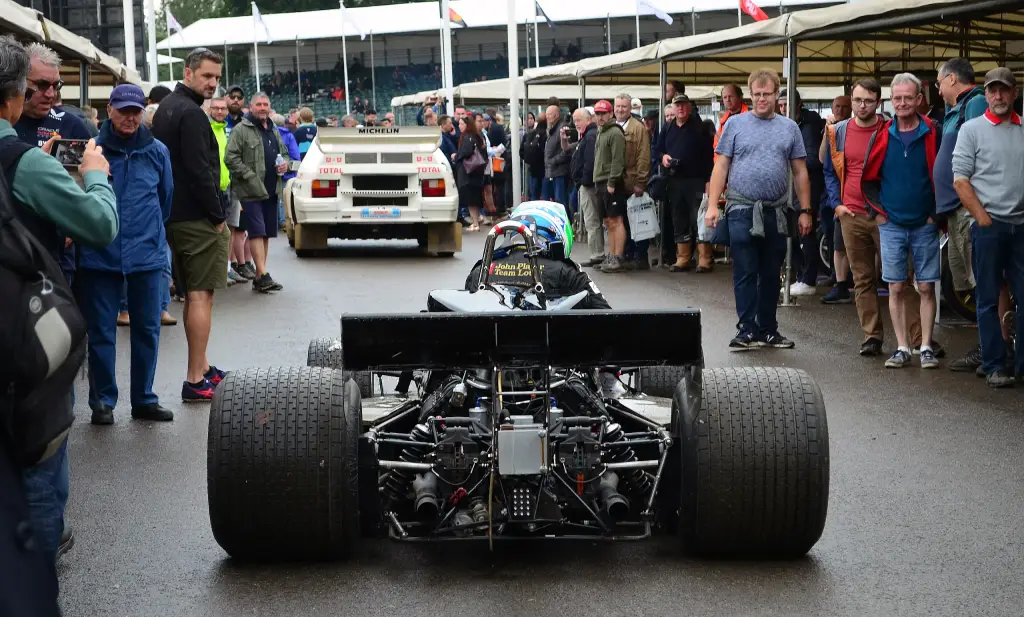
The arrangement was soon judged unsuitable and Len Terry was brought in to design a more orthodox system with rocker arms and outboard brakes. Later in the season Tony Southgate joined from Shadow as chief engineer, moving the oil radiator to the nose to improve weight distribution, adding a cockpit-adjustable rear anti-roll bar and a lighter compressed-air starter.
All the drivers found the steering and ride occasionally vague and the car short of straight-line speed. Mario Andretti disliked it, calling it a “dog”, which pushed Lotus to accelerate work on the Lotus 78. Andretti skipped Monaco to race at Indianapolis. After a slow start the 77 was best of the rest behind Ferrari, McLaren and Tyrrell and improved from mid-season, especially on tracks with long corners such as Anderstorp, where Andretti led easily before engine failure; he finished on the podium at Zandvoort and Mosport Park.
Chapman refused Andretti’s request to race the Lotus 78 at Zandvoort, so he stayed with the 77 to the end of the season. The last race was run in monsoon conditions at Fuji, where the car was set to its narrowest width with a virtually flat rear wing, and Andretti drove a clever tactical race to win by a lap from Patrick Depailler and the new champion James Hunt. He was glad to put the 77 aside and concentrate on developing the 78.
Design and features
- Rocker-arm suspension: designed to be set up for each circuit, hence “The Adjustacar”.
- Lighter monocoque: slimmer than the Lotus 72’s.
- Cosworth DFV: the same stressed V8 as in the 72.
- Mid-season changes: outboard front brakes, oil radiator in the nose and a cockpit-adjustable rear anti-roll bar.
- Rain win: Andretti’s tactical victory at Fuji in 1976.
Lotus 77 versions
- Lotus 77 (1976): three chassis, all still in existence.
The 77 replaced the Lotus 72 and was quickly superseded by the ground-effect Lotus 78. More racing cars are in the Lotus collection.
Sources
- Lotus 77, English Wikipedia: design, suspension, season, Fuji win