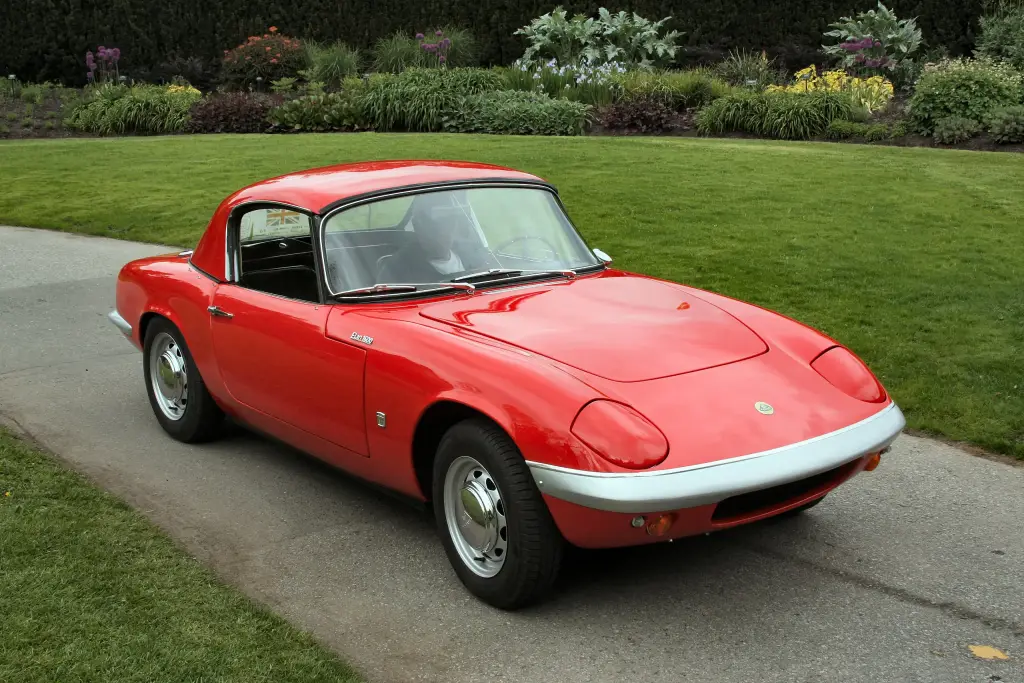
Lotus Elan is the name of two separate ranges of cars. The first was built from 1962 to 1975 as a rear-wheel-drive sports car; the second, from 1989 to 1995, was a front-wheel-drive car co-developed with Isuzu and unrelated in engineering to the original.
Lotus Elan at a glance
| First series | 1962–1975 |
|---|---|
| Second series | 1989–1995 (M100) |
| First car | Elan 1500, 1962 |
| Construction | steel backbone chassis and fibreglass body |
| Engine | 1,558 cc Lotus-Ford twin-cam |
| Weight | about 1,500 lb (680 kg) |
| Brakes | discs on all four wheels |
| Steering | rack and pinion |
| Body styles | drophead (Type 26, Type 45), fixed head (Type 36), Elan +2 (Type 50) |
| Designer | Ron Hickman |
Based on one source (English Wikipedia).
History of the Lotus Elan
The Elan was the first Lotus road car to use a steel backbone chassis with a fibreglass body, a construction repeated in later Lotuses for nearly three decades. At about 680 kg it embodied Chapman’s minimum-weight philosophy, and it was technologically advanced with a double-overhead-cam 1,558 cc engine, four-wheel disc brakes, rack-and-pinion steering and fully independent suspension. Gordon Murray, designer of the McLaren F1, reportedly said his only disappointment with the F1 was that he could not give it the perfect steering of the Lotus Elan. Sports Car International placed the Elan sixth among the top sports cars of the 1960s in 2004.
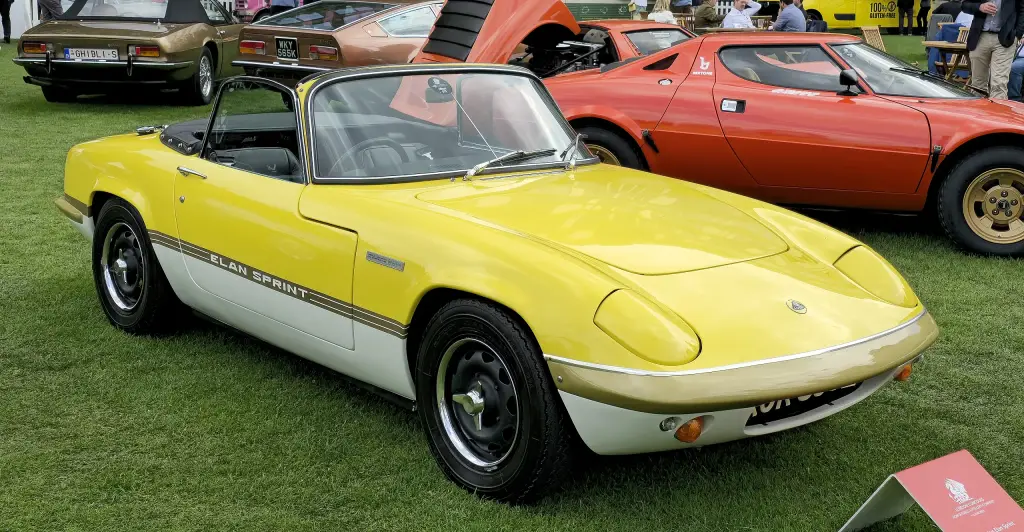
The car was designed by Ron Hickman, who also designed the first Lotus Europa and made his fortune with the Black & Decker Workmate. Its successful design and careful cost control on body, chassis, engine and transmission made the Elan Lotus’s first commercial success and helped fund a decade of racing achievement, reviving a company stretched by the expensive and unreliable Lotus Elite with its fibreglass monocoque and all-aluminium Coventry Climax engine.
The Elan 1500 was introduced in 1962 as a roadster; after only 22 cars the engine was enlarged and the car became the Elan 1600, with an optional hardtop. The 1600 of 1963 was replaced by the S2 in 1964. In 1965 the Type 36 fixed-head coupé arrived, and in 1966 the Type 45 drophead replaced the Type 26. Both were offered first as the S3, then the S4 from 1968 and finally the Sprint from 1970, production ending in 1973. Standard S2, S3 and S4 cars were also available in a more powerful, more luxurious Special Equipment variant. In Britain the Elan was sold fully assembled or, for tax reasons, as a kit for the customer to finish.
The backbone chassis was a fabricated mild steel structure rather like a double-ended tuning fork, with a fibreglass body bolted to it at sixteen points and fitting over it like a saddle. The chassis carried the main bending and torsional loads and is readily replaceable, so most surviving Elans have had a new one at some point. The engine and gearbox sat between the front fork arms and the differential between the rear ones, with suspension turrets at the ends of the arms. Total production is not definitively known: John Bolster gives 12,224, while Paul Robinshaw and Christopher Ross suggest between 8,676 and 9,153. A 1989 second series, the front-wheel-drive M100 co-developed with Isuzu, was also built in South Korea by Kia as the Kia Elan from 1996 to 1999.
Design and features
- Backbone chassis: a steel spine with a fibreglass body, used by Lotus for nearly three decades.
- Light weight: about 680 kg.
- Twin-cam engine: 1,558 cc double-overhead-cam four.
- Sharp steering: rack and pinion praised by Gordon Murray.
- Commercial success: the car that funded Lotus’s racing years.
Lotus Elan versions
- Elan 1500 (1962): the original roadster, only 22 built.
- Elan 1600 (1963): enlarged engine and optional hardtop.
- Elan S2 (1964): the second series.
- Type 36 fixed-head coupé (1965): S3, S4 and Sprint.
- Type 45 drophead (1966): replacement for the Type 26.
- Elan Sprint (1970–1973): the final and fastest of the first series.
- Elan +2 (Type 50): four-seater with small rear seats.
- Elan M100 (1989–1995): front-wheel-drive second series, also built by Kia.
The Elan replaced the Lotus Elite as Lotus’s road car and shared its chassis ideas with the Lotus Europa. Its spirit returned in the Lotus Elise and the rest of the Lotus collection.
Sources
- Lotus Elan, English Wikipedia: models, construction, production, engines