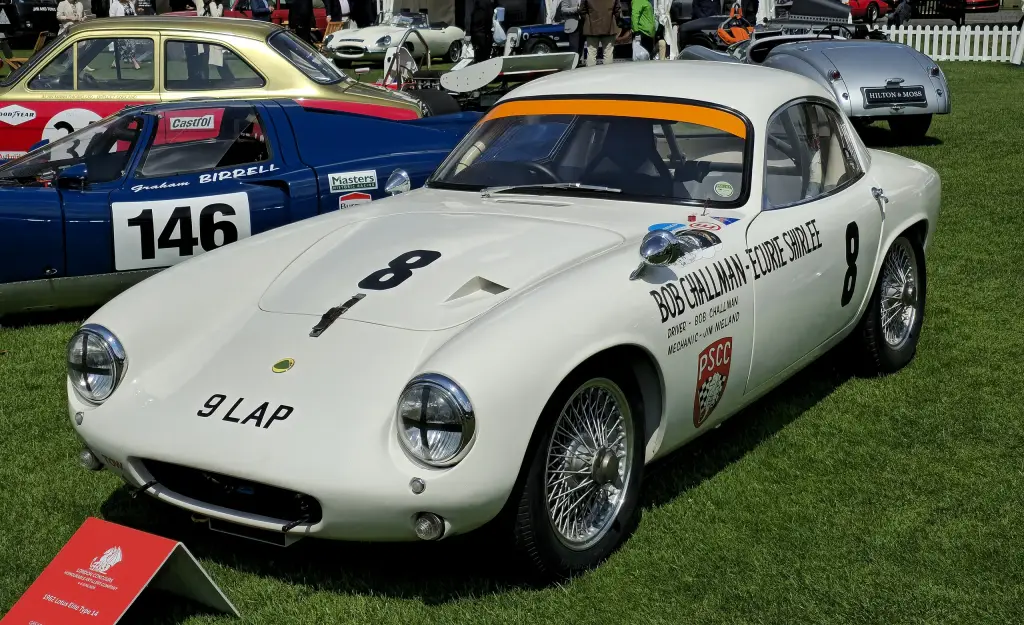
The Lotus Elite name has been used for two production cars and a concept. The first generation, the Elite Type 14, was produced from 1957 until 1963; the second, types 75 and 83, from 1974 until 1982; and the name was also used on a concept car shown in 2010.
Lotus Elite at a glance
| Type 14 | 1957–1963 |
|---|---|
| Type 75 and 83 | 1974–1982 |
| Debut | 1957 London Motor Car Show, Earls Court |
| Construction | stressed fibreglass monocoque |
| Engine | 1,216 cc Coventry Climax FWE, 75 hp |
| Weight saving | racecar performance from 75 hp |
| Suspension | wishbones front, Chapman struts rear |
| Brakes | Girling discs, inboard at the rear |
| Drag coefficient | Cd 0.29 |
| Built | 1,030 (some sources 1,047) |
Based on one source (English Wikipedia).
History of the Lotus Elite
The first Elite, type 14, was a lightweight two-seater coupé produced from 1957 to 1963. It debuted at the 1957 London Motor Car Show at Earls Court with chassis 1006 after a year of development aided by carefully selected racing customers. Its most distinctive feature was the highly innovative fibreglass monocoque: a stressed-skin glass-reinforced plastic unibody replacing separate chassis and body. Unlike the Corvette, which used fibreglass only for exterior panels, the Elite used it for the entire load-bearing structure. A steel subframe for the engine and front suspension was bonded into the front of the monocoque, as was a square-section windscreen hoop giving door hinge mounts, a jacking point and roll-over protection. The first 250 or 280 shells were made by Maximar Mouldings in Sussex, and the structure caused early problems until production moved to the Bristol Aeroplane Company.
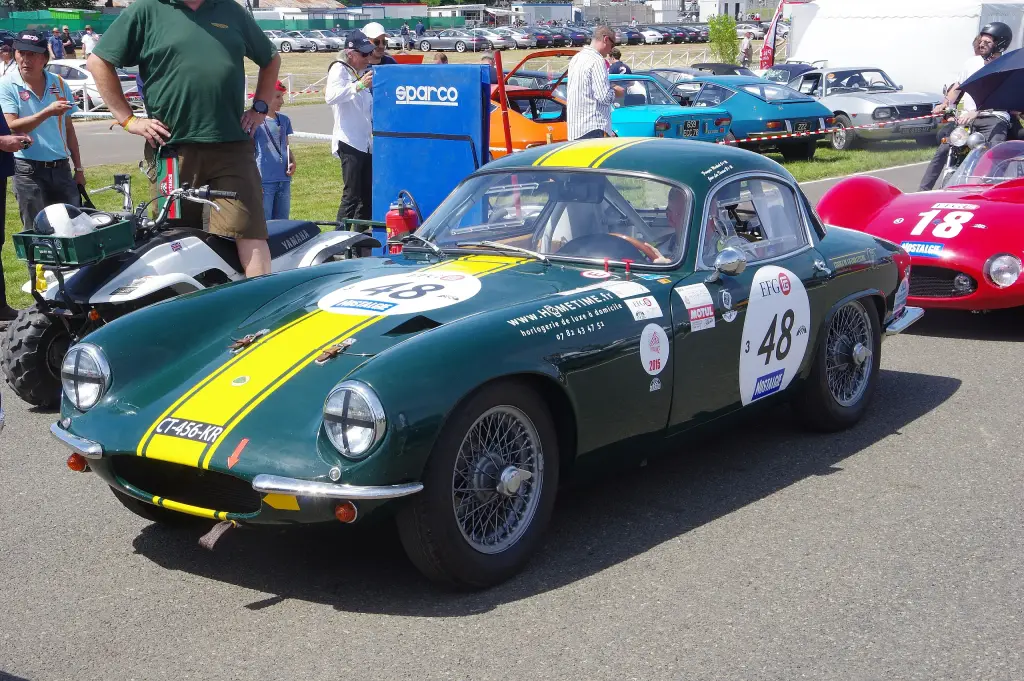
The body was lighter, stiffer and gave better crash protection, but understanding of fibreglass-reinforced plastic was still years away and the rear suspension arm attachment points regularly pulled out of the structure. The weight saving let the Elite achieve racecar-like performance from a 75 hp, 1,216 cc Coventry Climax FWE all-aluminium four, while returning 35 mpg. All production cars used the FWE engine, derived from a lightweight fire-fighting water pump engine, except one testbed for the Lotus-Ford Twin Cam. The car had independent suspension all round, with transverse wishbones at the front and Chapman struts at the rear so tall that their tops could be seen through the rear window from a car behind. Series 2 cars had triangulated trailing radius arms for better toe control. Girling 9.5 in disc brakes, usually without servo, were used, inboard at the rear.
The original body drawings were by Peter Kirwan-Taylor, with the final shape helped by Frank Costin, then chief aerodynamic engineer at de Havilland. Later aerodynamic testing showed a drag coefficient of 0.29, excellent without computer-aided design or wind tunnel access. The SE of 1960 raised power to 85 hp with twin SU carburettors and a cast alloy manifold, added a four-speed ZF gearbox in place of the cheaper MG unit, Lucas PL700 headlamps and a silver roof. The Super 95 had a 10.5:1 compression ratio and two Weber 40DCOE carburettors, and a few Super 100 and Super 105 cars were built for racing.
Among the Elite’s few faults were a resonant vibration at 4,000 rpm, poor quality control and an overly low price that lost Lotus money on every car, worsened by offering it as a kit. Production ended in 1963 after 1,030 cars, though some sources say 1,047. A 1960 road test by The Motor recorded a top speed of 111.8 mph, 0–60 mph in 11.4 seconds and 40.5 mpg, the test car costing £1,966 including taxes. The Elite won its class six times at Le Mans and twice the Index of Thermal Efficiency, and Leo Geoghegan won the 1960 Australian GT Championship in one. The second-generation Elite, types 75 and 83, was built from 1974 to 1982 as a larger four-seater.
Design and features
- Fibreglass monocoque: a stressed-skin unibody with no separate chassis.
- Light and slippery: 75 hp, 35 mpg and a drag coefficient of 0.29.
- Chapman struts: tall rear struts visible through the rear window.
- Racing success: six class wins at Le Mans and two thermal efficiency prizes.
- SE and Super models: up to 85 hp and a ZF gearbox.
Lotus Elite versions
- Elite Type 14 (1957–1963): the original fibreglass-monocoque coupé, 1,030 built.
- Elite SE (1960): 85 hp, twin SU carburettors, ZF gearbox and silver roof.
- Super 95, Super 100 and Super 105: more powerful and racing versions.
- Elite Type 75 and 83 (1974–1982): the second-generation four-seater.
The Elite was replaced as Lotus’s road car by the Lotus Elan, and the second-generation car gave rise to the fastback Lotus Eclat. More cars are in the Lotus collection.
Sources
- Lotus Elite, English Wikipedia: Type 14 construction, engines, variants, results