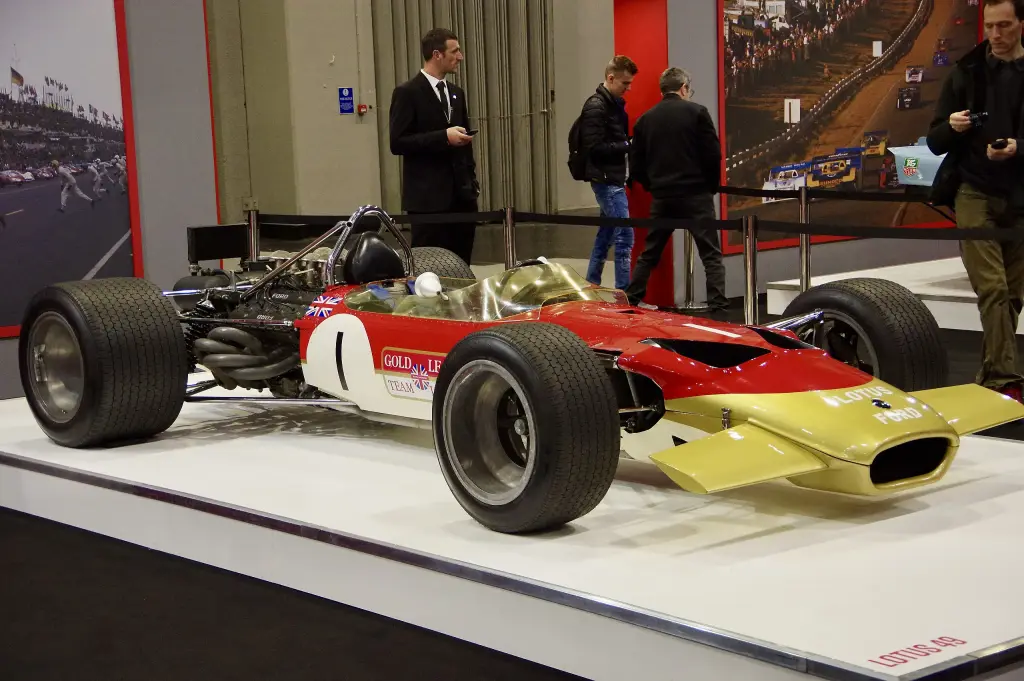
The Lotus 49 was designed by Colin Chapman and Maurice Philippe for the 1967 Formula One season. It was one of the first Formula One cars to use a stressed-member engine combined with a monocoque to save weight, and it was the first car powered by the Ford Cosworth DFV.
Lotus 49 at a glance
| Season | 1967 Formula One |
|---|---|
| Designers | Colin Chapman, Maurice Philippe |
| Engine | Ford Cosworth DFV 3.0-litre V8, stressed member |
| Chassis | monocoque, engine bolted between tub and gearbox |
| Debut | 1967 Dutch Grand Prix, Zandvoort |
| Debut result | win, Jim Clark |
| 1968 champion | Graham Hill (49 and 49B) |
| 49B innovation | strutted aerofoil wings, later banned in high form |
| Tasman version | 49T with 2.5-litre Cosworth DFW |
| Built | 12, of which 7 remain |
Based on one source (English Wikipedia).
History of the Lotus 49
After a difficult first year of the three-litre formula with the heavy and unreliable BRM H16, Chapman and Philippe went back to the drawing board, drawing on the BRM P83, the Lotus 43 and the Lotus 38 Indycar. Chapman persuaded Ford to finance Keith Duckworth’s DFV design, and the 49 became the first Formula One car to use it.
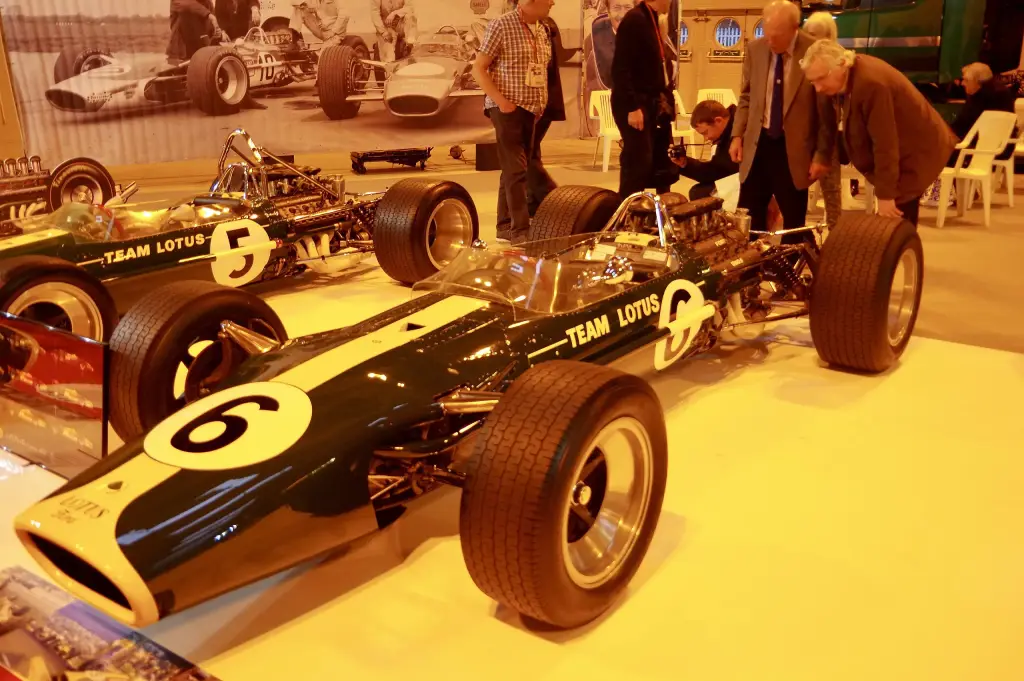
The 49’s great advance was its chassis layout. The engine became a stress-bearing structural member, bolted to the monocoque at one end and to the suspension and gearbox at the other, an arrangement used earlier with the H16 in the Lotus 43 and BRM P83 and before that in the Lancia D50 of 1954. Almost every Formula One car since has been built this way.
Graham Hill found the car easy to drive and responsive in testing, though the DFV’s sudden bursts of power took some handling; after his first run he said, “It’s got some poke! Not a bad old tool.” Jim Clark won with ease on the car’s debut at Zandvoort and took three more wins that season, but early unreliability with the DFV ended his title hopes. Mechanical failures, including a spark plug problem at Spa and running out of fuel at Monza, cost Lotus the championship.
For 1968 the 49B appeared at Monaco with strutted aerofoil wings mounted directly to the wheel hubs, the first Formula One car to do so after Ferrari and following the Chaparral 2E. The high wings were later banned after breakages caused dangerous accidents, and Lotus had to mount them on the bodywork. Clark won the first race of 1968 in South Africa and the Tasman Series before he was killed in a Formula Two race at Hockenheim; Hill took over as team leader and won his second world championship. Jo Siffert won the 1968 British Grand Prix in a Rob Walker 49B, the last championship Formula One race won by a genuine privateer, and Jochen Rindt took his first victory in one at Watkins Glen in 1969 and the model’s last at Monaco in 1970. The 49C filled in when the Lotus 63 failed, and the model took twelve wins and two drivers’ and constructors’ titles before the Lotus 72 replaced it.
Design and features
- Stressed DFV: the engine formed part of the chassis structure.
- Cosworth DFV: the 3-litre V8 that changed Formula One.
- Wings: the 49B was the first Formula One car with aerofoils mounted on the wheel hubs.
- Privateer success: Rob Walker’s 49B won the 1968 British Grand Prix.
- Tasman version: the 49T used a 2.5-litre Cosworth DFW.
Lotus 49 versions
- Lotus 49 (1967): the original car with the DFV as a stressed member.
- Lotus 49B (1968): strutted aerofoil wings and detail changes.
- Lotus 49C: interim development used when the Lotus 63 failed.
- Lotus 49T: Tasman Series car with the 2.5-litre Cosworth DFW.
The 49 followed the Lotus 38 Indianapolis car and the Climax-engined Lotus 33, and was replaced by the Lotus 72. More racing cars are in the Lotus collection.
Sources
- Lotus 49, English Wikipedia: design, DFV, racing history, Tasman Series