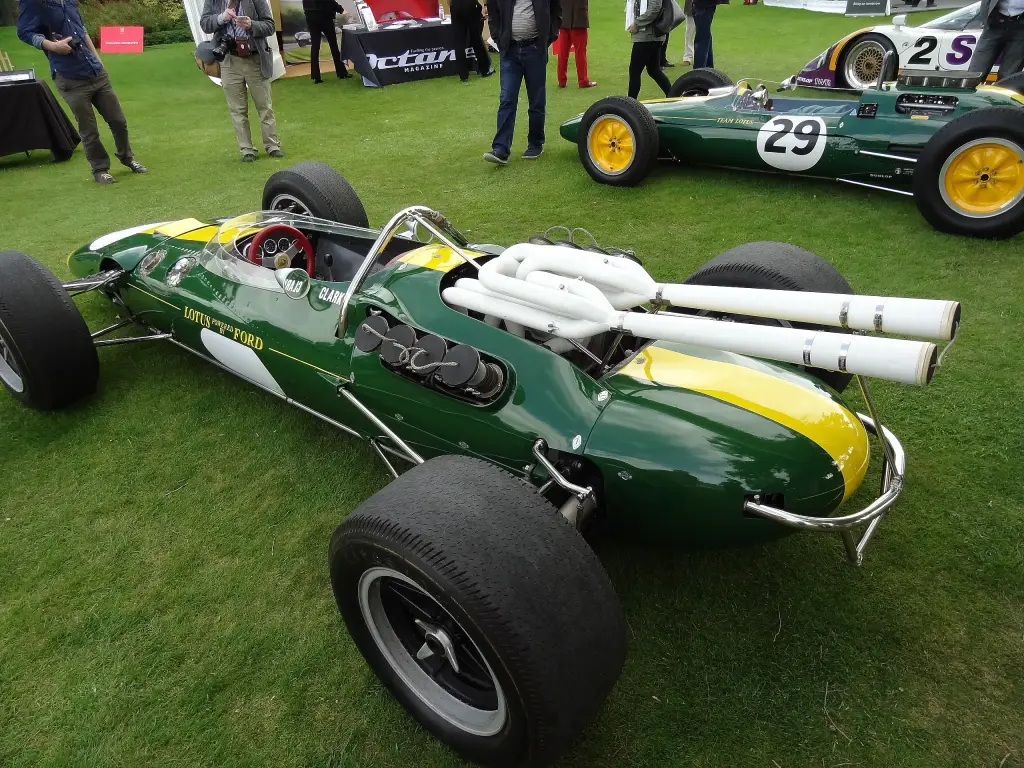
The Lotus 38 was the first rear-engined car to win the Indianapolis 500, in 1965, driven by Jim Clark. Lotus ran it at Indianapolis from 1965 to 1967 and built eight cars in total, most for its own team but several sold to other drivers, including A. J. Foyt and Mario Andretti.
Lotus 38 at a glance
| Built | 1965, eight cars |
|---|---|
| Designers | Colin Chapman, Len Terry |
| Engine | four-cam Ford V8, fuel injected, about 500 bhp |
| Chassis | full monocoque tub |
| Layout | mid-engined |
| Suspension | offset, body set to the left on unequal-length arms |
| 1965 Indy 500 | won by Jim Clark |
| Qualifying | second, 160.729 mph four-lap average |
| Race average | 150.686 mph, a new record |
| Indianapolis | 1965, 1966 and 1967 |
Based on one source (English Wikipedia).
History of the Lotus 38
The 38 was Lotus’s 1965 entry for the Indianapolis 500, designed by Colin Chapman and Len Terry as an evolution of the earlier Lotus 29 and 34 with a full monocoque tub chassis. It used the same four-cam, fuel-injected Ford V8 as the 34, giving around 500 bhp, and the engine was mid-mounted for better weight distribution. The car was much larger than a Formula One car of the time but still dwarfed by the American roadsters.
A distinctive feature was its offset suspension: the body sat asymmetrically between the wheels, shifted to the left on suspension arms of unequal length. In theory this suited ovals with only left-hand turns, for instance by evening out tyre wear, but in practice the handling was idiosyncratic enough that the idea never caught on.
At the 1965 Indianapolis 500 Clark qualified second with a four-lap average of 160.729 mph and a new one-lap record of 160.973 mph. A. J. Foyt took pole in a modified Lotus 34, but Clark led from the start, lost the lead only briefly around the first pit stops and led all but ten laps to win, with Parnelli Jones second in another modified 34. Clark’s race average of 150.686 mph was the first over 150 mph at Indianapolis, beating Foyt’s 1964 record. It was also payback for 1963, when many, including Chapman, felt Jones’s oil-spraying front-engined roadster should have been black-flagged.
Only four of the 33 starters in 1965 had front engines, and the days of the roadster were effectively over — Foyt’s 1964 win in a Watson-Offy was the last for a front-engined car. Lotus returned with the 38 in 1966, when Graham Hill won in a Lola after confusion over the lap chart, and in 1967, when Clark retired early with a blown engine. Design elements of the 38 later went into the Lotus 49, and Foyt’s early Coyotes were Lotus 38 clones.
Design and features
- Monocoque tub: a full monocoque chassis for the Indianapolis car.
- Mid-mounted Ford V8: about 500 bhp from the four-cam, fuel-injected engine.
- Offset suspension: the body sat to the left on unequal-length arms.
- Record pace: the first 150 mph race average at Indianapolis.
- End of an era: its win finished the front-engined roadster at the Brickyard.
Lotus 38 versions
- Lotus 38 (1965): the works cars and the customer cars sold to drivers such as Foyt and Andretti.
- 1966 and 1967 entries: further Indianapolis attempts with the same model.
The 38 followed the earlier Lotus 29 and 34 Indy cars, and its ideas went into the Lotus 49. The Formula One cars of the period are in the Lotus collection.
Sources
- Lotus 38, English Wikipedia: design, 1965 race, later entries