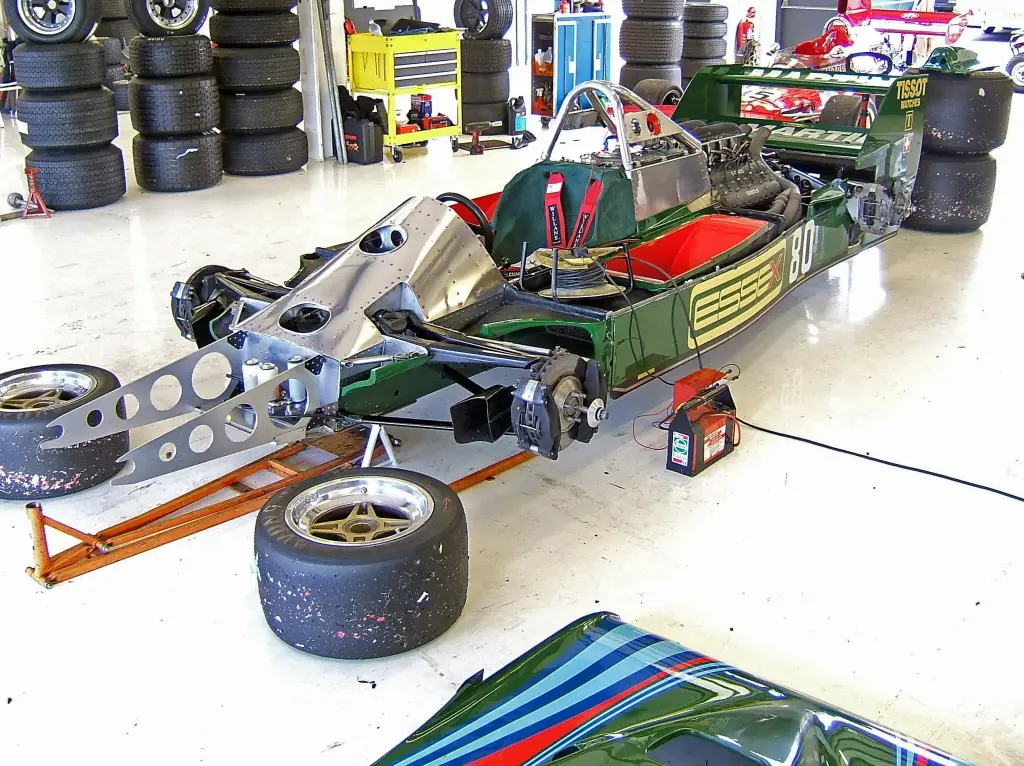
The Lotus 80 was a Formula One car used by Team Lotus in 1979. Designed by Colin Chapman, Martin Ogilvie, Peter Wright and Tony Rudd, it was an attempt to take ground effect as far as possible.
Lotus 80 at a glance
| Season | 1979 Formula One |
|---|---|
| Designers | Colin Chapman, Martin Ogilvie, Peter Wright, Tony Rudd |
| Concept | the whole chassis as one ground-effect system |
| Body | “Coke bottle” sidepods |
| Livery | British racing green, after John Player Special withdrew |
| Wings | none needed in theory |
| Main problem | porpoising and extreme ride-height sensitivity |
| Best result | third, Mario Andretti, 1979 Spanish Grand Prix |
| Fate | replaced by the Lotus 79 |
Based on one source (English Wikipedia).
History of the Lotus 80
Ogilvie and Rudd reasoned that to move ahead of the competition the new car should be one huge ground-effect system, starting just behind the nose and running all the way back beyond the rear wheels. An additional ground-effect system was built into the nose, in an effort to turn the whole chassis into an aerodynamic device. In theory this would create tremendous downforce, so the chassis had to be more rigid than the Lotus 79’s, and the car would not need wings at all. Chapman approved the idea immediately.
The car appeared in British racing green, since John Player Special had pulled out of Formula One, and featured the “Coke bottle” sidepods that became familiar in the 1980s. Testing revealed a serious problem: Mario Andretti reported that the car behaved very well at speed but lost downforce alarmingly in braking and cornering, then regained it unexpectedly. The low-pressure area under the car moved around with the centre of gravity, a phenomenon known as porpoising as the car lifted and squatted at different speeds and lurched violently through corners. The slightest difference in ride height, including off-camber corners and kerbs, hugely affected the undercar pressure.
The team tried fitting wings, with little effect. Andretti persevered, but his new team-mate Carlos Reutemann refused to drive the car after testing it and stayed with the Lotus 79.
Chapman eventually admitted that the 80 was not the wonder car he had planned. After a reasonable third place for Andretti in the 1979 Spanish Grand Prix, Andretti qualified fifth for the Belgian Grand Prix but raced the 79 because of problems with the 80. The trouble became obvious in Monaco and France, where Andretti retired from both races, and the 79 was modified and pressed back into service. It was a massive setback, but Chapman persevered with the idea of a full-length ground-effect chassis in the Lotus 88.
Design and features
- Whole-body ground effect: one system from nose to tail, with a second under the nose.
- No wings needed: downforce was meant to come entirely from the underside.
- Coke bottle sidepods: a shape that became common in the 1980s.
- Porpoising: the low-pressure area shifted with the centre of gravity, making the car lurch.
- Ride-height sensitivity: kerbs and off-camber corners upset the undercar pressure.
Lotus 80 versions
- Lotus 80 (1979): the only version, raced briefly before the Lotus 79 returned.
The 80 followed the championship-winning Lotus 79 and its ideas were tried again in the Lotus 88. More racing cars are in the Lotus collection.
Sources
- Lotus 80, English Wikipedia: design, porpoising, 1979 season