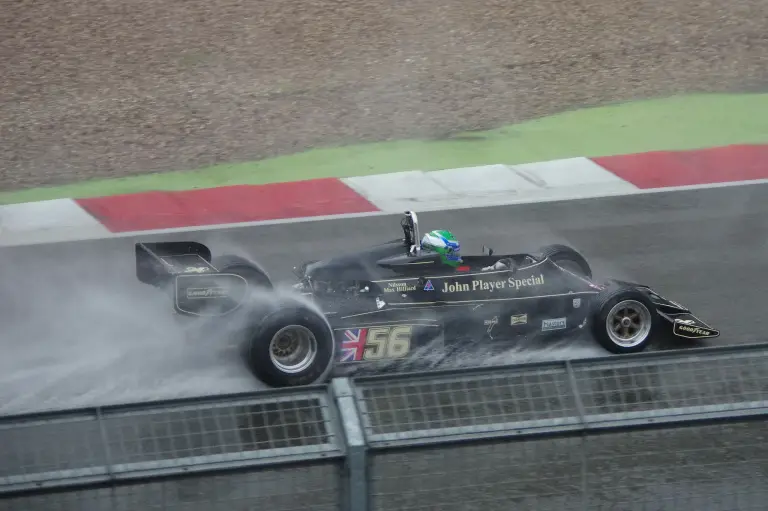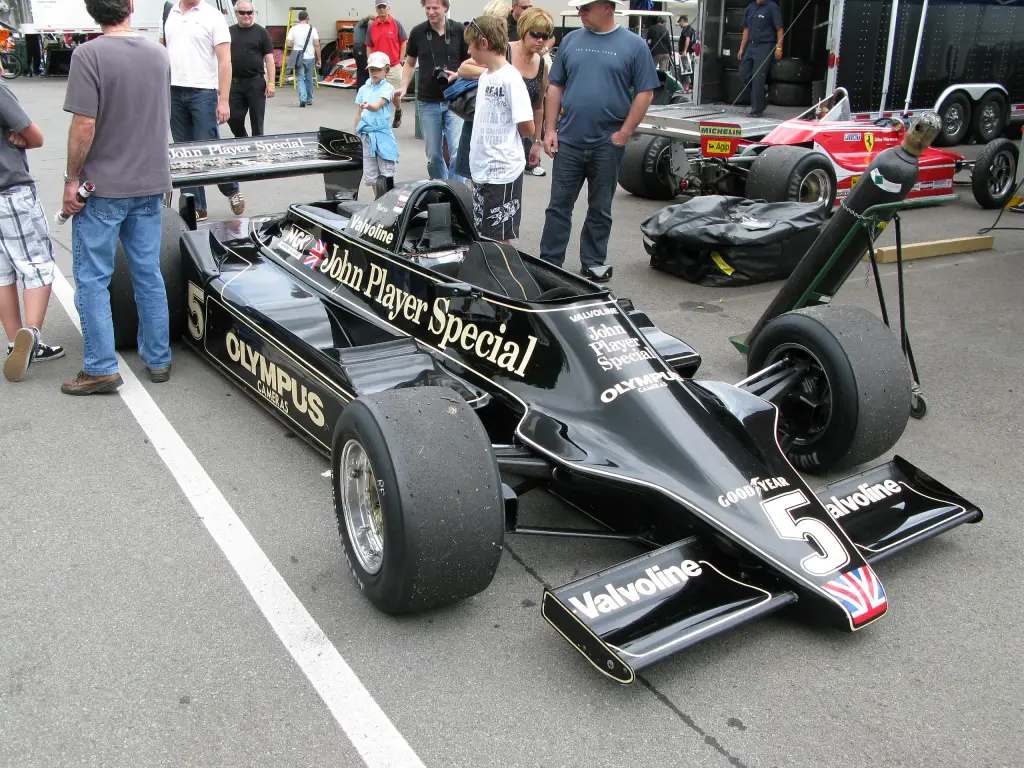
The Lotus 79 was designed in late 1977 by Colin Chapman, Geoff Aldridge, Martin Ogilvie, Tony Rudd, Tony Southgate and Peter Wright. It was the first Formula One car to take full advantage of ground-effect aerodynamics and it won the last drivers’ and constructors’ world championships for Lotus.
Lotus 79 at a glance
| Season | 1978 Formula One |
|---|---|
| Designers | Chapman, Aldridge, Ogilvie, Rudd, Southgate, Wright |
| Engine | Ford Cosworth DFV |
| Chassis | aluminium honeycomb, strengthened for ground-effect loads |
| Downforce | about 30% more than the Lotus 78 |
| Fuel | single cell behind the driver |
| Built | five chassis |
| Wins | 7 |
| Pole positions | 10 |
| Points | 121 |
| Titles | drivers’ and constructors’, 1978 |
Based on one source (English Wikipedia).
History of the Lotus 79
The ground-effect aerodynamics of the 79 were pioneered in the Lotus 78. The 79 solved the 78’s undercar pressure problems by developing the venturi tunnels beneath the car so that the low-pressure area was spread evenly along the whole underside. This was done by extending the rear bodywork to a point inside the rear suspension, so the underside ran further back instead of ending abruptly ahead of the rear wheels. The rear suspension was redesigned to let the air leave more cleanly, which allowed a smaller rear wing and lower drag. The car first appeared with steeply raked upper bodywork and “Coke bottle” sidepods, but wind tunnel work showed these were unnecessary because the car generated so much downforce; the features were later used on the Lotus 80.
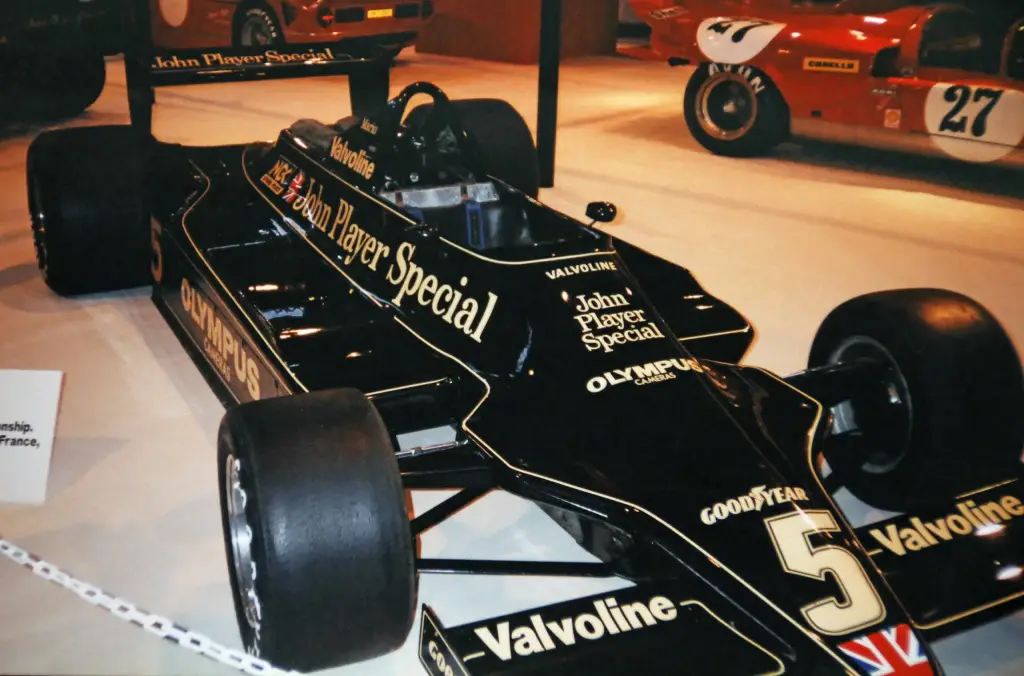
The 79 used a Ford Cosworth DFV in an aluminium honeycomb chassis specially strengthened for the pressures of ground effect, with a single fuel cell behind the driver instead of the 78’s separate tanks. This improved fire protection and moved the centre of gravity back towards the middle of the car. It was the first Formula One car designed with computer aids and the first to use computers for analysis in the pits on race weekends.
Ronnie Peterson tested the car secretly in late 1977 and found it extremely fast, but the chassis suffered early fatigue from the suction and g-forces of ground effect. The 79 produced about 30 per cent more downforce than the 78, more than Ogilvie and Rudd had expected, so the chassis was reinforced around the monocoque and load-bearing points and the car became even faster. Its clean lines and black and gold John Player Special livery earned it the nickname “Black Beauty”. On its debut at the 1978 Belgian Grand Prix at Zolder, Mario Andretti took pole by more than a second and won comfortably; he said the Lotus 78 felt “like driving a London bus” by comparison.
The car was not perfect: Andretti worried about brakes that faded over a race distance in hot conditions, the exhaust tended to overheat and the tub was not as stiff as the team wanted, so a new casting had to be made several times. Even so, the 79 was almost unbeatable in 1978. Andretti and Peterson finished one-two in Belgium, Spain, France and Holland, and Andretti took the title. Over its life the 79 scored seven wins, ten pole positions and 121 points. After Rubens Barrichello drove it at the Goodwood Festival of Speed in 2000 he spoke of its “phenomenal grip and traction” and said it felt like a modern Grand Prix car.
Design and features
- Full ground effect: venturi tunnels spread the low-pressure area along the whole underside.
- Extended rear bodywork: the underside ran back inside the rear suspension for cleaner airflow.
- Stronger chassis: aluminium honeycomb reinforced for ground-effect loads.
- Single fuel cell: better fire protection and a central centre of gravity.
- Black Beauty: the black and gold John Player Special livery.
Lotus 79 versions
- Lotus 79 (1978): five chassis; the prototype 79/1 was later sold to Héctor Rebaque as a privateer car.
The 79 developed the ground effect of the Lotus 78 and was followed by the over-ambitious Lotus 80. More racing cars are in the Lotus collection.
Sources
- Lotus 79, English Wikipedia: development, chassis, 1978 season, results