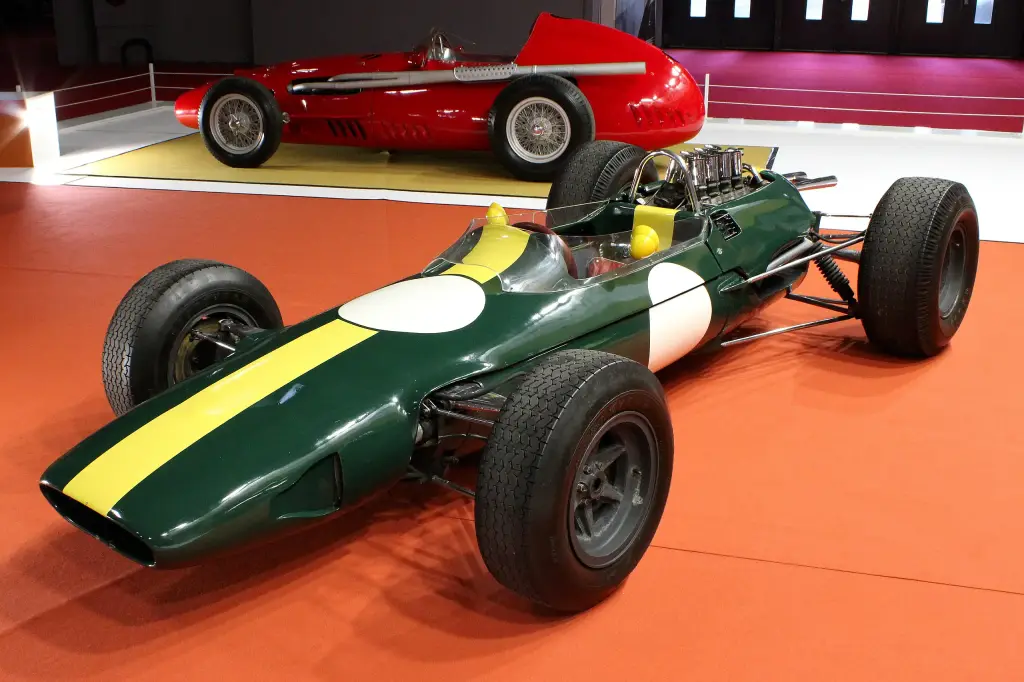
The Lotus 33 was a Formula One car designed by Colin Chapman and Len Terry and built by Team Lotus. A development of the successful Lotus 25, it won five World Championship Grands Prix in Jim Clark’s hands in 1965 and carried him to his second world championship.
Lotus 33 at a glance
| Introduced | 1964 |
|---|---|
| Designers | Colin Chapman, Len Terry |
| Based on | Lotus 25 |
| Chassis | monocoque, lighter and simpler to build than the 25 |
| Engine | 1.5-litre Coventry Climax V8 |
| 1965 engine | four-valve Climax, about 210–220 bhp |
| 1966 engine | 2-litre Climax V8 and BRM V8 |
| Built | 6 cars, R8 to R14 (R13 not used by the works team) |
| 1965 success | 5 Grand Prix wins, Clark’s second title |
Based on one source (English Wikipedia).
History of the Lotus 33
The 33 took the Lotus 25’s monocoque further. It was almost identical to the 25 but had suspension designed around newer, wider tyres, and it was both more rigid and simpler to build. Power came from the 1,500 cc Climax V8. Six cars were built with chassis numbers following on from the 25 and beginning at R8. R12 was modified for the stillborn Climax FWMW flat-16 and became the Lotus 39, while R13 was not used by Team Lotus but was later adopted by Reg Parnell Racing for its crashed R4 rebuilt around a 33 chassis. The last car, R14, had a 2-litre Climax V8 for 1966.
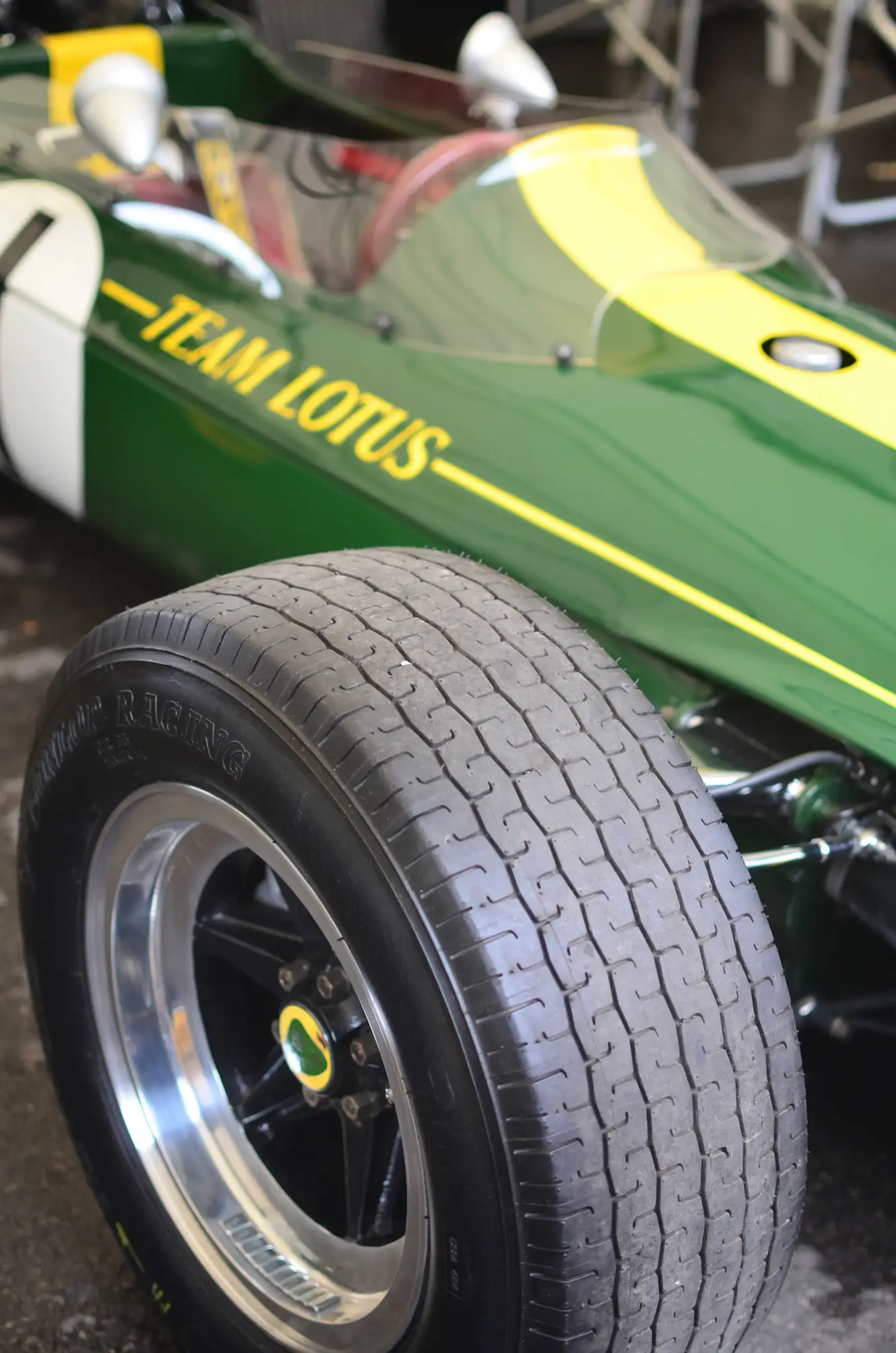
The 33 appeared for the 1964 season, first at the non-championship Aintree 200, where Clark qualified fourth and set fastest lap before retiring. Its first World Championship race was the German Grand Prix, but Clark and Mike Spence struggled with the car and it only came good the following year. In 1965 Clark won the opening race in South Africa and four more on the way to his second championship, missing Monaco to race at Indianapolis, which he also won.
A four-valve Climax engine of about 210–220 bhp replaced the older unit of roughly 200 bhp in 1965, but the extra power cost reliability and Clark retired from the last three races after clinching the title. For the early races of 1966 the 33 ran with a bored-out 2-litre Climax V8 and BRM V8 engines until the 3-litre Lotus 43 was ready. In 1967, with the Lotus 49 still troublesome, the 33 was chosen for the tight corners of Monaco: Clark set fastest lap before retiring, while Hill brought the BRM-engined car home second. The model’s last World Championship race was the 1967 Canadian Grand Prix, where the privateer Mike Fisher finished eleventh; Clark also won the 1967 Tasman Series in a 33.
Design and features
- Developed monocoque: more rigid and easier to build than the Lotus 25.
- Suspension for wider tyres: the main change from the 25.
- Four-valve Climax: about 210–220 bhp in 1965, at some cost in reliability.
- Long service: raced from 1964 into 1967, including 2-litre and BRM-engined versions.
Lotus 33 versions
- Lotus 33 (1964–1965): the standard Climax-engined works car.
- Lotus 39: R12 modified for the Climax FWMW flat-16.
- 2-litre cars: Climax V8 and BRM V8 engines for early 1966.
- Privateer cars: run by DW Racing Enterprises and Reg Parnell Racing.
The 33 was developed from the Lotus 25 and gave way to the 3-litre Lotus 49. More racing cars are in the Lotus collection.
Sources
- Lotus 33, English Wikipedia: design, chassis numbers, racing history