
The Lotus 25 was designed by Colin Chapman for the 1962 Formula One season and was the first Formula One car with a fully stressed monocoque chassis. In the hands of Jim Clark it took fourteen World Championship Grand Prix wins and the 1963 drivers’ title.
Lotus 25 at a glance
| Season | 1962 Formula One |
|---|---|
| Designers | Colin Chapman, with early sketches and Frank Costin’s input |
| Chassis | fully stressed monocoque |
| Engine | Coventry Climax FWMV V8, 1,496 to 1,499 cc |
| Stiffness | three times the Lotus 24, at half the chassis weight |
| Frontal area | 8 sq ft (0.74 m²), against about 9.5 sq ft normally |
| Nickname | “The Bathtub” |
| Built | 7 cars, R1 to R7 |
| Championship wins | 14 Grands Prix |
| Fuel | first Formula One car to use Esso fuel |
Based on one source (English Wikipedia).
History of the Lotus 25
The idea took shape on napkins while Chapman discussed it with Frank Costin, the designer of the Vanwall and several Lotus bodies. When the 25 appeared at Zandvoort in 1962 it shocked the competition, especially teams such as Brabham and UDT/Laystall that had just bought Lotus 24s on the understanding that they would be mechanically identical to the works cars — Chapman had reserved the right to change the bodywork.
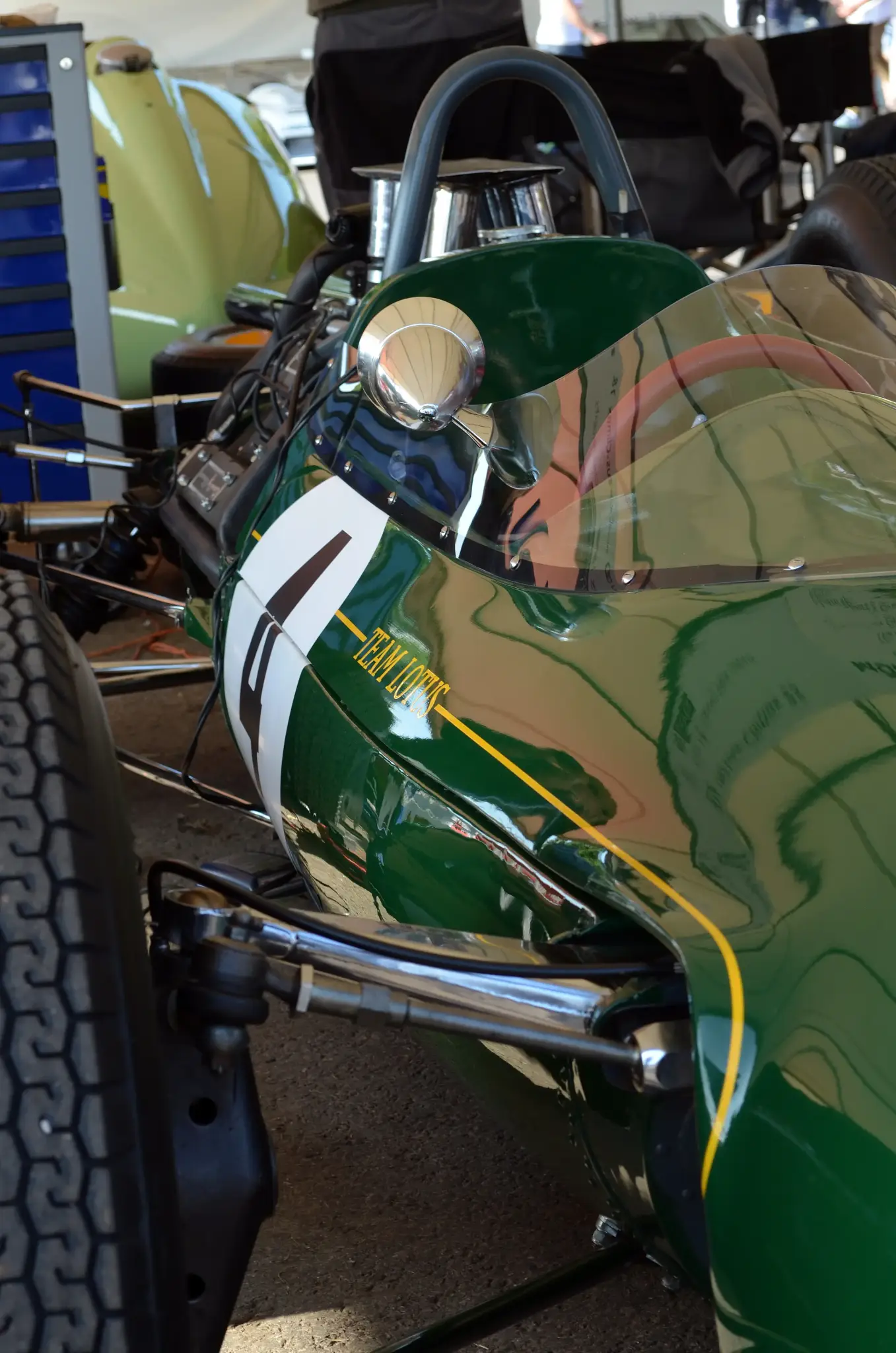
The monocoque made the car far more rigid and stronger than its rivals: three times as stiff as the interim Lotus 24 while weighing half as much. It was extremely low and narrow, with a frontal area of 0.74 square metres instead of the usual 0.88. The driver reclined sharply behind the wheel, which earned the car its “Bathtub” nickname, and the front coil and damper units were moved inboard. A column gear lever was tried to keep the cockpit narrow but was discarded. Power came from the Coventry Climax FWMV V8 in 1,496 to 1,499 cc form, in crossplane and flatplane versions; in 1964 Reg Parnell Racing fitted BRM P56 engines to its second-hand cars.
Jim Clark took the 25’s first World Championship win at Spa in 1962 and added wins in Britain and the United States, but an engine seizure while leading the final race in South Africa handed the title to Graham Hill. In 1963 Clark won seven races — Belgium, France, Holland, Britain, Italy, South Africa and Mexico — took his first championship and gave Lotus its first constructors’ title. A 25 was then taken to Indianapolis for evaluation, which encouraged Chapman to attack the 500.
The 25 won three more races in Clark’s hands in 1964, but at the final round in Mexico the Climax engine leaked oil with a lap to go and the title went to John Surtees. Seven cars were built, numbered R1 to R7; four were written off in accidents, three of them by Trevor Taylor. R4 was the most successful, winning all seven of Clark’s 1963 races, and it was later rebuilt as a Lotus 33 and unofficially called R13. The 25 remained in use well into 1965 and took its last win at that year’s French Grand Prix.
Design and features
- Stressed monocoque: the first in Formula One, three times stiffer than a spaceframe Lotus 24.
- Low frontal area: 0.74 m² thanks to a reclined driving position and inboard front springs.
- Climax FWMV V8: 1.5-litre engine in crossplane and flatplane forms.
- Seven cars: chassis R1 to R7, with R4 the most successful.
Lotus 25 versions
- Lotus 25 (1962–1965): the works car, Climax FWMV V8.
- BRM-engined cars: second-hand 25s run by Reg Parnell Racing from 1964.
- R13: the crashed R4 rebuilt around a Lotus 33 monocoque.
The 25 replaced the spaceframe Lotus 24 and was developed into the Lotus 33. Its ideas fed into the Lotus 49 and the Lotus collection.
Sources
- Lotus 25, English Wikipedia: design, engines, racing history, chassis numbers