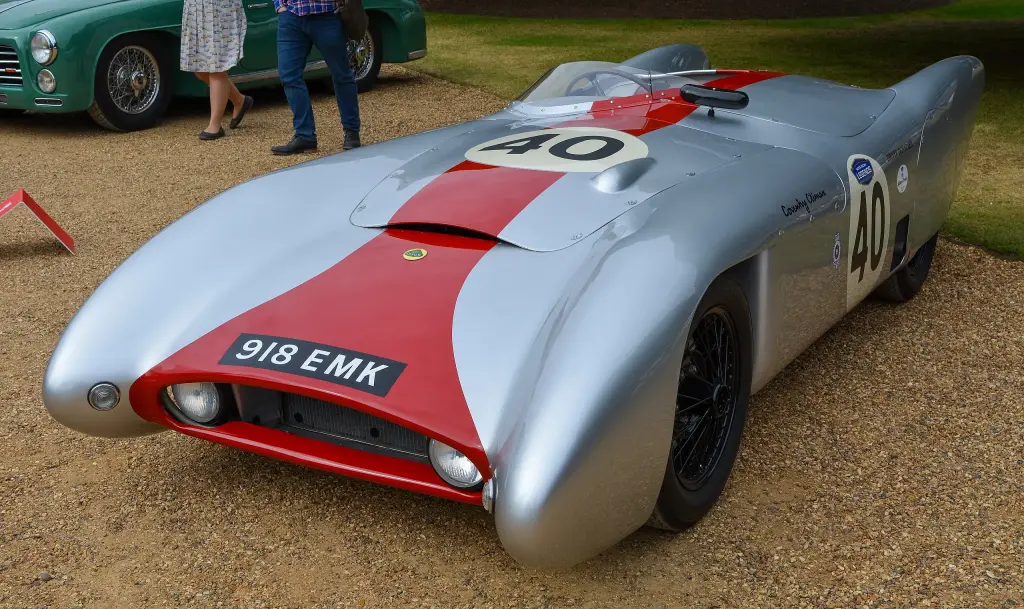
The Lotus Mark VIII was Colin Chapman’s first fully enclosed aerodynamic design. Chapman wanted a car of 1,100 lb with an 85 bhp engine and a top speed of 125 mph, and work began in late 1953 with the aerodynamicist Frank Costin helping to shape the body.
Lotus Mark VIII at a glance
| Built | 1954 |
|---|---|
| Designers | Colin Chapman, body by Frank Costin |
| Target | 1,100 lb, 85 bhp, 125 mph |
| Chassis | first true space frame, 35 lb |
| Frame | 19 members, fully triangulated |
| Suspension | divided front axle, De Dion rear with inboard brakes |
| Engine | modified MG 1,500 cc |
| Body | fully enclosed aluminium, stressed undertray |
| Built | about 7 |
| Relation | predecessor of the Mark IX and Eleven |
Based on one source (English Wikipedia).
History of the Lotus Mark VIII
The Mark VIII’s spaceframe has been described as “the most nearly perfect sports car chassis”. It was Lotus’s first true space frame and relied on the aircraft experience of Peter Ross and Gilbert McIntosh. Extremely light — the frame alone weighed only 35 lb — and very stiff, it consisted of just nineteen members, fully triangulated. In practice the frame had maintenance limitations: to install the engine it had to be disassembled and reassembled inside the framework.
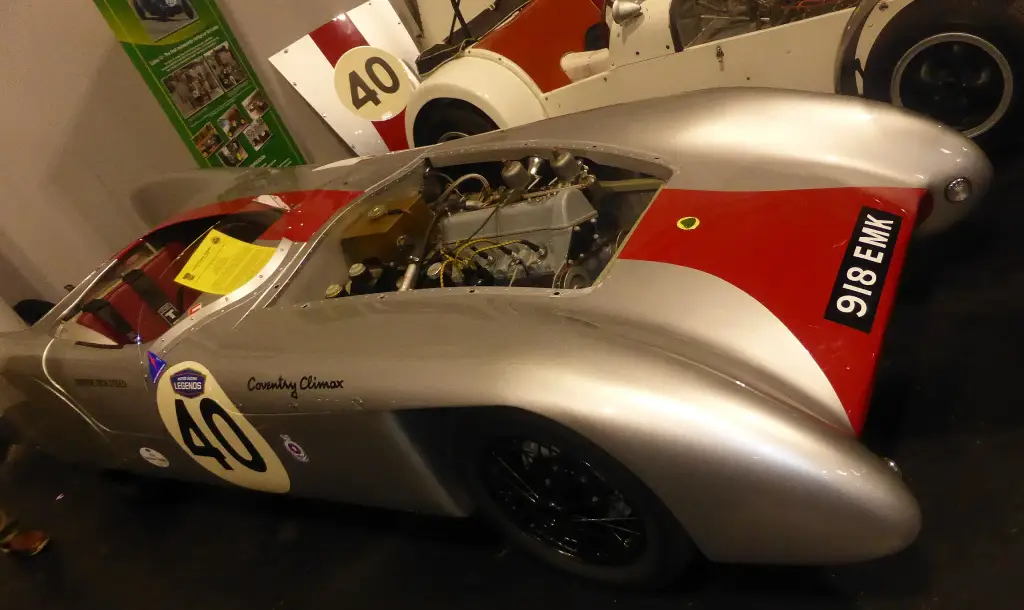
The space frame kept the divided front axle independent suspension Chapman had used on his earlier cars and used a De Dion layout with inboard brakes at the rear. A modified MG 1,500 cc engine and transmission were installed, and a stressed undertray further stiffened the chassis.
In its first race at Oulton Park, Chapman set the fastest lap of the day in the prototype P3 but retired with a blown head gasket. At the next race at Silverstone he won the 1,500 cc class outright. At the RAC British Grand Prix meeting at Silverstone on 17 July 1954 the reputation of Lotus cars was made when Chapman in the Mark VIII and Peter Gammon in the Mark VI beat the works quad-cam Porsche driven by Hans Herrmann and again won the class.
The Mark VIII was a precursor to the later aerodynamic Lotus cars, and it led to the closely related Mark IX and, through a separate Mark X with a 2.0-litre Bristol engine, to the Eleven. Of the Mark VIII only about seven were made, while the Mark X, essentially identical but with the larger Bristol engine, accounted for another six or seven. The Mark VIII, Mark IX and Mark X were transitional forms, but they represent the first fully bodied aerodynamic Lotus sports cars, with a De Dion tube locating the rear axle and inboard rear brakes. The Eleven, of which 270 were built between 1956 and 1958, was their direct descendant, and the earlier cars are now rare and highly valued.
Design and features
- First true space frame: nineteen members, fully triangulated, only 35 lb.
- Costin body: the first fully enclosed aerodynamic Lotus shape.
- De Dion rear: inboard brakes and a tube locating the axle.
- Stressed undertray: extra stiffness from a stressed floor panel.
- Giant killer: beat the works quad-cam Porsche at Silverstone in 1954.
Lotus Mark VIII versions
- Mark VIII (1954): about seven cars with MG power.
- Mark X: essentially identical, with a 2.0-litre Bristol engine, six or seven made.
The Mark VIII led to the Lotus Mark IX and then the Lotus Eleven. More cars are in the Lotus collection.
Sources
- Lotus Mark VIII, English Wikipedia: design, chassis, racing record, Mark X