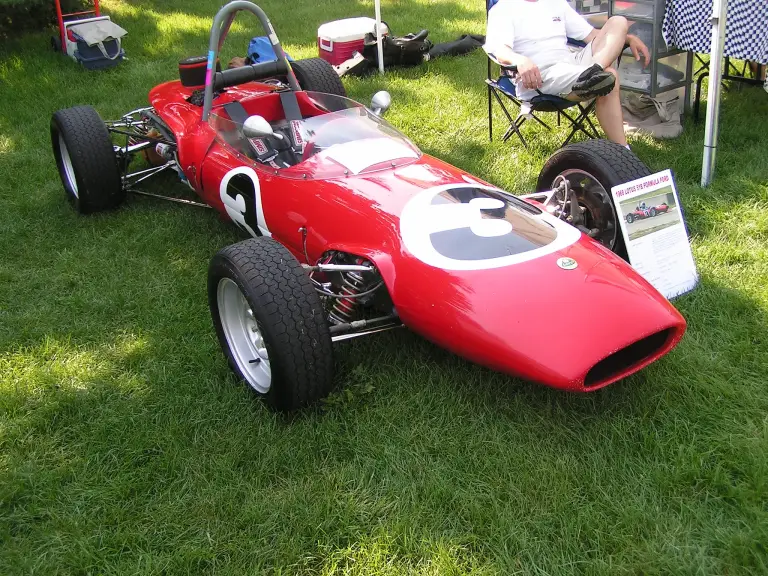
The Lotus 27 was a Formula Junior version of the Lotus 25 Formula One car, built for the 1963 Formula Junior season. Its body was an aluminium monocoque with steel bulkheads.
Lotus 27 at a glance
| Season | 1963 Formula Junior |
|---|---|
| Based on | Lotus 25 |
| Chassis | aluminium monocoque with steel bulkheads |
| Early body | fibreglass sides, replaced with aluminium |
| Team | Team Lotus, run by Ron Harris |
| Notable driver | Peter Arundell |
| Success | 1963 British Formula Junior championship |
Based on one source (English Wikipedia); the English article is short, so this page is shorter than usual.
History of the Lotus 27
The 27 brought the ideas of the Lotus 25 into Formula Junior. The body was an aluminium monocoque with steel bulkheads, and it was originally designed with fibreglass sides, which flexed and had to be replaced with aluminium.
The Team Lotus cars were run by Ron Harris, and Peter Arundell won the 1963 British championship once the initial flexing problems had been solved.
Design and features
- Monocoque construction: aluminium and steel in place of a spaceframe.
- Lotus 25 lineage: the Formula One car’s layout scaled to Formula Junior.
- All-aluminium body: fibreglass sides were abandoned after flexing problems.
Lotus 27 versions
- Lotus 27 (1963): the standard Formula Junior car.
The 27 was the Formula Junior counterpart of the Lotus 25, and it followed the earlier Lotus 20. More racing cars are in the Lotus collection.
Sources
- Lotus 27, English Wikipedia: construction, team, championship