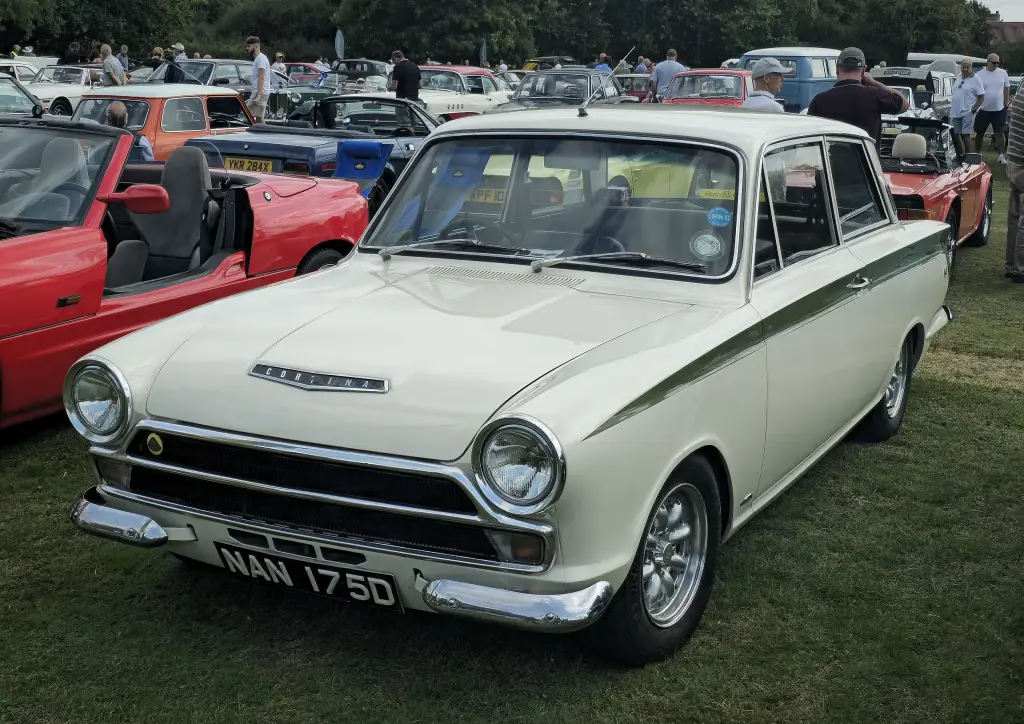
The Ford Cortina Lotus, commonly known as the Lotus Cortina, was a high-performance sports saloon produced in the United Kingdom from 1963 to 1970 by Ford in collaboration with Lotus. The original version was based on the Cortina Mark 1 and promoted by Ford as the “Consul Cortina developed by Lotus”; the Mark 2 was sold as the “Cortina Lotus”. Lotus gave it the type number Type 28.
Lotus Cortina at a glance
| Production | 1963–1970 |
|---|---|
| Makers | Ford and Lotus Cars |
| Lotus type | Type 28 |
| Engine | 1,557 cc Lotus-Ford twin-cam, 105 bhp |
| Gearbox | close-ratio, as in the Lotus Elan |
| Front brakes | 9.5 in (240 mm) Girling discs, with servo |
| Suspension | shorter front struts, coil springs and A-bracket at the rear |
| Body | alloy doors, bonnet and boot; white with green stripe |
| Mk1 built | 3,306 |
| Mk2 built | 4,093 |
Based on one source (English Wikipedia).
History of the Lotus Cortina
The story began in 1961, when Colin Chapman wanted Lotus to build its own engines because the Coventry Climax unit was so expensive. He commissioned Harry Mundy, a friend and the designer of the Coventry Climax engine, to design a twin-cam version of the Ford Kent engine on the 997 cc and 1,340 cc bottom end; when Ford released the five-bearing 1,498 cc 116E in 1962 the work centred on that block. Keith Duckworth of Cosworth played an important part in tuning it. The engine first appeared in 1962 at the Nürburgring in a Lotus 23 driven by Jim Clark. Almost as soon as it reached production in the Elan it was enlarged to 1,557 cc to bring the car closer to the 1.6-litre racing class.
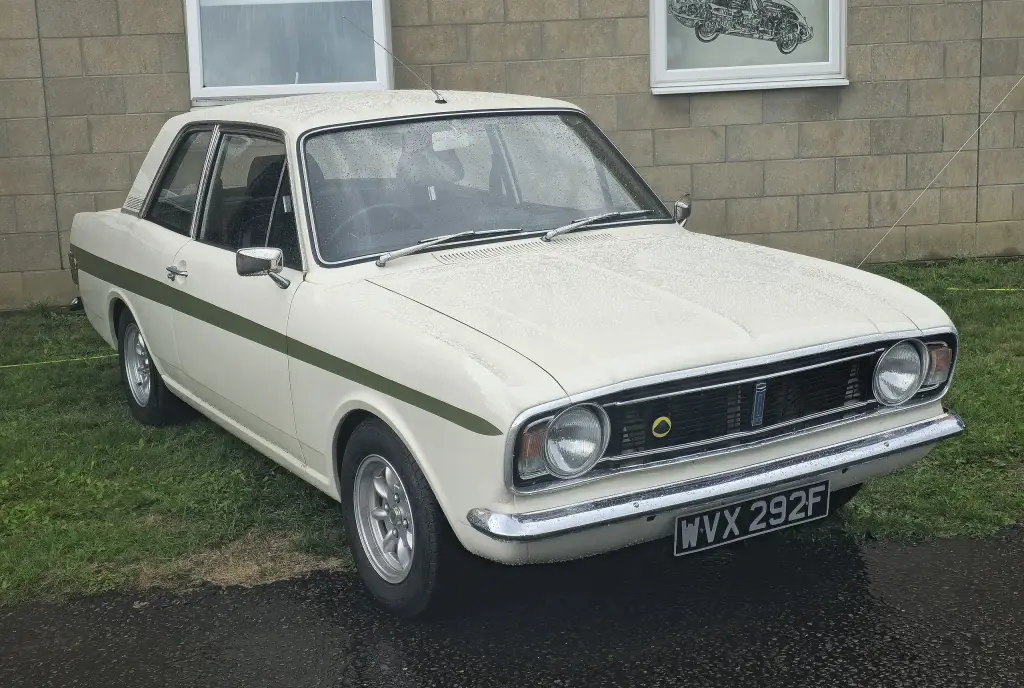
While the engine was being developed, Ford’s Walter Hayes asked Chapman to fit it to 1,000 Cortina saloons for Group 2 homologation. Ford supplied two-door bodyshells and handled marketing and sales while Lotus did the mechanical and cosmetic work. The main changes were the 1,557 cc engine of 105 bhp, the Elan’s close-ratio gearbox, shorter front struts, forged track control arms, 13-inch steel wheels and a rear end in which coil spring/dampers and an A-bracket replaced the leaf springs. Stiffening braces behind the rear seat and in the boot meant the spare wheel was bolted to the boot floor and the battery moved behind the right wheelarch, improving weight distribution. Girling front discs with a servo, lightweight alloy panels for doors, bonnet and boot, lightweight gearbox and differential casings, front quarter bumpers and round Lotus badges completed the package.
Factory cars were painted white with a green stripe, though Ford built some racers in red and one customer chose a dark blue stripe out of superstition. Early cars were popular and earned rave reviews — one magazine called it a tin-top version of the Lotus 7 — but the launch was not perfect. Some engines were down on power, the gear ratios were too close and, worst of all, the differential housing could come away from the casing, partly because the A-bracket made the axle part of the rear suspension and any oil leak reached its bushes. Four main updates during Mark 1 production fixed these problems, including a two-piece propshaft, a standard Ford transmission casing and Cortina GT gear ratios.
Engines were first built by J. A. Prestwich of Tottenham and then Villiers of Wolverhampton; in 1966, after Lotus moved to Hethel, the company had its own engine facilities. The Cortina Lotus used an 8.0 in diaphragm-spring clutch where Ford fitted coil-spring clutches elsewhere, and the ultra-close ratios that suited racing made the clutch work hard in traffic, so the ratios were later changed. Inside there was a centre console for the new gear lever, different seats, a later dashboard with tachometer, speedometer, oil pressure, water temperature and fuel gauges, and a wood-rimmed steering wheel. A total of 3,306 Mark 1 and 4,093 Mark 2 Lotus Cortinas were built.
Design and features
- Twin-cam engine: the Lotus-Ford 1,557 cc unit tuned with help from Cosworth.
- Elan gearbox: close ratios that suited the track but strained the clutch in traffic.
- Lightweight panels: alloy doors, bonnet and boot.
- Revised rear suspension: coil springs and an A-bracket in place of leaf springs.
- White with a green stripe: the standard works livery.
Lotus Cortina versions
- Lotus Cortina Mk1 (1963–1966): based on the Cortina Mark 1, 3,306 built.
- Lotus Cortina Mk2 (1967–1970): based on the Cortina Mark II, sold as the Cortina Lotus, 4,093 built.
The Cortina used the twin-cam engine developed for the Lotus Elan, and its engine first ran in a Lotus 23. More cars are in the Lotus collection.
Sources
- Lotus Cortina, English Wikipedia: engine, conversion, production, problems