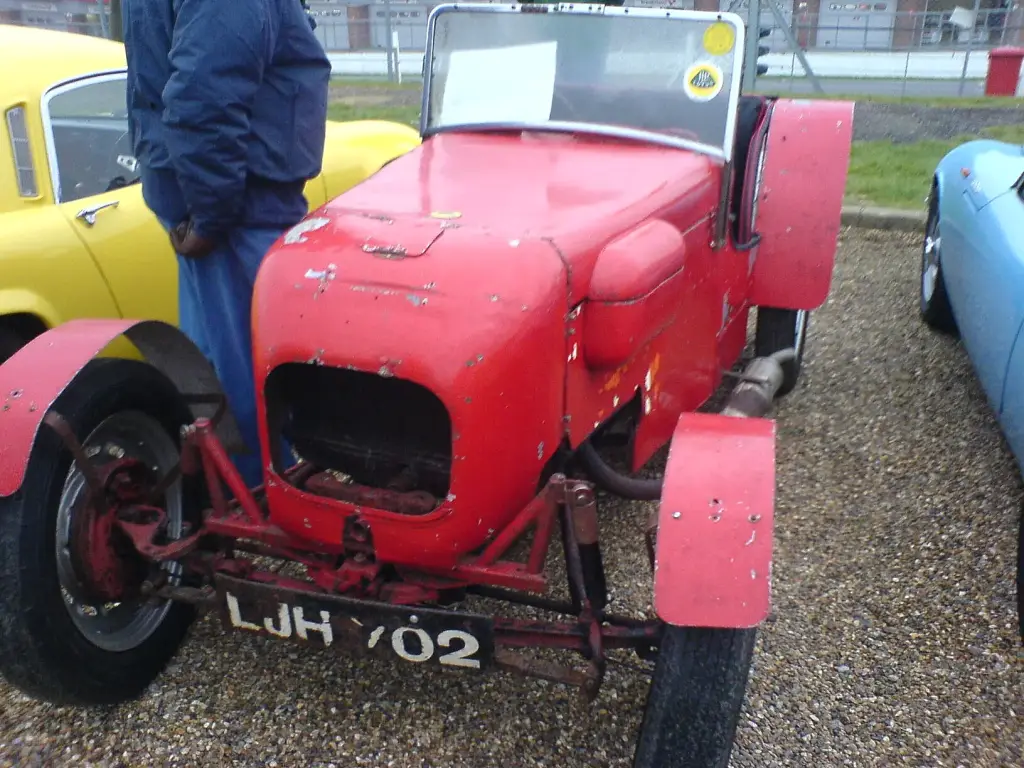
The car that came to be known as the Lotus Mark II was created in 1949, while Colin Chapman was serving in the RAF. For his second car he built on what he had learned from the Mark I, again starting from the cheap and widely available Austin 7 chassis.
Lotus Mark II at a glance
| Built | 1949 |
|---|---|
| Designer | Colin Chapman |
| Base | Austin 7 chassis |
| Chassis changes | boxed rails, tubular cross members |
| Engine | 1,172 cc Ford sidevalve four |
| Engine details | 63.5 mm bore, 92.456 mm stroke |
| Rear axle | Austin 7 |
| Body | cigar-shaped, rounded nose, cycle mudguards |
| Use | trials and circuit racing |
Based on one source (English Wikipedia); the English article is short and no free photo of the car is available, so this page is shorter than usual.
History of the Lotus Mark II
Chapman boxed in the chassis rails and replaced the cross members with stronger tubular braces. He swapped the Austin engine for a Ford unit and transmission, first from a Ford 8 and then a Ford 10, while keeping the Austin 7 rear axle. To use wider tyres he adapted Ford pressed-steel wheels, and he modified the engine as far as the club rules allowed.
That chassis and running gear carried a cigar-shaped body with a rounded nose and rudimentary cycle-type mudguards. The result was a very competitive trials car that was also suitable for circuit racing. Chapman competed in events sponsored by the 750 Motor Club, and although he built the car for English trials he also entered track events such as Silverstone, where he won his class. From then on he concentrated on designing cars for race circuits rather than trials.
Design and features
- Stronger Austin chassis: boxed rails and tubular cross members.
- Ford sidevalve engine: 1,172 cc, tuned within club rules.
- Cigar body: rounded nose and cycle mudguards.
- Dual purpose: competitive in trials and on the circuit.
- Turning point: the car that moved Chapman towards circuit racing.
Lotus Mark II versions
- Lotus Mark II (1949): the single car.
The Mark II followed the Lotus Mark I and led to the first production Lotus, the Mark VI. More cars are in the Lotus collection.
Sources
- Lotus Mark II, English Wikipedia: chassis, engine, body, competition