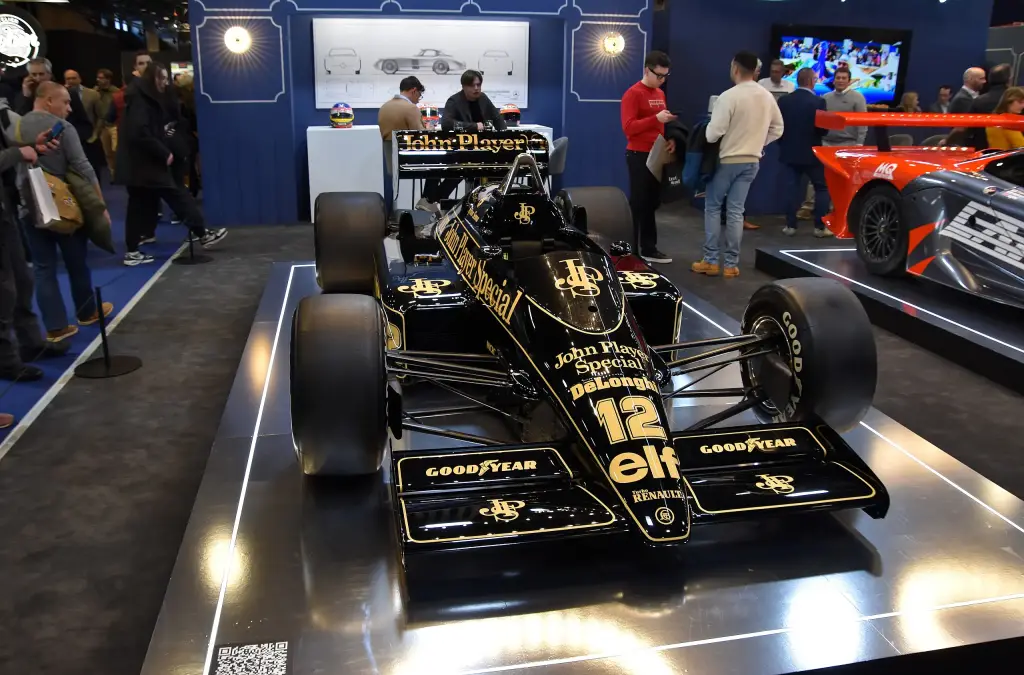
The Lotus 98T was designed by Gérard Ducarouge and Martin Ogilvie and built by Team Lotus for the 1986 Formula One World Championship. A development of the 97T, it was driven by Ayrton Senna in his second year with the team and by the Scottish newcomer Johnny Dumfries.
Lotus 98T at a glance
| Season | 1986 Formula One |
|---|---|
| Designers | Gérard Ducarouge, Martin Ogilvie |
| Engine | Renault EF15B 1.5-litre turbo V6 |
| Fuel capacity | 195 litres, reduced by regulation |
| Qualifying power | claimed over 1,000 bhp at unrestricted boost |
| Race power | about 900 bhp |
| Gearbox | Hewland internals in a Lotus casing, five or six speeds |
| Drivers | Ayrton Senna, Johnny Dumfries |
| Innovations | two-stage ride height, water injection, fuel microcomputer |
| Last of | black and gold John Player colours; Renault engines |
Based on one source (English Wikipedia).
History of the Lotus 98T
The 98T’s monocoque was lower than the 97T’s because a regulation change cut fuel capacity to 195 litres. Power came from the new Renault EF15B turbo V6 through a six-speed manual Hewland transmission, with Hewland internals in a Lotus-designed casing. The engine appeared in two forms: the standard unit and a “D.P.” version with pneumatic valve springs for the first time. At the end of the season Renault introduced the revised EF15C, which added common-rail fuel injection and revised water cooling through the cylinder head to reduce pre-ignition.
Power figures from that period are largely speculative, since most manufacturers admitted their test beds could not measure the output of a 1.5-litre turbo above 4 bar of boost. The EF15B is claimed to have produced in excess of 1,000 bhp at unrestricted boost, making it one of the most powerful engines in Formula One history — but only in qualifying, where those engines lasted a couple of clean laps. Race engines produced around 900 bhp, about the most the unit could stand over a distance. The 98T was the last Lotus powered by Renault, as the team switched to Honda for 1987.
The gearbox came in two variants: a conventional five-speed and a new six-speed. The six-speed was a development unit and largely unreliable; Senna chose to run only the five-speed while Dumfries was given the six-speed to test. Other notable features were a two-stage ride-height adjustment, water injection through the intercoolers, an early form of bargeboard also seen on the 97T, and an advanced fuel-consumption microcomputer.
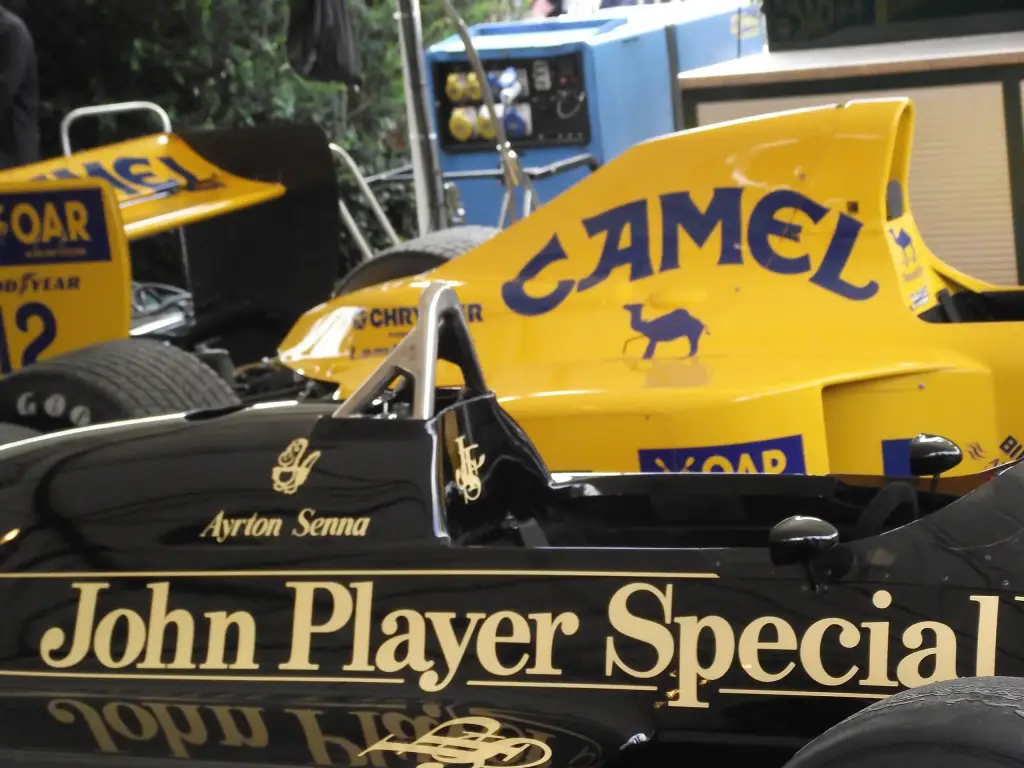
At the end of 1985 Elio de Angelis left for Brabham and Lotus intended to sign Derek Warwick, but Senna did not believe the team could sustain two number-one drivers and pressed for his fellow countryman Maurício Gugelmin as number two. The team conceded the first point but signed Johnny Dumfries rather than Gugelmin, reportedly because the long-time sponsor John Player wanted a British driver. Warwick went to Brabham and eventually joined Lotus in 1990, while Gugelmin did not reach Formula One until 1988 with March. The 98T was the last Lotus to carry John Player’s black and gold colours: with Renault leaving Formula One at the end of 1986, Lotus did a deal for Honda engines and signed Honda’s test driver Satoru Nakajima as Senna’s team-mate for 1987, after which John Player pulled its sponsorship and Camel took over.
Design and features
- Renault EF15B: claimed at over 1,000 bhp in qualifying and about 900 bhp for races.
- Lower monocoque: a response to the 195-litre fuel limit.
- Two gearboxes: a reliable five-speed for Senna and a troublesome six-speed for Dumfries.
- Fuel microcomputer: advanced for its time, along with water injection and two-stage ride height.
- Last of a line: the final black and gold Lotus and the final Renault-powered one.
Lotus 98T versions
- Lotus 98T (1986): five-speed and six-speed gearbox versions.
The 98T followed the Lotus 97T and was replaced by the Honda-powered Lotus 99T. More cars are in the Lotus collection.
Sources
- Lotus 98T, English Wikipedia: design, engine, gearboxes, driver situation