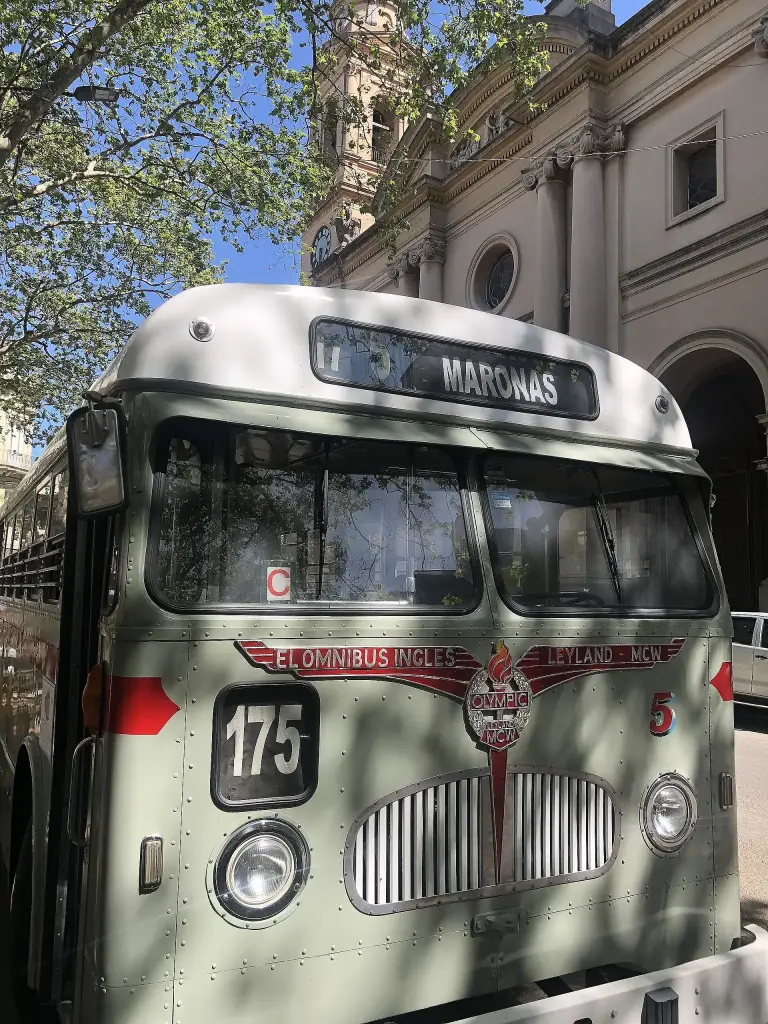
The Leyland-MCW Olympic was an underfloor-engined single-deck bus manufactured for at least eighteen countries from 1949 to 1971. A total of 3,564 were built at four factories, three in Britain and one in South Africa, and it proved a durable heavy-duty bus for arduous conditions.
Leyland Olympic at a glance
| Makers | Leyland Motors and Metro-Cammell-Weymann |
|---|---|
| Type | underfloor-engined single-decker |
| Production | 1949–1971 |
| Total built | 3,564 |
| Factories | three in Britain, one in South Africa |
| Right-hand drive | 1,299, or 36 per cent |
| Left-hand drive | 2,265, or 64 per cent |
| Engine | O.600H horizontal diesel, later O.680H |
| Gearbox | Pneumocyclic from the second series |
| Construction | integral, body permanently attached to the underframe |
| Series | three, from 1949 |
| Series Two | 1956, with Worldmaster units |
Based on one source, the English Wikipedia article on the Leyland-MCW Olympic.
History of the Leyland Olympic
Origins
In 1948 the first post-war Olympic Games were held in London, and Leyland Motors was working on a horizontal version of its recently announced O.600 9.8-litre diesel. Leyland was not new to the idea: the pre-war 8.6-litre engine had been used horizontally in the London Transport TF-class Tiger FEC single-deckers and the sole Leyland Panda, although such designs had been set aside for the war effort. The O.600H was first sold to the Scandinavian bus makers Scania-Vabis of Sweden and Strømmen of Norway, and by showing it at the 1948 Commercial Motor Show at Earls Court Leyland made clear that it would soon be available at home.
In 1948 Leyland and the MCW sales organisation concluded a twenty-year agreement to collaborate exclusively on integral designs and to favour one another with body-on-chassis business. Their idea was an underframe of durable Leyland engines and mechanical units permanently attached to a similarly heavy-duty body structure. This became the Leyland-MCW Olympic, built over three series from 1949.
The integral body
The body frame was made of welded steel tube longitudinals, uprights and diagonals to the waistrail, with heavy-duty stress panels and aluminium upper frame sections riveted on. It was built to a joint design by Weymann or Metro-Cammell in England, or by the MCW group’s South African subsidiary Bus Bodies (South Africa) in Port Elizabeth. The body was permanently attached to a Leyland underframe and could not be driven without it. Leyland fitted the radiator, engine, axles, suspension, steering, gearbox, brakes and controls to the underframe; once the two were married up, the frame was clad in aircraft-grade aluminium and finished. The aim was one bus to three specifications, home market, right-hand-drive export and left-hand-drive export, stronger than any bus built before and a standard bus for all world markets.
Series One
The components of the Series One underframe, built at Leyland’s Farington works, were mainly as in the Tiger PS2 and Titan PD2, except that the radiator was a fabricated unit behind the front axle and below the passenger floor, and the rear axle was a new spiral-bevel unit. Bodies came from Weymann (W), Metropolitan-Cammell (M) or Bus Builders in South Africa (B). Metro-Cammell bus production was at Elmdon until 1969, when the parent Laird Group sold the factory and moved bus building back to the Washwood Heath A shop, where the Midland Carriage Works had built its first body in 1924; among the last vehicles built at Elmdon were two Metro Scania single-deck prototypes, and the final 115 Olympic EL3A/41 coaches for Cuba were built at Washwood Heath. After a relaxation of British dimensional rules in 1950 the HR models could be 30 ft long with the same wheelbase, coded HR44 for 44 seats, and widths up to the new 8 ft maximum produced designations such as HR44/90/S for the old width or EL44/96/S for 8 ft.
Series Two
Leyland announced the Royal Tiger Worldmaster in 1954 as the replacement for the Royal Tiger, and from about eighteen months later its units became standard in EL and ER Olympics. Around 1956 the Series Two Olympic was announced with Worldmaster units, in particular the O.680H diesel and the Pneumocyclic gearbox, and revised body styling. Designations were now EL2 or ER2, since home-market sales had been dropped in 1953. Lengths and wheelbases were quoted as Ex2/40 with an 18 ft wheelbase and 33 ft overall length, and Ex2/44 with a 20 ft wheelbase and 35 ft overall length.
Home market
Of the 92 home models built in the British Isles, two were exported, one each to Trinidad and New Zealand, and a further 31 home models were built by the South African subsidiary, which exported eleven of them to Rhodesia. Eight home Olympics went to the Isle of Man Road Services. Four Leyland-owned prototypes and demonstrators were built at Metro-Cammell’s Elmdon works in 1948 and 1949 and registered in 1950 and 1951 as KOC233-4 and 241-2, making up 4 per cent of production for the British Isles; the other 96 per cent were built by Weymann.
Design and features
- Underfloor engine: the horizontal O.600H, later O.680H, sat below the passenger floor.
- Integral construction: a heavy steel-tube body permanently attached to a Leyland underframe.
- World bus: built to home, right-hand-drive export and left-hand-drive export specifications.
- Long life: 3,564 buses over 22 years, many in arduous conditions.
Leyland Olympic versions
- HR series: the home-market models, including the HR44 with 44 seats.
- EL and ER series: left-hand-drive and right-hand-drive exports.
- Series Two EL2 and ER2: the 1956 models with Worldmaster units.
- EL3A/41 coach: the final coach version, 115 of them for Cuba.
The Olympic was an early underfloor Leyland single-decker; later ones include the Leyland National and the Leopard. More Leyland vehicles are in the Leyland collection.
Sources
- Leyland-MCW Olympic, English Wikipedia: origins, construction, series, production