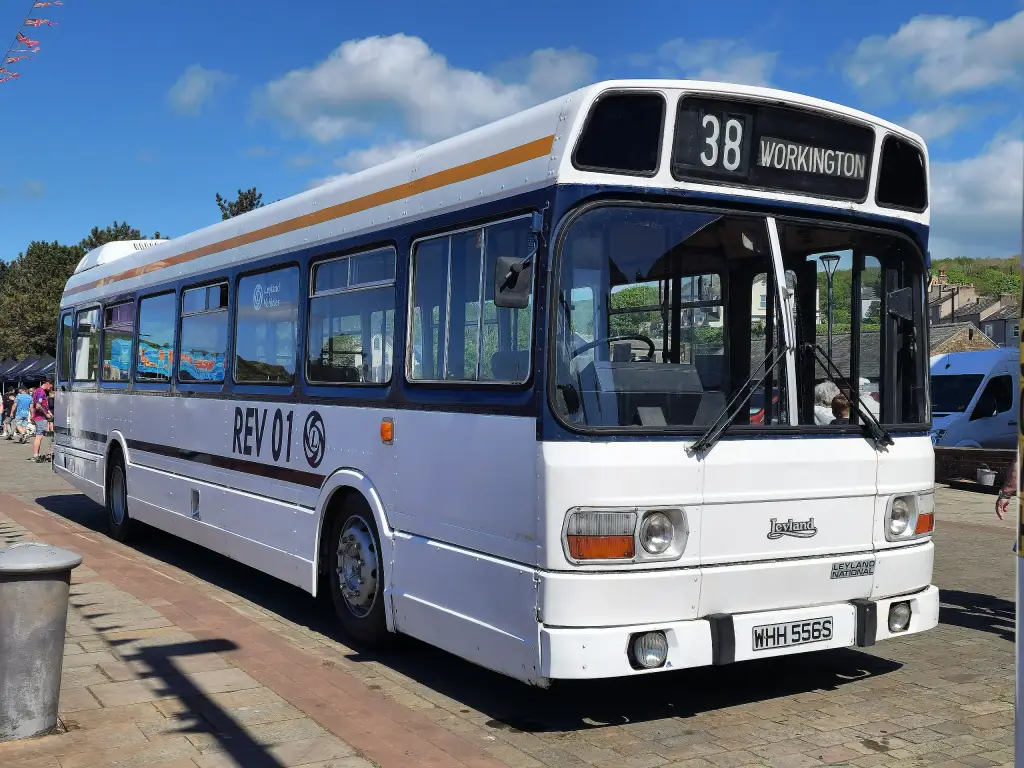
The Leyland National is an integrally constructed British step-floor single-decker bus manufactured in large quantities between 1972 and 1985. It was developed as a joint project between two nationalised industries, the National Bus Company and British Leyland, and built at a purpose-built factory at the Lillyhall Industrial Estate in Workington.
Leyland National at a glance
| Makers | British Leyland and the National Bus Company |
|---|---|
| Type | integral step-floor single-decker |
| Production | 1972–1985 |
| Built at | Workington, Cumbria |
| Styling | Giovanni Michelotti |
| Lengths | 10.3 m, 11.3 m and 10.9 m for Australia |
| Construction | integral, modular, Avdelok rivets |
| Engine | 8.3-litre Leyland 510 turbocharged diesel |
| Simplified model | 10351B/1R, 150 bhp |
| Series B | 1978, 10.3 m only |
| National 2 | 1979, O.680 then TL11, later Gardner |
| First delivery | March 1972, Cumberland Motor Services |
Based on one source, the English Wikipedia article on the National.
History of the Leyland National
A joint project
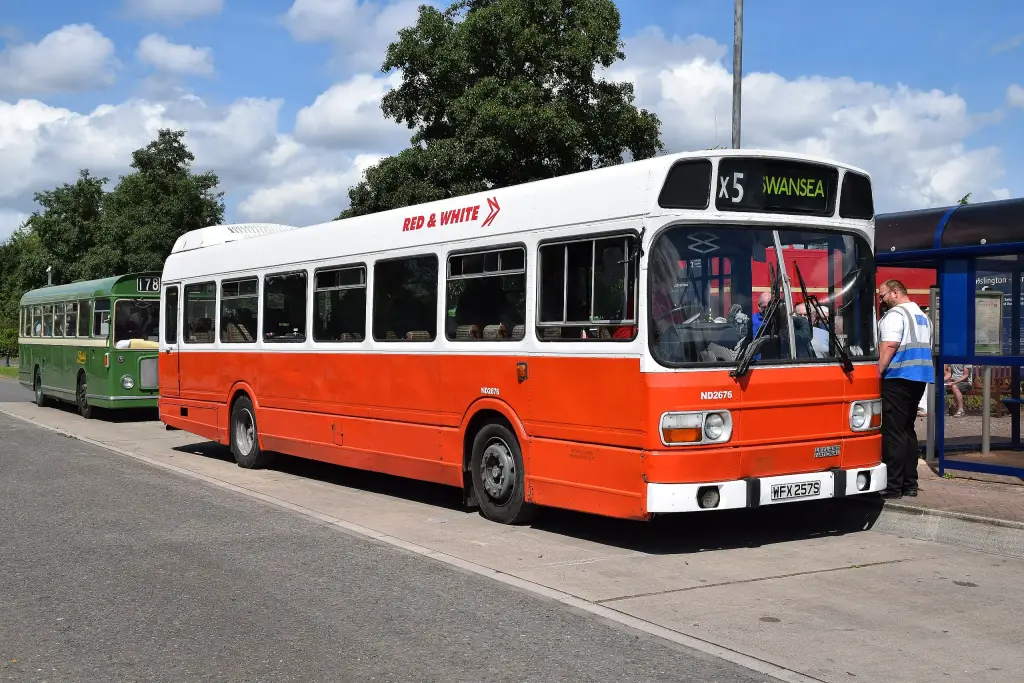
The National was developed by the National Bus Company and British Leyland and built at a specially built factory at Lillyhall in Workington. Styling was by the Italian designer Giovanni Michelotti, who had worked for Triumph and for Scammell. The bus was meant to replace all the rear-engined single-deckers offered by British Leyland, including the AEC Swift, Bristol RE, single-deck Daimler Fleetline, Daimler Roadliner and Leyland Panther.
Design
The National had integral, modular construction with a rear engine, and every component was designed to be easy to build and replace. Until 1978 it always had a roof-mounted pod at the rear for the heating equipment, which blew warm air out at roof level; at first the pod was almost the length of a bay, keeping dirt away from the heaters and giving the bus a transatlantic look. A shorter pod arrived in 1976, when the battery moved to the front under the cab. The bus came in three lengths: most were 10.3 m and 11.3 m, and the longer ones can be recognised because all their side windows are the same length, while the shorter ones have shorter windows except for one in the middle. The third length, 10.9 m, was made for Australian operators with strict axle weight limits and used the front of the long version with the rear of the short one; its prototype went to Rennies of Dunfermline as a dual-purpose express coach.
The design was simple, with every part replaceable. Some operators, including London Transport, bought dual-door models and later converted some to single-door, helped by the interchangeable parts and by the Avdelok rivets developed specially for the National instead of ordinary pop rivets, screws or welding. Leyland found that body repairs could be completed at least a tenth quicker than on buses with conventional welded panels. Early vehicles came in a limited number of standard colours such as dark red, light red and dark green, meant to match operators’ liveries while simplifying production; this just predated the National Bus Company’s decision to standardise on poppy red and leaf green, so several dark red buses went to Ribble and were repainted before service. London Transport insisted on adding London bus red to the colour card, and its fleet reached 506 examples, 69 of them National 2s for Red Arrow services, between 1973 and 1980.
Series B and National 2
In 1978 Leyland introduced the simplified Series B, meant to replace the Bristol LH of 1967, a type popular with National Bus Company companies on rural routes. It was available only at 10.3 m, had minimal interior lighting and dropped the rear roof pod; heating was under the seats, basic but effective. The lighter weight and lower cost brought extra sales, and London Country bought many, which other operators quickly took second-hand when London Country was broken up in 1986. The National 2 followed in 1979 with a wider choice of engines, a new nose moulding and grille to cool a front-mounted radiator, and a revised rear end with new lights and a different engine door.
Engines
The Mark I National had an 8.3-litre straight-six turbocharged Leyland 510 headless diesel. Its cylinder heads could not be detached, so any valve work required removing the crankshaft and pistons to reach the valves through the bores. The engine was not popular with all operators, being prone to poor fuel consumption and heavy smoke if not maintained to a high standard, and some operators looked for alternatives. A simplified model, the 10351B/1R, was offered with power cut to 150 bhp instead of the usual 180 bhp of the heavier-duty version. With the 510 dropped, the National 2 used first the O.680 and later the TL11. In 1981 a Gardner 6HLXB was experimentally fitted to an accident-damaged Eastern Counties bus, paving the way for many conversions; Gardner took Leyland to court for not offering its engine in the fast-selling National, and from 1982 the National 2 was offered with Gardner engines, first the 6HLXB and later the 6HLXCT. The first National was delivered in March 1972 to Cumberland Motor Services as ERM 35K.
Design and features
- Integral construction: a modular body with every part designed for easy replacement.
- Michelotti styling: the Italian designer gave the National its distinctive shape and rear roof pod.
- Three lengths: 10.3 m, 11.3 m and a 10.9 m Australian version.
- Avdelok rivets: special rivets made body repairs faster than welded panels.
- Leyland 510: an 8.3-litre headless diesel that was powerful but demanding to maintain.
Leyland National versions
- Mark I: the original integral bus with the rear roof pod.
- 10351B/1R: a simplified model with a 150 bhp engine.
- Series B: the 1978 lightweight 10.3 m version for rural routes.
- National 2: the 1979 model with new nose, O.680 or TL11 engines and later Gardner options.
The National was replaced by the Leyland Lynx, and it shared the Leyland range with the Olympian. More Leyland vehicles are in the Leyland collection.
Sources
- Leyland National, English Wikipedia: design, lengths, engines, Series B, National 2