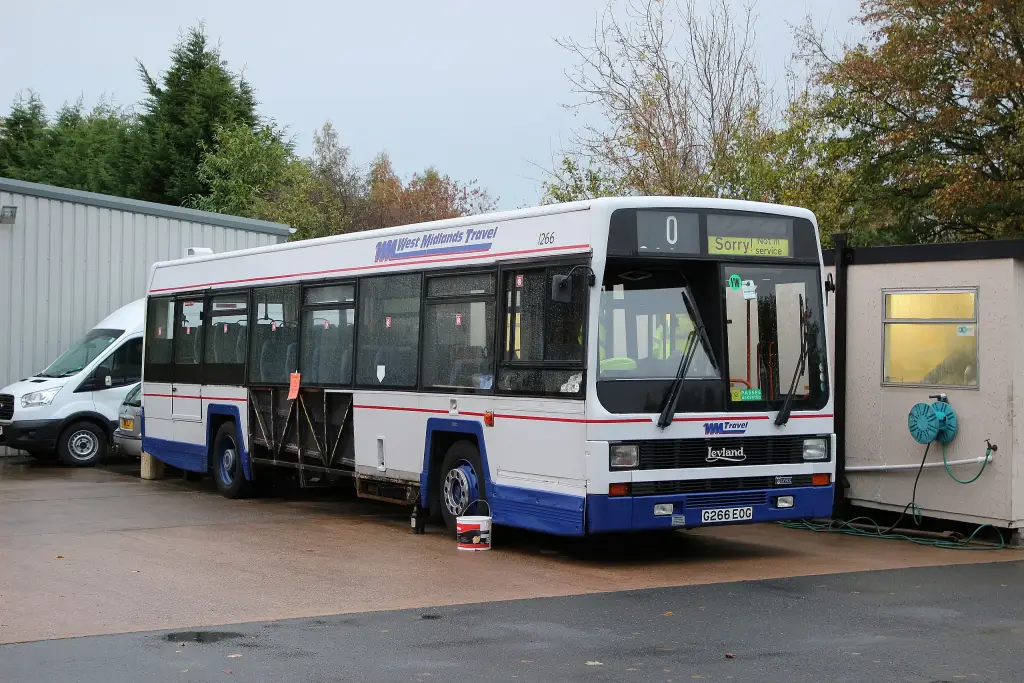
The Leyland Lynx is a step-entrance integral single-deck bus manufactured by Leyland Bus in Workington, England, between 1986 and 1992. Developed internally as the B60 to replace the Leyland National, it was the company’s last integral single-decker and was updated as the Lynx II in 1990.
Leyland Lynx at a glance
| Maker | Leyland Bus |
|---|---|
| Type | integral step-entrance single-deck bus |
| Project code | B60 |
| Chassis revealed | 1984 |
| Production | 1986–1992 |
| Built at | Workington, England |
| Length | 11.18 m (36.7 ft) |
| Floor height | 500 mm at the front, 900 mm at the rear |
| Suspension | air-sprung trailing arms on both axles |
| Gearbox | four-speed automatic Leyland Hydracyclic with retarder |
| Engines | Leyland TL11, Gardner 6HLXCT, Cummins L10 |
| Lynx II | 1990, with Volvo THD102KF or Cummins L10 and ZF Ecomat |
Based on one source, the English Wikipedia article on the Lynx.
History of the Leyland Lynx
The B60
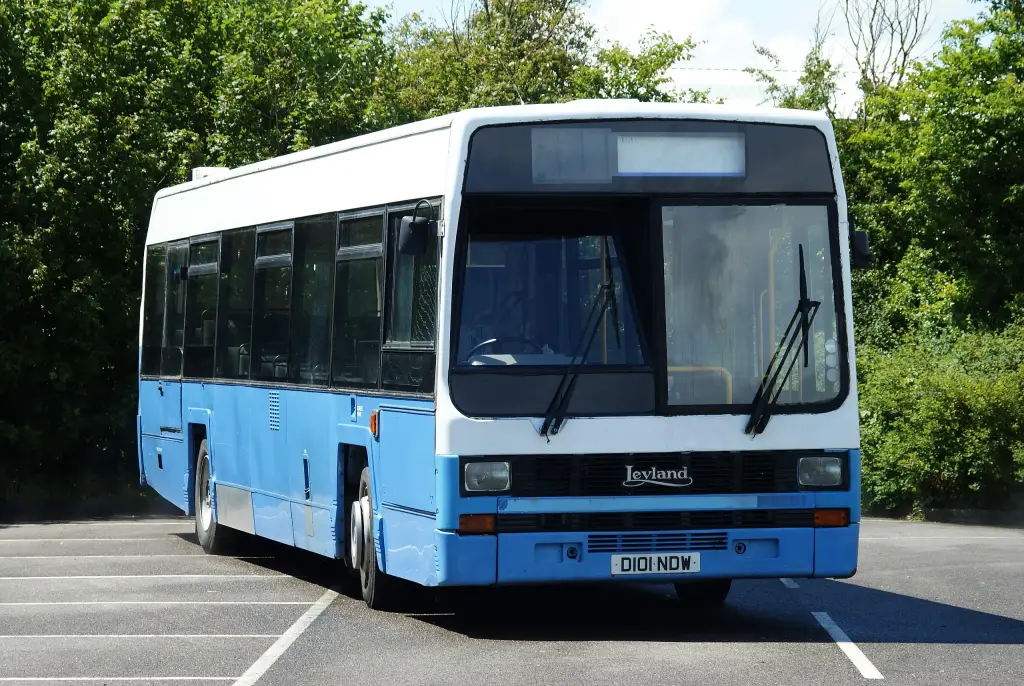
Leyland Bus revealed the Lynx chassis in 1984 as the B60, a replacement for the ageing Leyland National integral. For a short time the chassis was assembled alongside the National at the Workington factory until the National was discontinued in 1985. It was marketed first as an export product while the British market recovered from bus deregulation in 1986. The B60 had a welded steel underframe with a floor 500 mm above the ground at the front and 900 mm at the rear, air-sprung trailing-arm suspension on both axles and a four-speed automatic Leyland Hydracyclic gearbox with an integral retarder as standard. Engines were the Leyland TL11, the Gardner 6HLXCT and the Cummins L10.
Launch
A year later the Lynx was launched as a complete 11.18 m single-deck city bus with Leyland-built bodywork at the 1985 International Bus & Coach Exhibition at Earls Court. The body was largely squared off, drawing on feedback from operators of the National and other Leyland Bus products: it used bonded window glazing without curved glass and two separate windscreens, the driver’s one raked back to reduce glare. A single-piece flat windscreen was considered but not adopted. Inside there was a split-step entrance, with the option of a floor with a step in the middle or one that ramped gently from front to rear. The design allowed for double-decker and articulated versions, but none were built.
The Lynx name had been used before: British Leyland used it for a truck chassis between 1936 and 1940 and revived it for a new model between 1968 and 1979. Ashok Leyland later used it again for a midibus.
Lynx II, 1990
The updated Lynx II appeared in 1990 with a restyled front, a protruding grille panel and new headlights. After Volvo took over Leyland in March 1988, the Lynx II could be ordered with Volvo’s THD102KF or Cummins’ L10 engine, and it had a ZF Ecomat four-speed automatic as standard. Softer front air suspension with shock absorbers answered complaints about ride quality. The interior was built to the suggested specifications of the Disabled Persons Transport Advisory Committee, with a single 305 mm entrance step instead of the split step, a non-slip PVC floor and painted handrails; the rearmost seats became one bench, the walls had textured laminate, the rear platforms were raised by 80 mm to remove a further step and soundproofing was improved.
As with the earlier Lynx, the Lynx II was also sold as an underframe for other coachbuilders. Most carried Leyland bodies, but seven chassis were bodied by Walter Alexander (Belfast) with N-Type bodywork for Citybus of Belfast, including the first prototype. Northern Counties catalogued bodies for the Lynx, though none were built. The Lynx was discontinued when Volvo closed the Workington factory in 1992; the last two entered service with Halton Transport in August 1992, and Volvo replaced the model with a UK version of the B10B.
Operators
The largest British operator was West Midlands Travel, whose order for 250 Lynxes for delivery in 1989 and 1990 was the country’s largest single-deck bus order since 1977. Of the 155 delivered up to early 1990, all were returned to Leyland Bus to fix fuel supply, radiator and windscreen problems, and the remaining 95 were modified before delivery. Six Gardner-engined demonstrators with semi-automatic Hydracyclic gearboxes went to the West Midlands Passenger Transport Executive in early 1986. Caldaire Group companies West Riding and Yorkshire Woollen bought 129 Lynxes and Lynx IIs new or second-hand up to late 1991, and Badgerline bought 130, including 62 for Bristol City Line, 50 for Midland Red West, eleven for PMT and seven for Badgerline itself. London Regional Transport took six for London United on route 283 in 1989, and Lothian Regional Transport had the only dual-door Lynxes.
Design and features
- Integral construction: a welded steel underframe with the body built in, developed from the National.
- Squared Leyland body: bonded glazing, two windscreens and a raked driver’s screen to cut glare.
- Flexible floor: a split-step entrance, with a stepped or gently ramped floor offered.
- Hydracyclic gearbox: a four-speed automatic with integral retarder as standard.
Leyland Lynx versions
- B60: the 1984 chassis, sold first for export.
- Lynx: the 1985 integral bus with Leyland bodywork.
- Lynx II: the 1990 update with a restyled front, new engines and a DIPTAC-friendly interior.
- Alexander N-Type chassis: seven chassis bodied in Belfast for Citybus.
The Lynx replaced the Leyland National and was one of the last Leyland buses, alongside the Leyland Olympian. More Leyland vehicles are in the Leyland collection.
Sources
- Leyland Lynx, English Wikipedia: design, engines, Lynx II, operators