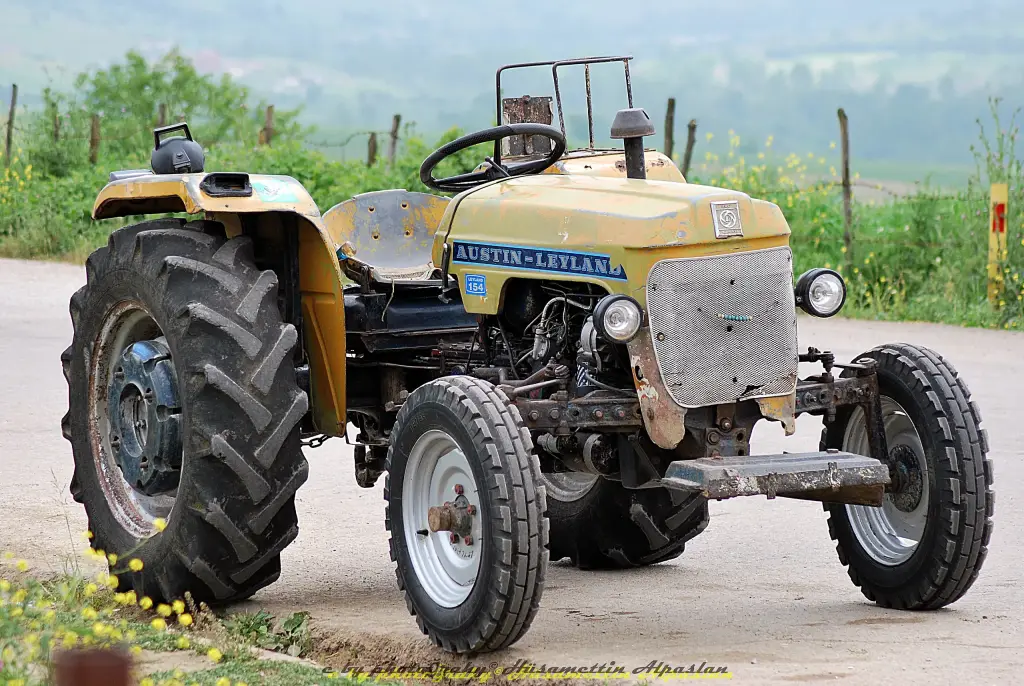
The Leyland 154 was one of the models in the Leyland tractor range, created when the British Motor Corporation merged with Leyland Motors to form British Leyland in 1968. The tractors replaced the Nuffield line, were built at Bathgate in Scotland and stayed in production until 1982.
Leyland 154 at a glance
| Maker | Leyland Tractors, British Leyland |
|---|---|
| Model | 154, one of the models in the Leyland tractor range |
| Created | 1968, after the BMC and Leyland Motors merger |
| Predecessor | Nuffield tractors |
| Production site | Bathgate, Scotland |
| Colour | two-tone blue instead of Nuffield poppy red |
| Cab | Leyland’s own design, to meet safety regulations |
| Engines | 98-series 4/98 and 6/98 in the range |
| Gearbox | nine-speed 3×3 synchro with flat cab floor |
| Range sold | 1982, to Marshall Tractors Ltd |
| New home | Gainsborough, Lincolnshire |
The 154 is listed only in the English Wikipedia article on Leyland Tractors; this page is based on that single source.
History of the Leyland 154
From Nuffield to Leyland
Leyland Tractors was created after the British Motor Corporation merged with Leyland Motors to form British Leyland in 1968. Nuffield Tractors had been started after the Second World War by Lord Nuffield, the owner of Morris Motors, which had become part of BMC in 1951. After the merger Leyland moved tractor production to Bathgate in Scotland and changed the colour from Nuffield’s poppy red to two-tone blue.
The 154 in the range
The 154 was one of the models in the new Leyland range, alongside the 184, 245, 253, 255, 262, 270, 272, 282, 285, 2100, 344, 384, 462, 472, 482 and 485. At first the skid units were carried over from Nuffield, including the 3.4-litre and 3.8-litre engines and a ten-speed gearbox with high and low range. Leyland changed the bodywork and introduced its own cab to comply with safety regulations. Later the engines were replaced by the 98-series 4/98 and 6/98, named after their number of cylinders and bore, and the ten-speed gearbox gave way to a nine-speed 3×3 synchro unit with a flat cab floor.
The end of the range
In 1982 British Leyland sold Leyland Tractors to Marshall Tractors Ltd and production moved to Gainsborough in Lincolnshire. The 154 belongs to the Bathgate years, when Leyland was building its own range of blue tractors in Scotland.
Design and features
- Two-tone blue livery: Leyland replaced Nuffield’s poppy red with its own colour scheme, which lasted into the early 1980s.
- Leyland cab: a new cab was introduced to comply with safety regulations, replacing the Nuffield bodywork.
- 98-series engines: the 4/98 and 6/98 were named after their number of cylinders and bore diameter.
- Flat-floor cab: the nine-speed 3×3 synchro gearbox was matched to a cab with a flat floor.
Leyland 154 versions
- Early Bathgate tractors: Nuffield-derived 3.4-litre and 3.8-litre engines with a ten-speed high/low gearbox.
- Later tractors: 98-series engines and a nine-speed 3×3 synchro gearbox.
- Harvest gold models: the later 302, 602, 604, 702, 704, 802, 804 and 904XL were finished in a different colour.
The 154 belonged to the same range as the Leyland 262. More Leyland vehicles are in the Leyland collection.
Sources
- Leyland Tractors, English Wikipedia: range, engines, colour, Bathgate, sale to Marshall