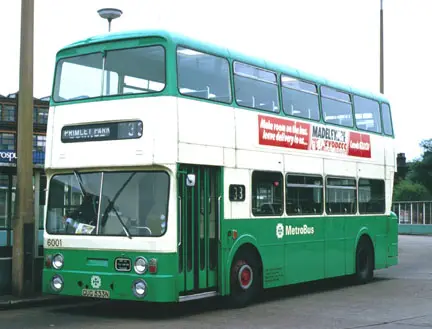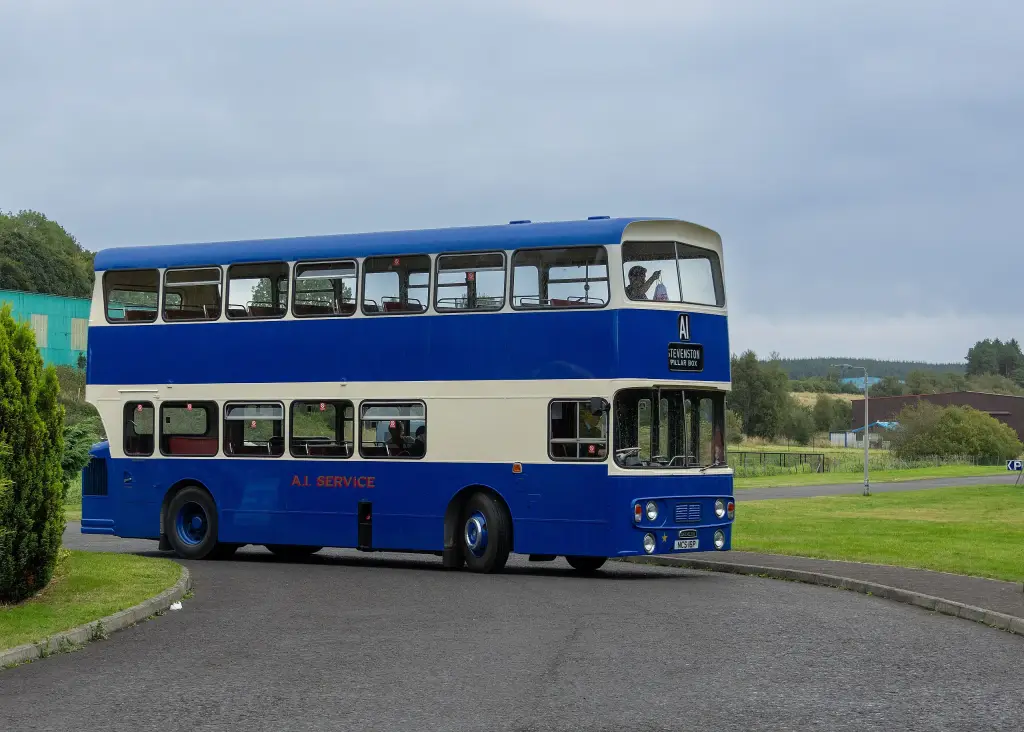
The Daimler Fleetline, known as the Leyland Fleetline from about 1975, is a rear-engined double-decker bus chassis built between 1960 and 1983. It was the second British rear-engined double-decker after the Leyland Atlantean, and it became one of the most numerous buses of its kind in London.
Leyland Fleetline at a glance
| Maker | Daimler, later Leyland |
|---|---|
| Name | Daimler Fleetline, Leyland Fleetline from about 1975 |
| Type | rear-engined double-decker chassis |
| Production | 1960–1983 |
| Prototype | unveiled December 1960 |
| Built at | Coventry until 1973, then Farington |
| Engines | Gardner 6LX or 6LW; Gardner 6LXB from 1968; Leyland O.680 from 1970 |
| Rear axle | drop-centre, standard from the start |
| Lengths | 30 ft standard, 33 ft and 36 ft available |
| London Transport | 2,646 bought between 1970 and 1978 |
| London first service | 2 January 1971, routes 95 and 220 |
| B20 version | Leyland O.690, for London Transport |
Based on one source, the English Wikipedia article on the Daimler Fleetline.
History of the Leyland Fleetline
Design
The Fleetline was the second rear-engined double-decker chassis launched by a British maker, after Leyland’s Atlantean of 1958. From the outset it had a drop-centre rear axle as standard, which allowed low-height bodywork without the awkward upper-deck seating of the early Atlanteans. Leyland responded by offering the axle as an option on the Atlantean, but after the two companies came under the same ownership in 1968 the low-height Atlantean option was dropped.
The prototype had a Daimler engine, but production models used Gardner 6LX or 6LW engines. From 1968 the more powerful Gardner 6LXB was available, and in 1970 Leyland’s O.680 joined the list. Gardner engines were valued for reliability and economy, Leyland engines for liveliness at the cost of fuel, and most customers preferred Gardner, though the Leyland became popular in the 1970s when Gardner could not meet demand.
In the late 1960s Daimler developed a 36 ft double-deck Fleetline with a longitudinally mounted Cummins V6 at the rear offside corner. It was intended mainly for export, but one was built for Walsall Corporation Transport. In the mid-1970s Leyland developed a special version called the B20, with a Leyland O.690 engine, air cowls above the engine compartment on both sides and lower noise; all went to London Transport. The first prototype was unveiled in December 1960, and the Fleetline was built in Coventry until 1973, when production moved to Farington.
Designations
Fleetline chassis codes began with CR, the C standing for Coventry or Commercial and the R for rear-engined; single-deckers used SR. An engine code followed: D6 for the Daimler six of the prototypes, G6 for Gardner (often written G6LW, G6LX or G6LXB), L6 for Leyland and C6 for Cummins. The standard length was 30 ft, with 33 ft and 36 ft sometimes marked by a -33 or -36 suffix. Later Leyland Fleetline codes were different: FE for Fleetline, followed by 30 or 33 for the length, A for air brakes, G or L for the engine and R for right-hand drive.
London
London Transport was the largest British Fleetline operator, buying 2,646 between 1970 and 1978, the last 400 as B20s, in addition to eight XF evaluation buses delivered to London Country in 1965 to be compared with the Leyland Atlantean. London’s Fleetlines had Park Royal or MCW bodywork and were classed DMS, for Daimler Mono-Standee or Multi-Standee. The first entered service on 2 January 1971 on routes 95 and 220 from Brixton and Shepherds Bush. The first batch had Gardner engines, but most were Leyland-engined, and nearly 200 B20s received Iveco engines in the 1980s.
The type proved unpopular in London, mainly because boarding was slower than on the open-platform AEC Routemaster. London Transport tried an automated fare collection turnstile on part of the fleet, but it was unreliable and the trial was abandoned on 27 May 1979, when it produced 4 per cent of revenue. Maintenance was another problem, because rear-engined buses could not be separated from their bodies for modular overhaul as easily as older half-cab models, and a 50 per cent government grant for new vehicles made withdrawal attractive. Withdrawals began in February 1979, with Leyland Titans and MCW Metrobuses as replacements; many Fleetlines went to Ensignbus or the Wombwell Diesels scrapyard, some before reaching ten years of service, while hundreds found second-hand buyers around Britain.
Design and features
- Drop-centre rear axle: standard from the start, allowing low-height bodywork.
- Engine choice: Gardner 6LX, 6LW and 6LXB, or the Leyland O.680 from 1970.
- Length options: 30 ft as standard, with 33 ft and 36 ft bodies.
- B20: a quieter London-only version with the Leyland O.690 and air cowls.
Leyland Fleetline versions
- CR: the original double-deck chassis code.
- SR: the single-deck version.
- 36 ft export model: with a Cummins V6, one built for Walsall.
- B20: the mid-1970s London Transport version with the O.690 engine.
- Leyland Fleetline FE: the later Leyland designation, with length, brake and engine codes.
The Fleetline followed the Leyland Atlantean and was later joined by the Leyland Olympian. More Leyland vehicles are in the Leyland collection.
Sources
- Daimler Fleetline, English Wikipedia: design, engines, designations, London fleet