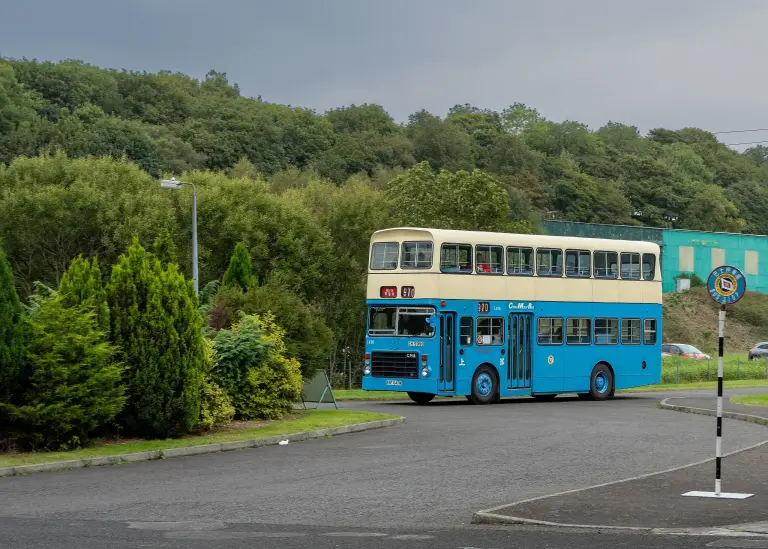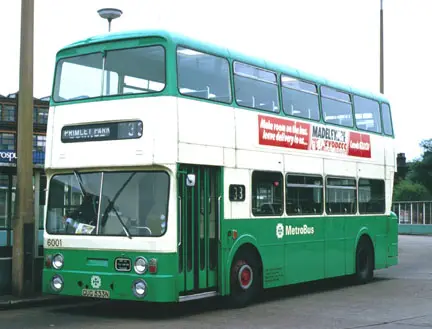
The Leyland Atlantean is a predominantly double-decker bus chassis manufactured by Leyland Motors between 1958 and 1986. It pioneered the rear-engined, front-entrance double-decker in the United Kingdom, allowed one-man operation and dispensed with the need for a bus conductor.
Leyland Atlantean at a glance
| Maker | Leyland Motors |
|---|---|
| Type | double-decker bus chassis |
| Production | 1958–1986 |
| First prototype | 1952, PDR1, registered STF 90 |
| Second prototype | 1956, the “Lowloader”, registered XTC 684 |
| First production model | Atlantean PDR1/1, launched 1958 |
| Layout | rear engine, front entrance |
| Engine | Leyland O.350 in the prototypes, O.600 in the prototype Atlantean |
| Gearbox | Pneumocyclic |
| Length | 30 ft (9.1 m), permitted for double-deckers from 1956 |
| London Transport | 50 buses bought in 1965 |
| In service by 1972 | over 6,000 |
| Single-deck chassis | 17 bodied as single-deckers from new |
Based on one source, the English Wikipedia article on the Atlantean.
History of the Leyland Atlantean
The prototypes
After the Second World War British bus operators faced falling passenger numbers, and makers looked for ways to economise. Several underfloor-engined single-deckers had been tried, but they raised the floor and forced extra steps at the entrance; on a double-decker the problem was worse. In 1952 Leyland built a rear-engined prototype, STF 90, with a Saunders-Roe body, a transversely mounted turbocharged Leyland O.350 engine, an automatic clutch and a self-changing gearbox. It was designated PDR1, the R standing for rear-engined.
A second prototype, XTC 684, followed in 1956 with a Metro-Cammell body and an O.350 engine across the frame, a centrifugal clutch, a Pneumocyclic gearbox and an angle drive. It was 13 ft 2.75 in high on a 16 ft 2.875 in wheelbase, 29 ft 10 in long and seated 78. Leyland called it the Lowloader. Both prototypes had rear entrances, and the space beside the driver was still wasted.
PDR1 and PDR2
A 1956 change to the Construction and Use Regulations raised the maximum length of double-deckers to 30 ft (9.1 m), which allowed a wider entrance ahead of the front axle. Leyland showed the first Atlantean prototype at the 1956 Commercial Motor Show at Earls Court, but engine noise in the lower saloon kept it off the market. The prototype used an O.600 engine mounted transversely at the rear, a Pneumocyclic gearbox in the rear offside corner, a light fabricated frame with light-alloy floor plates riveted to it, and a drop-centre rear axle that kept the floor only one step above the ground.
By 1958 Leyland had moved the engine into a compartment outside the main body and launched the first production Atlantean PDR1/1 at the 1958 Commercial Motor Show, with a 16 ft 3 in wheelbase and simpler mechanical specification. Glasgow Corporation, James of Ammanford and Wallasey Corporation each put their first example into service in December 1958. From 1964 a drop-centre rear axle was optional, and the resulting buses were known as PDR1/2 and later PDR1/3. The PDR2/1 of 1967 could take 33 ft (10 m) bodywork.
London Transport bought a fleet of 50 Atlanteans in 1965, first on routes 7, 24, 67 and 271 and later transferred to Croydon. Although the National Bus Company and the Scottish Bus Group preferred the Bristol VR and Daimler Fleetline, municipal operators in Aberdeen, Bournemouth, Glasgow, Edinburgh, Newcastle, Manchester, Liverpool, Newport, Nottingham and Plymouth bought large numbers. Three chassis were bodied as single-deckers by Marshall for Great Yarmouth in 1968, Portsmouth had 12 with Seddon Pennine bodywork and Birkenhead ordered three with Northern Counties bodies. By 1972 over 6,000 Atlanteans had entered service.
AN68 and AN69
In February 1972 Leyland announced the AN68 series to replace the PDR1 and PDR2, continuing the Atlantean line into its later years.
Design and features
- Rear engine: the engine sat behind the rear axle, freeing the front of the bus for passengers and the driver.
- Front entrance: boarding ahead of the front axle allowed one-man operation without a conductor.
- Drop-centre rear axle: kept the lower-saloon floor only one step above the ground.
- Light frame: a fabricated frame with riveted light-alloy floor plates served as both structure and floor.
- Long production: built from 1958 to 1986, with more than 6,000 in service by 1972.
Leyland Atlantean versions
- PDR1/1: the first production model of 1958, with a 16 ft 3 in wheelbase.
- PDR1/2 and PDR1/3: versions with the optional drop-centre rear axle from 1964.
- PDR2/1: from 1967, able to take 33 ft (10 m) bodywork.
- AN68 and AN69: the series announced in February 1972 to replace the PDR1 and PDR2.
- Single-deckers: 17 chassis were bodied as single-deck buses from new.
The Atlantean competed with the Leyland Fleetline, and its later stablemate was the Leyland Olympian. More Leyland vehicles are in the Leyland collection.
Sources
- Leyland Atlantean, English Wikipedia: prototypes, production, operators, variants