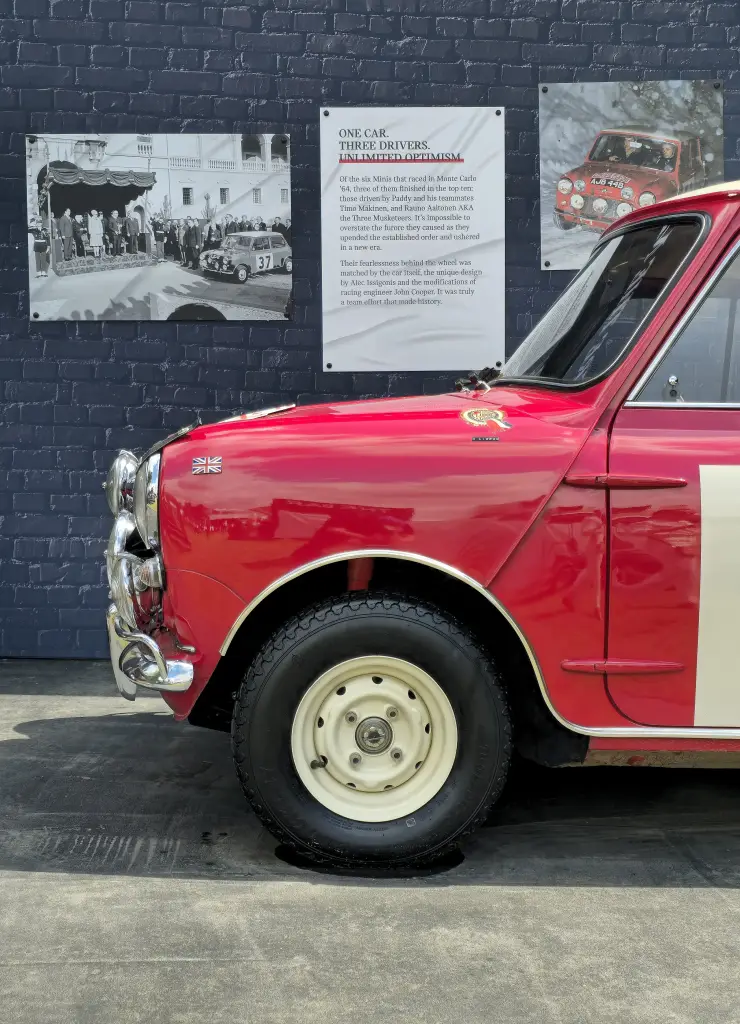
The Mini is a two-door, four-seat small car produced over four decades in a single generation by the British Motor Corporation and its successors British Leyland and the Rover Group, and briefly under BMW. It was launched in 1959, became a marque in its own right in 1969 and was built until October 2000.
Leyland Mini at a glance
| Maker | BMC, then British Leyland and Rover Group |
|---|---|
| Type | two-door, four-seat small car |
| Production | 1959–2000 |
| Total built | about 5.38 million |
| Designer | Sir Alec Issigonis |
| Layout | transverse engine, front-wheel drive |
| Gearbox | four-speed, in the engine sump |
| Original names | Austin Seven and Morris Mini-Minor |
| Mini marque | from 1969 |
| Major updates | Mark II, Clubman, Mark III |
| Bodies | saloon, estate, convertible, van, pick-up, Moke |
| Built at | Longbridge and Cowley, plus overseas plants |
The Mini is described in the English Wikipedia article on the Mini; this page covers the car as built under British Leyland ownership.
History of the Leyland Mini
The Suez origins
The Mini came about because of the fuel shortage caused by the 1956 Suez Crisis. Petrol was rationed again in Britain, sales of large cars slumped and German bubble cars became popular even in the United Kingdom. Leonard Lord, the head of BMC, detested these cars and vowed to replace them with a proper miniature car. He set the brief: the car should fit inside a box of 10 by 4 by 4 feet, the passenger space should take 6 feet of the 10-foot length, and the engine should be an existing unit to save cost.
Alec Issigonis, who had worked for Alvis, had been recruited back to BMC in 1955. His smallest project, XC9003, had the lowest priority until Lord’s brief in October 1956, when work on the larger car stopped and XC9003 became the priority. With a team including John Sheppard, Jack Daniels, Chris Kingham, Charles Griffin, Vic Everton, Ron Dovey, Dick Gallimore and George Cooper, Issigonis had designed and built the original prototype by July 1957. It was nicknamed the Orange Box for its colour, Lord approved it for production on 19 July, and XC9003 became project ADO15.
The package
The ADO15 used BMC’s conventional A-Series four-cylinder water-cooled engine, but mounted it transversely, with the four-speed gearbox lubricated by the engine oil and set in the sump, and drove the front wheels. Drive passed through a conventional clutch to primary gears on the end of the crankshaft, which gave the Mini its characteristic transmission whine. Almost every small front-wheel-drive car since has used a similar layout, though with the gearbox separately enclosed and unequal-length driveshafts. The radiator sat on the left so that the engine-driven fan could be kept, blowing air into the low-pressure area under the front wing. That saved length but fed the radiator with air heated by the engine and exposed the ignition to rain through the grille.
The space-saving layout let 80 per cent of the floorpan be used for passengers and luggage. It influenced a generation of makers and was adopted in cars such as the Honda N360 of 1967, the Nissan Cherry of 1970 and the Fiat 127 of 1971. In 1999 the Mini was voted the second-most influential car of the twentieth century, behind the Ford Model T and ahead of the Citroën DS and Volkswagen Beetle, and it became an icon of 1960s British popular culture.
Names and versions
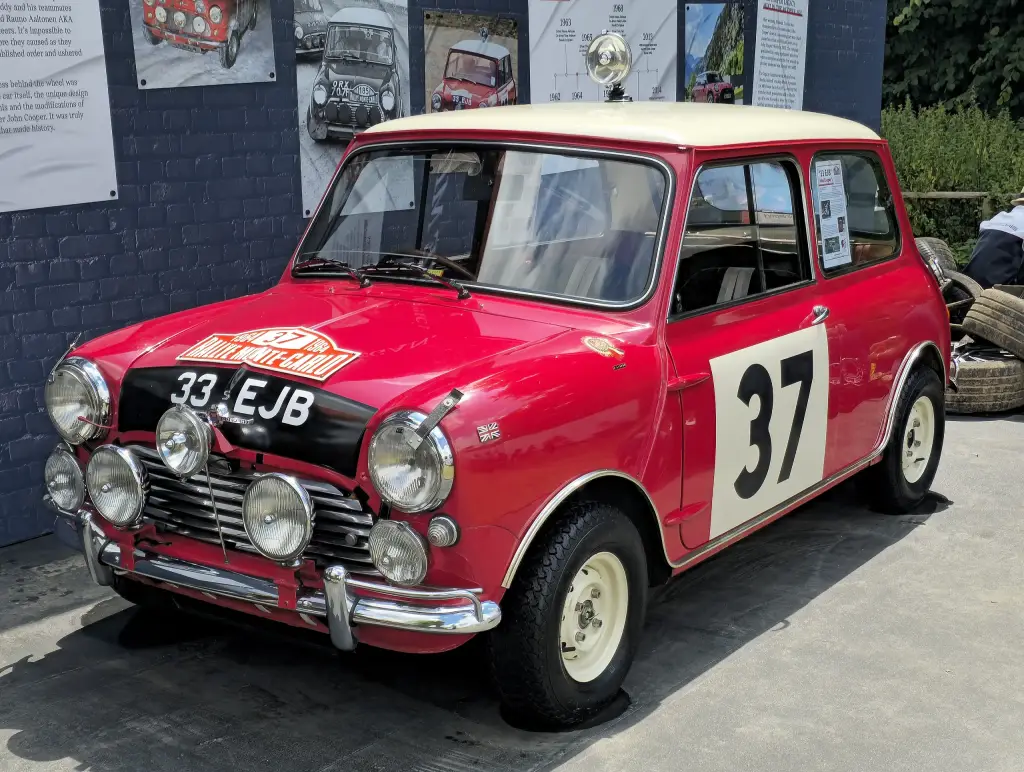
The Mini was first sold as the Austin Seven and the Morris Mini-Minor. The Austin Seven became the Austin Mini in 1962, and Mini became a marque in its own right in 1969. The Mark I had three major British updates, the Mark II, the Clubman and the Mark III, and within them came an estate, a pick-up, a van and the Mini Moke, a jeep-like buggy. The performance Mini Cooper and Cooper S won the Monte Carlo Rally in 1964, 1965 and 1967. The car was built at Longbridge in Birmingham and at Cowley, and also in Australia, Spain, Belgium, Italy, Chile, Malta, Portugal, South Africa, Uruguay, Venezuela and Yugoslavia. British Leyland launched the Austin Metro as its follow-up in 1980, but the Mini outlasted it and stayed at Longbridge until October 2000. The original car is now called the Classic Mini to distinguish it from the BMW MINI built since 2001.
Design and features
- Transverse engine: the A-Series engine was turned sideways to save length.
- Gearbox in the sump: the four-speed transmission shared the engine oil and gave the famous whine.
- Space efficiency: 80 per cent of the floorpan was available for passengers and luggage.
- Huge influence: the layout was copied by small front-wheel-drive cars around the world.
Leyland Mini versions
- Austin Seven and Morris Mini-Minor: the original 1959 names.
- Mark II, Clubman and Mark III: the three major British updates.
- Estate, van, pick-up and Moke: the other body styles.
- Cooper and Cooper S: the performance versions, Monte Carlo Rally winners.
- Classic Mini: the retrospective name for the original car.
The Mini was sold next to the Leyland Marina in the 1970s, and the Australian P76 was built by the same group. More Leyland vehicles are in the Leyland collection.
Sources
- Mini, English Wikipedia: design, names, production, variants