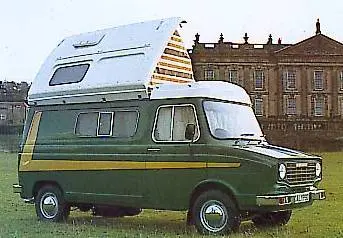
The Leyland Sherpa was a panel van launched in 1974, developed by the Austin-Morris division of British Leyland from the earlier Morris and BMC light commercial vehicles. It was sold under several names during the 1970s and eventually became the LDV Pilot, staying in production in various forms until 2005.
Leyland Sherpa at a glance
| Maker | British Leyland, later Freight Rover and LDV |
|---|---|
| Type | panel van |
| Launched | 1974, as the Leyland Van |
| Renamed | Sherpa soon afterwards |
| Derived from | Morris and BMC J4 and JU250 vans |
| Layout | forward control, engine ahead of the cab under a bonnet |
| Initial versions | 185, 215 and 240 vans |
| Payloads | 13 to 23 cwt |
| Loadspace | 190 cubic feet (5.4 m3) |
| 1978 engines | 1.7 and 2.0 litre O-series petrol, 1.8 litre B-series diesel |
| Final model | LDV Pilot, 1996–2005 |
The Sherpa is described in the English Wikipedia article on the LDV Pilot, the van’s final name; this page covers the Leyland years.
History of the Leyland Sherpa
From J4 to Sherpa
The Sherpa was derived from the Morris and BMC J4 and JU250 vans of the 1960s. The main change was to the forward-control layout: the engine was moved ahead of the cab and made accessible through a bonnet, bringing Leyland’s light van into line with the Ford Transit and Bedford CF. This allowed a longer wheelbase, giving greater stability, payload and side loading, and produced the distinctive Sherpa profile, although the last J4s and the first Sherpas were largely identical from the rear. The van was originally designed to be built on car production lines, which gave it a narrow track. Later publicity turned the narrow body into a virtue by stressing its ability in narrow city streets and lanes, which is why the Royal Mail and British Telecom preferred the Sherpa and its successors to the Ford Transit for many years; the Royal Mail in particular bought huge fleets.
Sherpa, 1974–1982
The model was launched in 1974 as the Leyland Van and soon renamed Sherpa. It was sold as a Leyland, Morris, Austin-Morris and finally a Freight Rover Sherpa as British Leyland’s names changed in the 1970s. The first range had vans in 185, 215 and 240 versions, where 185 meant a gross weight of 1.85 tons, pick-ups in 215 and 240, a 240 crewbus and minibus, and chassis cabs in 220 and 250. Payloads were quoted as 13 or 14 cwt for the 185, 18 or 19 cwt for the 215 and 220, and 22 or 23 cwt for the 240 and 250. Loadspace of 190 cubic feet was much larger than the J4’s and only just short of the Morris 250 JU.
In 1978 the 1.7 and 2.0 litre O-series engines replaced the original 1622 cc and 1798 cc B-series petrol units, while the 1798 cc B-series diesel stayed. The range was redesignated: vans 200, 230 and 250; pick-ups 230 and 250; minibus and crewbus 250 only; chassis cab 255 only. The 2.0 petrol cost only £50 more than the 1.7 with the same fuel consumption and much better drivability, and the 1.7 produced 62 PS. A few months after the engine changes the Sherpa was rebadged as a Morris, and in 1981 British Leyland created the Freight Rover division within the Land Rover group, so the badges changed again.
K2 and Freight Rover
With export sales falling and the Sherpa losing ground to the Transit and newer rivals, British Leyland considered dropping the van altogether, but instead launched a limited update, the short-lived Sherpa K2, in June 1982. It had a neater black slatted grille recalling the Range Rover and much better side access to the load bay, and it targeted driver comfort and noise. New doors and a B-pillar replaced the forward-leaning pillar inherited from the J4, which had obscured the driver’s view, and the side and rear door windows were enlarged. The van could now be bought in 200, 230, 250 and 280 versions, the numbers giving the gross weight in tens of kilograms. Loadspace stayed at 190 cubic feet, but a Hi Capacity walk-through body offered 330 cubic feet on the 255 or 280 chassis cab, and a Luton body took it to 460. The integral pick-up was dropped in favour of a dropside pick-up on the chassis cab, a four-wheel-drive Sherpa was offered, and an LPG conversion was available from Landi-Hartog.
The next facelift came in 1984, when the Sherpa became the Freight Rover 200 Series with square headlamps, new bumpers and repositioned indicators, joined by the wider 300 Series. The 200 Series later became the Leyland DAF 200 Series and finally the LDV Pilot after LDV was formed in 1993. In Pilot form it had 2.2 to 2.6 tonne capacities, a 5.7 cubic metre load area, a 1.9 litre Peugeot diesel driving the rear wheels through a five-speed gearbox, and access from the rear or a sliding side door. The line finally ended in 2005.
Design and features
- Bonneted engine: the engine ahead of the cab made access easier than in the J4.
- Narrow body: designed for car production lines, it suited narrow city streets.
- Big loadspace: 190 cubic feet, well above the J4 and close to the Morris 250 JU.
- Fleet favourite: the Royal Mail and British Telecom bought large numbers.
Leyland Sherpa versions
- 185, 215 and 240: the first vans, named after their gross weights.
- 200, 230, 250 and 280: the 1978 and 1982 designations.
- K2: the 1982 update with new grille, doors and B-pillar.
- Freight Rover 200 and 300 Series: the 1984 versions.
- LDV Pilot: the final version, built until 2005.
The Sherpa replaced the Leyland FG in the light commercial range. More Leyland vehicles are in the Leyland collection.
Sources
- LDV Pilot, English Wikipedia: Sherpa history, versions, engines, body changes