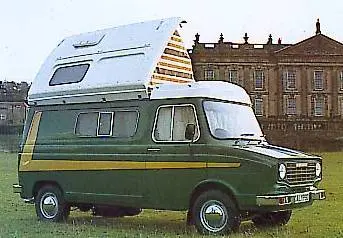
The Leyland FG was the British Leyland name for a light forward-control truck that began life in 1959 as the Morris FG and Austin S200 and 404. Its most distinctive feature was a cab whose doors were set into angled rear corners, an idea meant to make delivery work easier. It was built as the Leyland FG from 1970 to 1980.
Leyland FG at a glance
| Also known as | Morris FG, Austin S200 and 404, BMC FG |
|---|---|
| Presented | 1959, by the British Motor Corporation |
| Layout | forward-control light truck |
| Payload from 1960 | 1.5 to 5 tons |
| Cab | doors on angled rear corners, rear-hinged |
| Windows | curved Street-View windows below the windscreen |
| Bodies | flatbed, box body and delivery van |
| Renamed | BMC FG in 1968, Leyland FG in 1970 |
| Built as Leyland FG | 1970–1980 |
| Replaced by | new body variants of the Leyland Sherpa |
The FG is described mainly in the German Wikipedia article on the Morris FG, with background from the English article on Morris Commercial Cars.
History of the Leyland FG
Morris FG, 1959
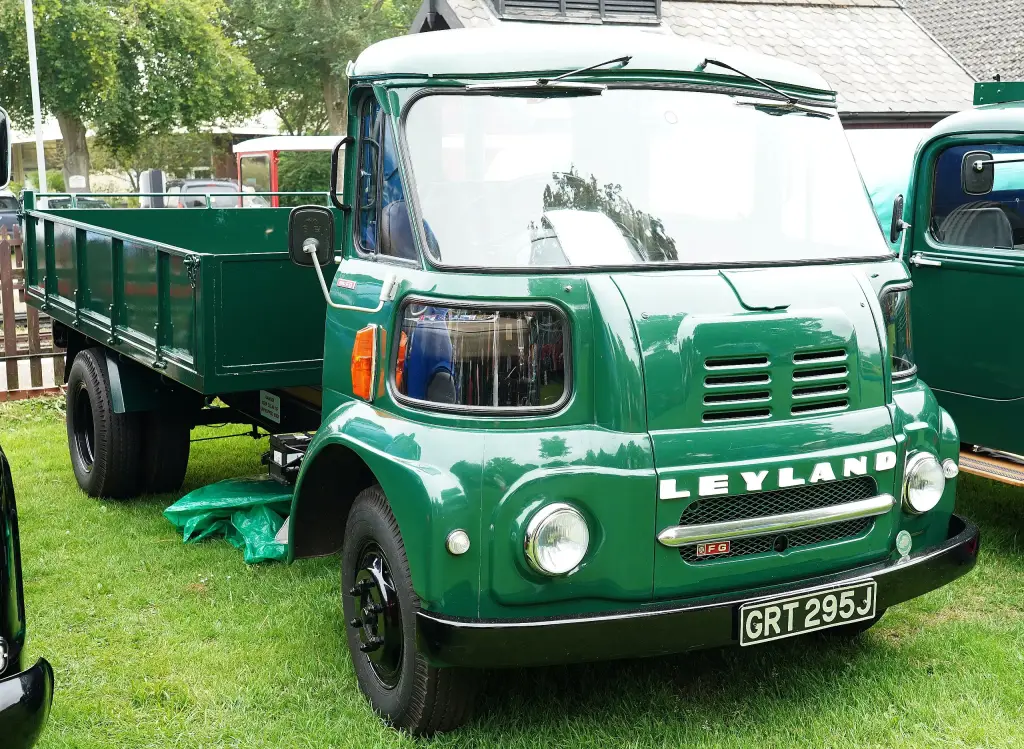
The British Motor Corporation presented the Morris FG and Austin S200 and 404 in 1959 as the successor to the lighter Morris FE and Austin FE and to the Morris LC and Austin 301, which still used a pre-war design. The FF had kept the FE chassis and only received new bodywork, but the FG was completely new. The Morris and Austin versions differed only in their grilles, badges and names, and the Austin was often sold for export as the Austin FG.
The angled cab
The FG’s cab was a leap in commercial vehicle design. Its doors were mounted on the angled rear corners of the cab and hinged at the back, so they barely projected beyond the cab width when opened, giving an effect similar to sliding doors. BMC called this the practical angle, and drivers nicknamed it the threepenny bit after the twelve-sided coin. The layout also made it easier to climb in, since the driver no longer had to step over the front wheel as on many forward-control trucks. BMC claimed that getting in and out took only a third of the effort needed in a conventional cab, a real advantage for delivery work, and the angled rear windows helped when manoeuvring.
Another innovation was a pair of curved Street-View windows at the front corners below the windscreen. They helped the driver park and cut the blind spot, so that even small children could be seen when driving through pedestrian areas. The gear lever and handbrake were mounted to the right of the driver’s seat, which kept the floor clear. The design had drawbacks too: the cab was narrow and the seats were slim, larger drivers had trouble with the narrow doors, and heat from the front engine made the cab stuffy in summer, which is probably why the front windows could still be opened as on the predecessor.
Payloads, bodies and the FM
From 1960 the range was sold with payloads from 1.5 to 5 tons. Besides flatbed trucks, box bodies were available from the factory, and with bodybuilders there were standard vans for delivery work, often seen as Sunblest bakery or laundry vehicles; these had a sliding door instead of a partition at the back of the cab. British Gas was a large customer. To soften the FG’s disadvantages, BMC added the FM in 1961, essentially an FG cab with a larger front so the engine could sit further forward and make room for bigger seats. The FM went almost entirely to the Post Office Telefon, later British Telecom, and the Royal Mail.
BMC and Leyland years
In 1968 all commercial vehicles in the group were marketed as BMC, so the model became the BMC FG. After the merger of BMC and Leyland Motors into British Leyland it was renamed the Leyland FG in 1970 and built under that name until 1980, when it was replaced by new body variants of the Leyland Sherpa. The angled-door idea was refined in the BMC 350 EA, which had sliding doors as standard, and the Street-View window returned in part on the Leyland Roadrunner, which had a small window on the passenger side below the windscreen.
Design and features
- Angled rear doors: doors set into the rear corners of the cab, hinged at the back so they opened within the cab width.
- Street-View windows: curved corner windows below the windscreen that cut the blind spot.
- Easy entry: the driver did not have to climb over the front wheel to reach the seat.
- Delivery bodies: factory box bodies and van conversions with sliding doors for bakery and laundry work.
Leyland FG versions
- Morris FG and Austin S200/404: the 1959 original, sold under both names.
- BMC FG: the 1968–1970 name for the same truck.
- Leyland FG: the 1970–1980 version.
- FM: the 1961 version with a longer front and a roomier cab, sold mainly to the Post Office and Royal Mail.
- BMC 350 EA: a later refinement of the angled cab with sliding doors.
The FG was replaced by the Leyland Sherpa, and its Street-View idea returned on the Roadrunner. More Leyland vehicles are in the Leyland collection.
Sources
- Morris FG, German Wikipedia: cab layout, payloads, bodies, Leyland years
- Morris Commercial Cars, English Wikipedia: company background, BMC and Leyland names