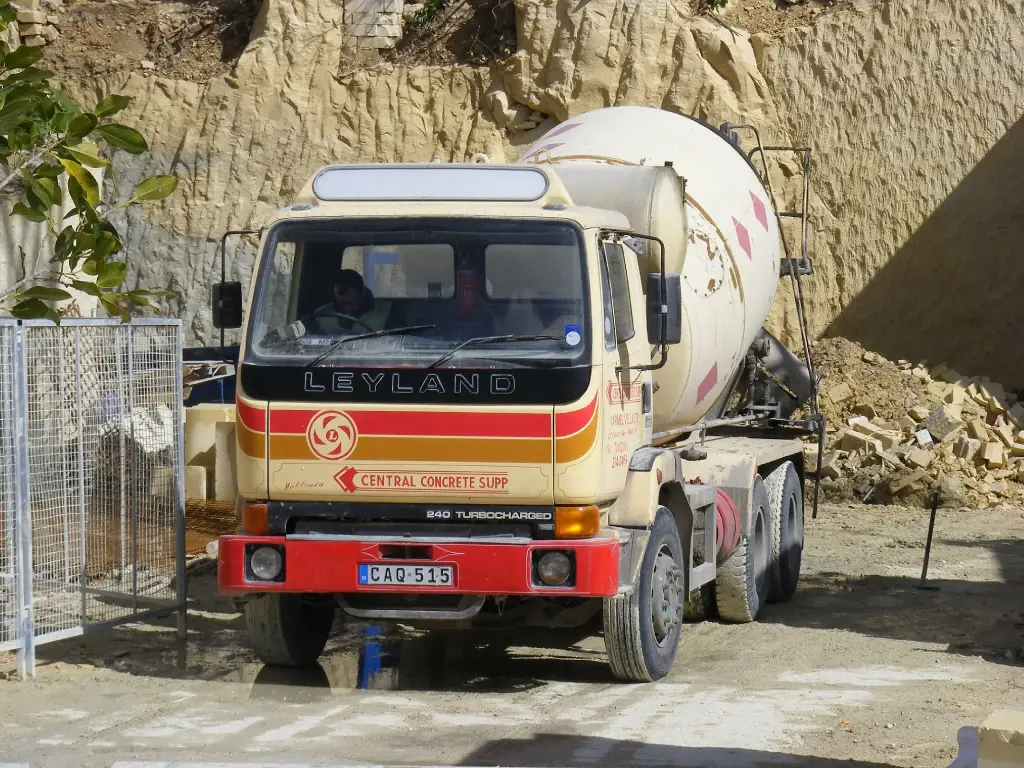
The Leyland Constructor was a forward-control lorry introduced in 1981 as the second model built by British Leyland on the T45 project. Designed mainly as a tipper, it replaced the Leyland Bison and Leyland Buffalo, and after the Leyland DAF merger it was sold as the Leyland DAF 60 and DAF 60.
Leyland Constructor at a glance
| Maker | British Leyland, later Leyland DAF |
|---|---|
| Type | construction truck, mainly a tipper |
| Introduced | 1981 |
| Project | T45 |
| Replaced | Leyland Bison and Leyland Buffalo |
| Drivelines | 6×2, 6×4, 8×2, 8×4 and 8×8 |
| Payload | 10 to 30 tonnes |
| Engines | Leyland TL11 181 or 209 hp; Rolls-Royce 220 hp; Gardner 6LXC-T 230 hp |
| 1985 update | TL11 up to 260 hp; Constructor 30:30 the most powerful tipper |
| From 1990 | Leyland DAF 60 in Britain, DAF 60 on the continent |
| Replaced by | DAF 85 in 1994 |
Based on one source, the German Wikipedia article on the Constructor.
History of the Leyland Constructor
1981–1990
The Constructor appeared in 1981 as the second model of the British Leyland T45 programme. It was built mainly as a tipper and replaced the Leyland Bison and Leyland Buffalo. Versions were available as 6×2, 6×4, 8×2, 8×4 and 8×8, but there were also models for general haulage with a box body and as a tractor unit. Payload ranged from 10 to 30 tonnes. All used the T45 cab, in standard or double-cab form with a sleeping space and an optional high roof; the Constructor’s cab had a thickly padded rubber floor instead of carpet and optional vinyl seats instead of cloth.
The Constructor took its chassis from the Bison and Buffalo, except for the front section of the ladder frame where the new T45 cab was mounted, and it also carried over an improved version of their braking system. The tandem rear axles with hub reduction came from the predecessors as well but were adapted for the higher power. In the first years this caused propshaft damage under heavy load, and an inadequate radiator guard caused problems on the 6x versions; Leyland corrected both fairly quickly.
The TL11 six-cylinder diesel, with high torque, was fitted with 181 or 209 hp. The 8x versions could also have a Rolls-Royce of 220 hp or a Gardner 6LXC-T of 230 hp. Transmission was an Eaton 400 gearbox, with a Fuller nine-speed for heavier 6x work and a Spicer ten-speed for the 8x. In 1985 the engine range was revised: the TL11 offered 260 hp, and the 8x could be ordered with Perkins or Cummins engines of 300 hp. This made the Constructor 30:30 the most powerful tipper in the world for a time. To handle the extra power and cut production costs, the Albion-derived double rear axles of the 30:30 were replaced by Eaton units.
Leyland DAF 60, 1990–1993
After the merger of Leyland Motors and DAF into Leyland DAF, the Constructor was sold from 1990 as the Leyland DAF 60 in the United Kingdom and as the DAF 60 in continental Europe. Only the DAF ATi 11.6-litre diesel remained, with 300 or 330 hp and an Eaton 12-speed split gearbox. Production ended at the end of 1993, and the DAF 85 replaced the range in 1994.
Design and features
- T45 cab: the same cab family as the Roadtrain, with a rubber floor and vinyl seats for site work.
- Wide driveline choice: from 6×2 to 8×8, with payloads from 10 to 30 tonnes.
- Strong engines: the TL11 up to 260 hp, with Rolls-Royce, Gardner, Perkins and Cummins options.
- 30:30: briefly the most powerful tipper in the world.
Leyland Constructor versions
- 6×2 and 6×4: two-axle and three-axle tippers and haulage trucks.
- 8×2, 8×4 and 8×8: four-axle versions, including the heavy 30:30.
- Tractor unit and box-body: non-tipper versions for general haulage.
- Leyland DAF 60 and DAF 60: the 1990–1993 version with the DAF ATi engine.
The Constructor shared its T45 cab with the Leyland T45 and sat above the Leyland Cruiser. More Leyland vehicles are in the Leyland collection.
Sources
- Leyland Constructor, German Wikipedia: drivelines, payloads, engines, DAF 60