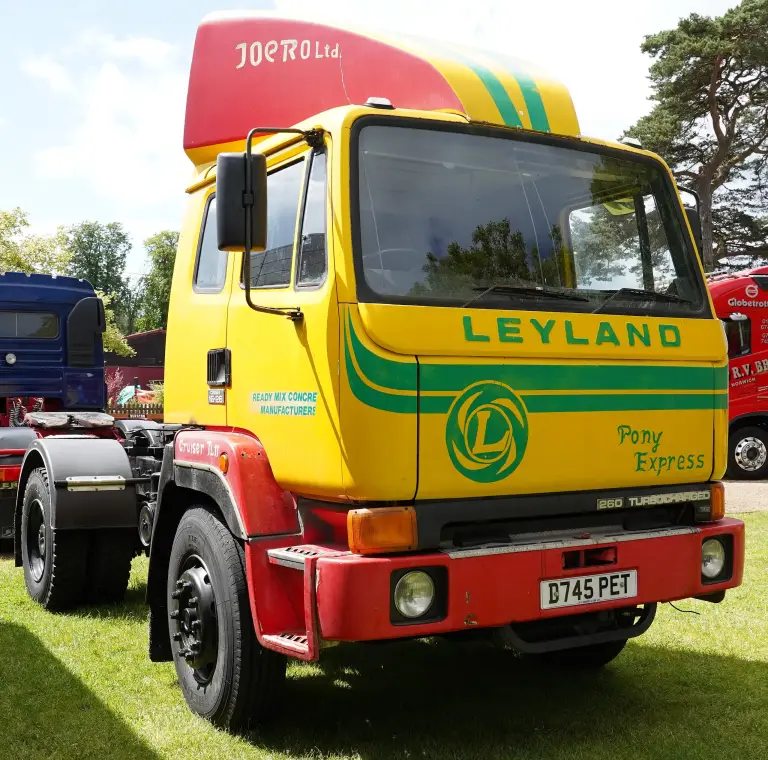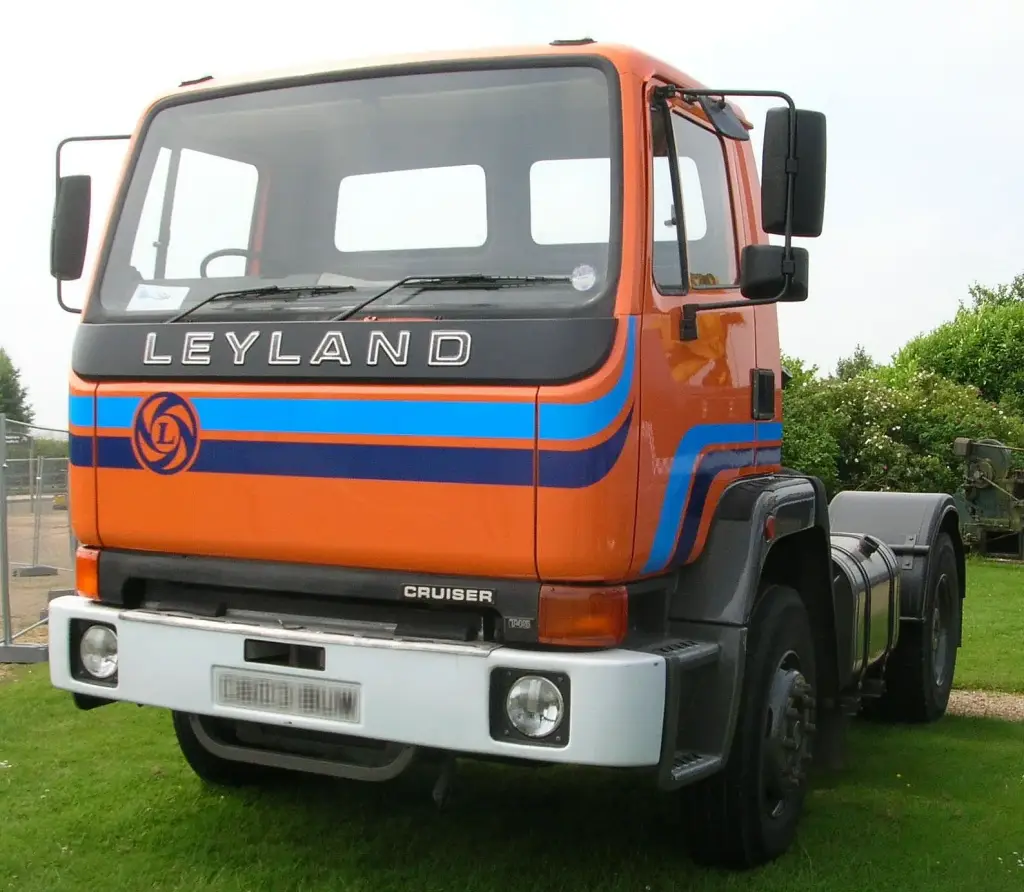
The Leyland Cruiser was a forward-control lorry introduced in 1982, a tractor unit and tipper placed below the Leyland Roadtrain in the British Leyland range. Its cab came from the T45 project, and it replaced the Leyland Buffalo in its market segment.
Leyland Cruiser at a glance
| Maker | British Leyland, later Leyland DAF |
|---|---|
| Type | tractor unit and tipper |
| Introduced | 1982 |
| Cab | T45 project |
| Gross weight | up to 28 tonnes |
| Drive | 4×2 only |
| Replaced | Leyland Buffalo |
| Engine | Leyland TL11, 210 or 230 hp |
| 1985 update | TL11C of 260 hp |
| Gearbox | Fuller R10, Spicer optional |
| Production ended | 1990 |
| Successor | Leyland Roadtrain, sold as Leyland DAF 70/80 |
Based on one source, the German Wikipedia article on the Cruiser.
History of the Leyland Cruiser
Based on the Buffalo
The Cruiser appeared in 1982 with a cab from the T45 project. British gross-weight rules at the time kept it to 28 tonnes, against more for the Roadtrain, and it was available only with rear-wheel drive in 4×2 form. In the market it replaced the Leyland Buffalo, whose Ergomatic cab dated from the 1960s and was thoroughly out of date. The Cruiser took over the Buffalo’s TL11 six-cylinder diesel, with 210 or 230 hp, and usually a Fuller R10 gearbox, though Spicer transmissions were available on request. The chassis came largely from the Buffalo, with a hub-reduction rear axle supplied by Albion. Unlike the Roadtrain there were no alternative engines from other makers, and the cab was smaller: it came as a standard or double cab with sleeping space but without the high roof, as on the Freighter.
1985 update and the end
In 1985 the Cruiser was revised with the rest of the range, the most visible change being the Leyland TL11C diesel of 260 hp. After the Leyland DAF merger and a loosening of British gross-weight rules, production ended in 1990. Its place was taken by the Leyland Roadtrain, now sold as the Leyland DAF 70/80 in Britain and the DAF 70/80 in continental Europe.
Design and features
- T45 cab: the modern cab of the 1980s Leyland range, in standard or double-cab form.
- TL11 engine: the reliable six-cylinder diesel inherited from the Buffalo, up to 260 hp.
- 28-tonne limit: British weight rules kept the Cruiser below the Roadtrain.
- Buffalo chassis: a proven ladder frame with an Albion hub-reduction rear axle.
Leyland Cruiser versions
- Standard cab: the usual tractor unit and tipper version.
- Double cab with sleeper: for longer-distance work; no high roof was offered.
- 1985 model: with the 260 hp TL11C engine.
The Cruiser shared its cab with the Leyland T45 and sat below the Leyland Constructor in the range. More Leyland vehicles are in the Leyland collection.
Sources
- Leyland Cruiser, German Wikipedia: cab, weights, engine, production end