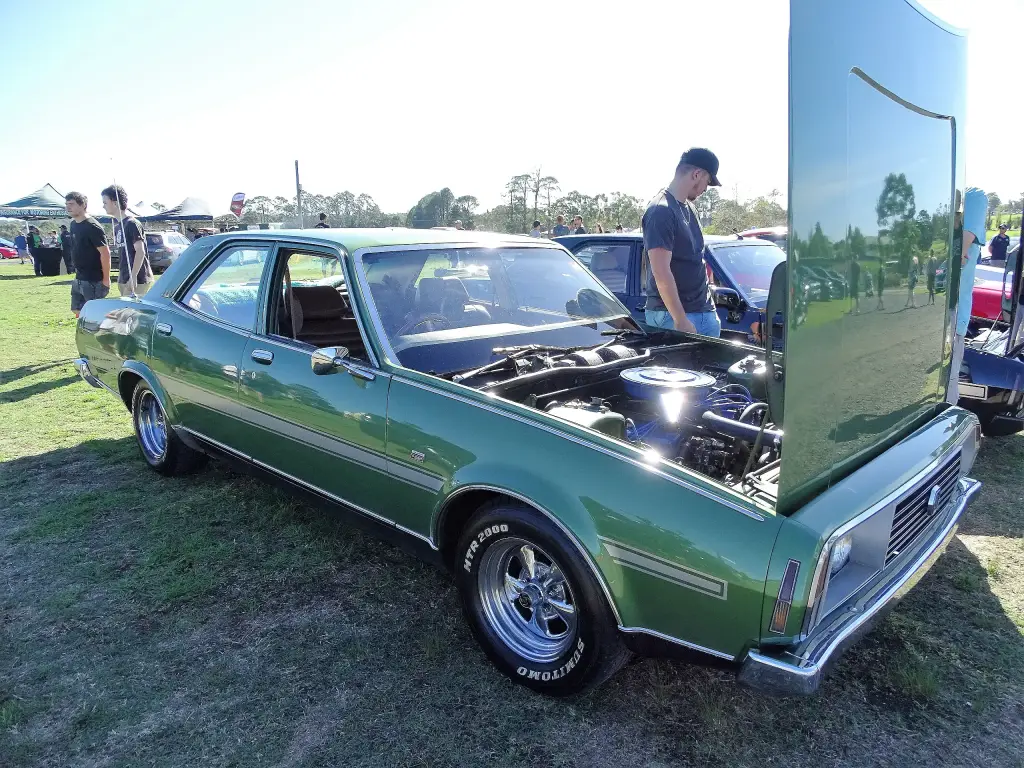
The Leyland P76 is a large car produced by Leyland Australia, the Australian subsidiary of British Leyland, in 1973 and 1974. It was meant to give Leyland a genuine rival to the Ford Falcon, Holden Kingswood and Chrysler Valiant, but the fuel crisis and rushed assembly ruined its reputation.
Leyland P76 at a glance
| Maker | Leyland Australia, British Leyland |
|---|---|
| Type | large family car |
| Production | 1973–1974 |
| Wheelbase | 111 inches, the standard Australian size |
| Designer | Giovanni Michelotti |
| Entry engine | 2,663 cc six, 121 bhp |
| Top engine | 4,416 cc aluminium V8, 192 bhp |
| Transmissions | Borg-Warner, including three-speed column shift |
| Suspension | MacPherson struts at the front, live rear axle |
| Brakes | power-assisted discs at the front |
| Award | Wheels Car of the Year, 1973 |
| Development budget | A$20 million |
Based on one source, the English Wikipedia article on the P76.
History of the Leyland P76
The Australian large car
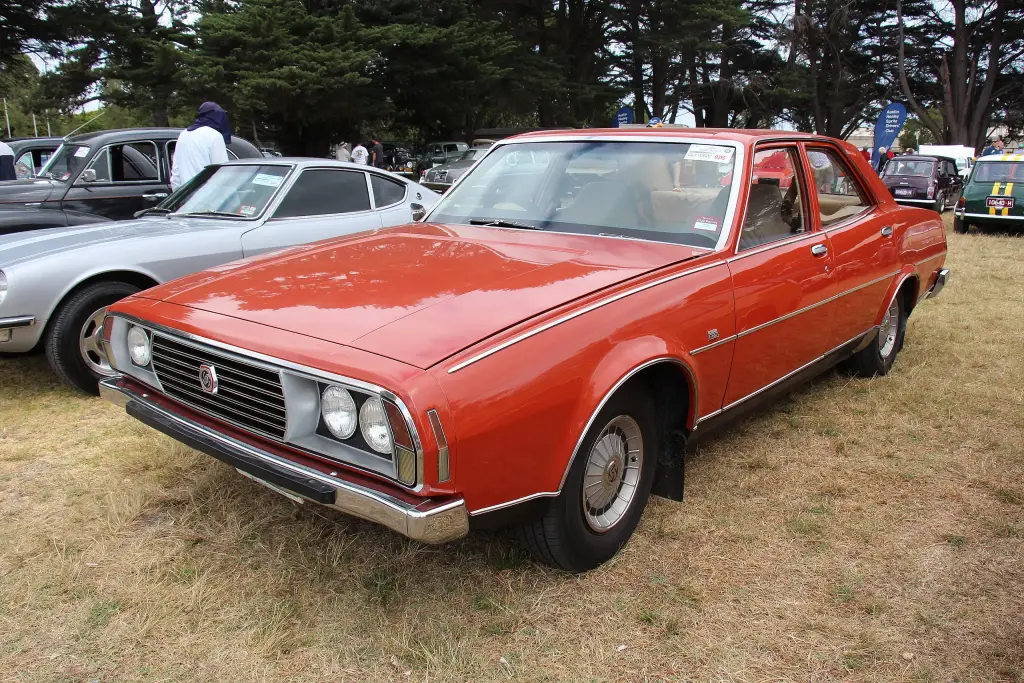
In 1969 Leyland Australia was given the go-ahead to build a large car for Australia. At the time of the launch Leyland Australia reportedly had an accumulated deficit of £8.6 million and had borrowed the same amount again to fund the P76, which was designed and built from scratch for only A$20 million. This was also a decade of serious financial difficulty for British Leyland in Britain, so commercial success for the P76 was seen as vital to Leyland’s survival in Australia. The car was launched in 1973 and nicknamed the wedge because of its shape, with a boot large enough to hold a 44-gallon drum. A station wagon and a Force 7 coupé were designed but never mass-produced.
The name
The name came from the car’s development codename, Project 76. Leyland’s official line was that the P76 was an original Australian-designed and built large family car with no overseas counterpart, and that P76 stood for Project 1976. The Rover SD1 of 1976 shared several engineering features with it, including MacPherson strut front suspension, the aluminium V8 and a live rear axle; the P76 was out of production by 1976. Another theory is that P76 was simply the first three digits of the army service number of Lord Donald Stokes, then chairman of British Leyland.
Design and engineering
The P76 was designed by Giovanni Michelotti. The entry-level model had an enlarged 2,663 cc version of the six-cylinder engine from the Austin Kimberley and Tasman, producing 121 bhp. The top model had a 4,416 cc aluminium V8 of 192 bhp, unique to the P76 and derived from the ex-Buick V8 used in the Rover 3500 and Range Rover. Leyland Australia claimed a weight advantage of almost 500 lb over its rivals, mostly from the lighter aluminium engine block compared with the larger cast-iron V8s of Chrysler, Holden and Ford. Despite this, the car was a full-size Australian model, and class-leading boot space was claimed.
Safety equipment went beyond the Australian Design Rules of the time, with front discs standard on all models, recessed door handles and full-length side-intrusion reinforcements in all doors. Transmissions were bought from Borg-Warner Australia, which also supplied Ford and Chrysler. Although the advertising slogan was Anything but average, the engineering was conventional, but it combined features advanced for the class in Australia: rack-and-pinion steering, power-assisted disc brakes, MacPherson-strut front suspension, a front-hinged bonnet, a glued-in windscreen, concealed wipers, Borg-Warner gearboxes including a three-speed column shift, and a live rear axle. Much attention went to structural rigidity, helped by reducing the body to 215 panels, only five more than a Mini. At the end of production Leyland was developing a V6 version derived from the 4.4-litre V8 with the two rear cylinders removed.
Sales and reputation
Demand far exceeded supply, and Leyland rushed assembly of the first cars, which led to poor build quality and reliability problems. With the first real fuel crisis, strikes at component suppliers and the rushed assembly, the P76 was labelled a lemon despite the V8 winning Wheels Car of the Year for 1973. By 1974 sales had slumped and production ended. The car is still viewed by some as an iconic Australian model with a loyal following.
Design and features
- Wedge shape: the nickname came from the car’s angular styling and huge boot.
- Aluminium V8: a 4.4-litre ex-Buick V8 of 192 bhp, unique to the P76.
- Advanced equipment: rack-and-pinion steering, front discs, MacPherson struts and side-intrusion bars.
- Only 215 panels: a body built from remarkably few pressings for rigidity.
Leyland P76 versions
- Six-cylinder P76: the 2,663 cc 121 bhp entry model.
- V8 P76: the 4,416 cc 192 bhp top model.
- Force 7 coupé: designed but never mass-produced.
- Station wagon: designed but never mass-produced.
The P76 was Leyland Australia’s large car, while the Leyland Marina covered the smaller class. More Leyland vehicles are in the Leyland collection.
Sources
- Leyland P76, English Wikipedia: design, engines, production, reputation