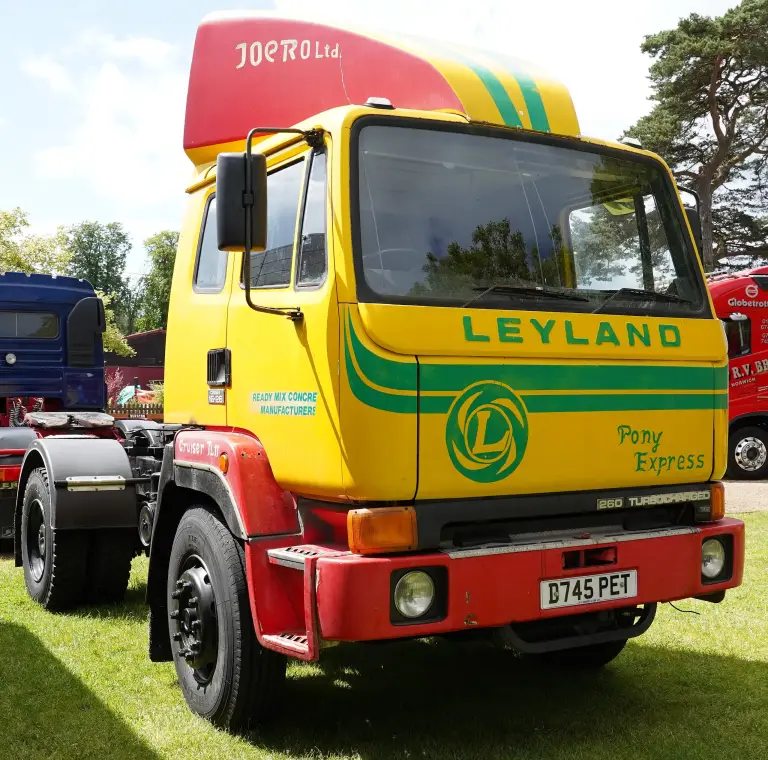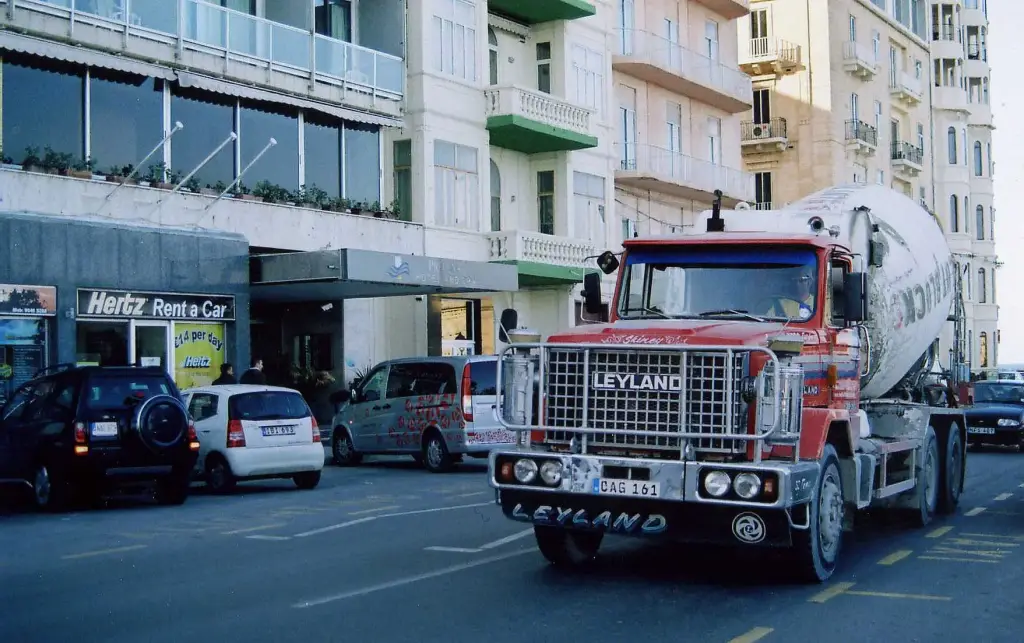
The Leyland Landtrain was a heavy truck produced in the 1980s by British Leyland. Designed for export markets in Africa, Asia, Latin America and the Middle East, it was particularly popular in Nigeria, Kenya and Zimbabwe, and it was built to work where roads were rough and fuel scarce.
Leyland Landtrain at a glance
| Maker | British Leyland |
|---|---|
| Type | heavy export truck |
| Project code | T129 |
| Launched | 1980 Geneva Motor Show |
| Gross weights | 19, 30 and 36 tonnes |
| Layouts | 4×2 rigid, 6×4 rigid and 6×4 tractor |
| Engines | four 14-litre six-cylinder diesels, two Leyland and two Cummins |
| Power | 212 to 290 bhp |
| Fuel tank | up to 700 litres |
| Built at | Wolverhampton, Bathgate, then Watford |
| Production | 1980–1987 |
| Assembly kits | Taiwan, Nigeria and Kenya |
Based on one source, the English Wikipedia article on the Landtrain.
History of the Leyland Landtrain
An export truck from the start
Given the project designation T129, the Landtrain was introduced by British Leyland as the first truck specifically built for the African, Asian, Latin American and Middle Eastern markets. The design drew on the expertise of Scammell Lorries, also owned by Leyland, and reflected the Thornycroft tractors made by the company at the same time. The truck was launched at the 1980 Geneva Motor Show. Its design was optimised for poor roads and long distances with infrequent refuelling and servicing: the chassis was a simple, strong channel-section ladder frame, fuel capacity could reach 700 litres, and the driver sat behind rather than above the engine, so the heat of the engine did not reach the cab in hot climates.
Body and chassis
The Landtrain was produced as a two-axle 4×2 and a three-axle 6×4 rigid, and as a 6×4 tractor. In three-axle form the rigid and tipper were 9,337 mm long, 2,478 mm wide and 2,780 mm high to the top of the cab, on a 5,680 mm wheelbase. Gross vehicle weight ranged from 19 to 36 tonnes. The tractor had a shorter 4,770 mm wheelbase and was 7,174 mm long, with a rated gross combination weight of 65 tonnes; where regulations allowed, an additional trailer could be mounted behind the semi-trailer to make a true land train. Variants were designated by two figures combining the gross weight in tonnes and the engine power in bhp, and these numbers were inscribed on the cab door.
Engines and transmission
The Landtrain was powered by four different six-cylinder diesels, all of 14 litres. Two were made by Leyland and two by Cummins, each pair with a naturally aspirated and a turbocharged version. The least powerful was the Leyland L12 at 212 bhp at 2,200 rpm, an adaptation of the larger TL12 used in the Marathon 2. The TL12 itself was the second engine, in a lower-revving version of 280 bhp at 2,000 rpm with ten per cent more torque. The Cummins options were the NHC250 of 250 hp and the NTE290 of 290 hp, the latter with a big-cam design for better fuel economy. The L12 used a six-speed Eaton 0403 gearbox with overdrive, the TL12 and NHC250 a nine-speed Fuller RT09509A or B range-change box, and the NTE290 first a six-speed ZF AK6-90, later replaced by the Fuller. A Dana Spicer twin-plate clutch was fitted.
In the two-axle version power reached the wheels through a hub-reduction axle derived from the Marathon and rated at 13 tonnes. The three-axle version had double reduction to both rear axles, each rated at 6.5 tonnes. The three-seat cab was simple, without air conditioning or other modern conveniences.
Production
The Landtrain was first built at the Guy Motors factory in Wolverhampton, where production was expected to reach 1,000 vehicles a year. Production moved to Bathgate in August 1982, which led to the closure of the Wolverhampton plant, and then to the Scammell plant in Watford when Bathgate closed in June 1984. Besides complete trucks, the plants made complete knock-down kits, partially completed vehicles exported for local assembly, mainly to Leyland plants in Thika, Kenya and Ibadan, Nigeria. The trucks were popular in Africa, especially Nigeria, Kenya and Zimbabwe, and were used for general work and for tasks such as emergency relief in Sudan or rebuilding the runway at Port Stanley after the Falklands War. Production ended in 1987 after the merger of Leyland with DAF.
Design and features
- Bonneted cab: the driver sat behind the engine, away from its heat, in hot climates.
- Strong simple chassis: a channel-section ladder frame built for rough roads.
- Long range: fuel tankage of up to 700 litres.
- Four engines: Leyland L12 and TL12, Cummins NHC250 and NTE290, from 212 to 290 bhp.
Leyland Landtrain versions
- 4×2 rigid: the two-axle version.
- 6×4 rigid and tipper: the three-axle cargo models.
- 6×4 tractor: with a shorter wheelbase and 65-tonne gross combination weight.
- 19, 30 and 36 tonne ratings: combined with 24 or 29 designations on the cab door.
The Landtrain followed the export role of the Leyland Comet and shared its engine family with the Marathon. More Leyland vehicles are in the Leyland collection.
Sources
- Leyland Landtrain, English Wikipedia: design, engines, production, export markets