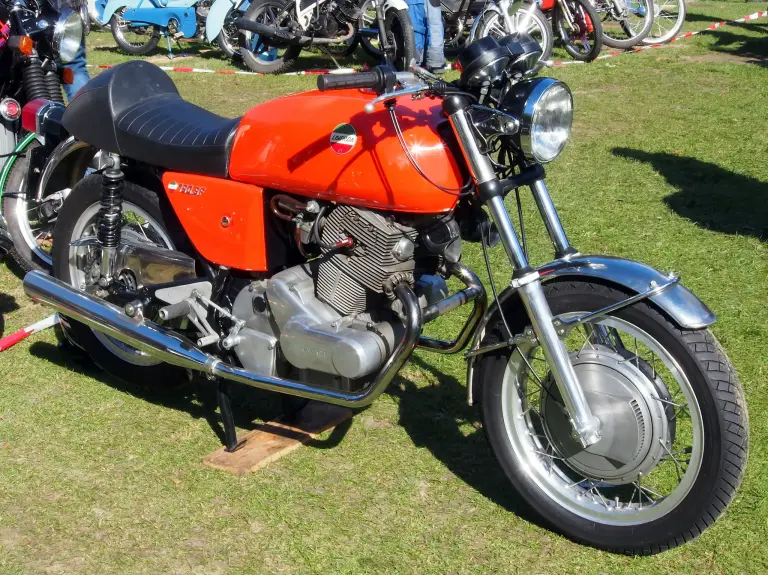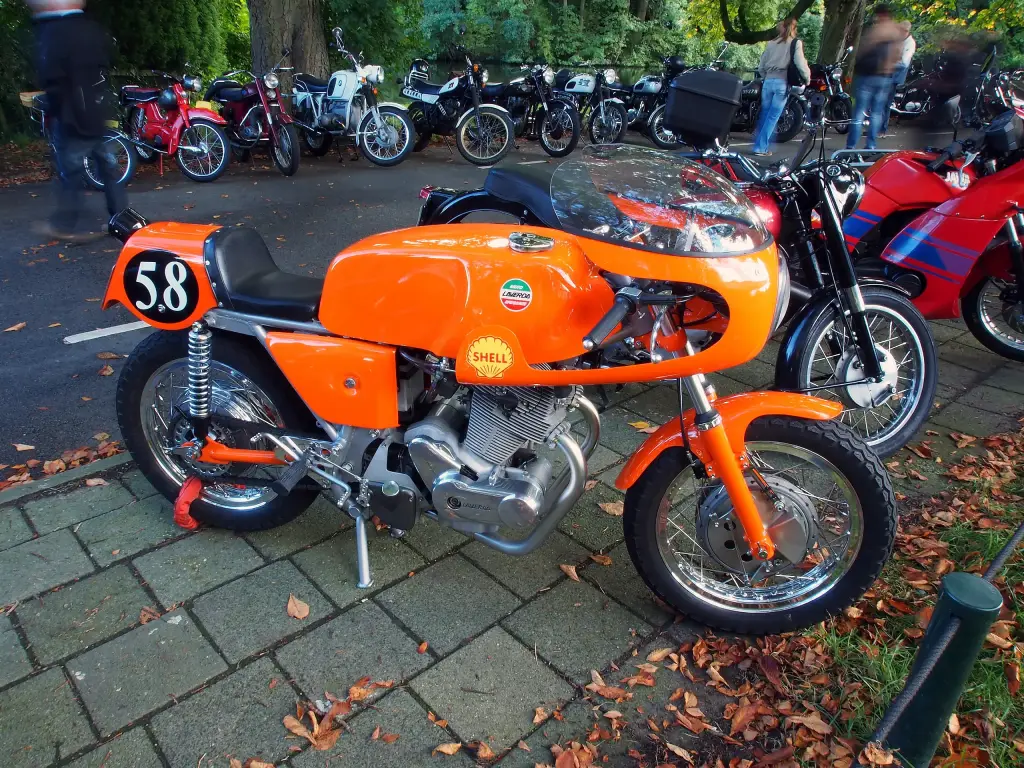
The Laverda 750 SFC is a sports motorcycle built at Breganze in three successive series between 1971 and 1977. Its name stands for Super Freni Competizione, and it was an evolution of the SF twin prepared for endurance racing. Hand-built in small batches and always painted orange, it is one of the most collectable Italian motorcycles of the 1970s.
Laverda 750 SFC at a glance
| Engine | 744 cc air-cooled SOHC parallel twin |
|---|---|
| Production | 1971–1977 |
| Series | three, continuously updated |
| Built | about 549 production machines |
| Pre-series | 23 machines (the ‘5000 lot’) in early 1971 |
| First-series lots | 78 machines (‘8000 lot’), then 58 (‘11000 lot’) |
| Colour | orange in all three series |
| Brakes | drum at first, derived from the SF |
| Crankshaft | 15 kg, 4 kg lighter than the SF’s |
| Price, 1971 | L. 1,410,000 |
| Price, 1972 | L. 1,549,000 |
| Bodywork | half fairing, single seat, large tank |
Most of the detail comes from the Italian page on the 750 SFC; the English page on the 750 supplies the production total of 549.
History of the Laverda 750 SFC
Born from endurance racing
In 1969 the Laverda racing department was revived to show what the SF could do in production-derived endurance events. The first races were run on near-standard SF machines with encouraging results, ridden by Laverda testers — above all Augusto Brettoni, and even Massimo Laverda himself, using the pseudonyms ‘Lover Otis’ and ‘C. Islero’ to get round the federation’s ban on licensed riders taking part in races it did not organise. In 1970, with demand coming from sporting customers and the publicity value plain to see, Laverda decided to build the SFC project, derived from the SF.
What was changed
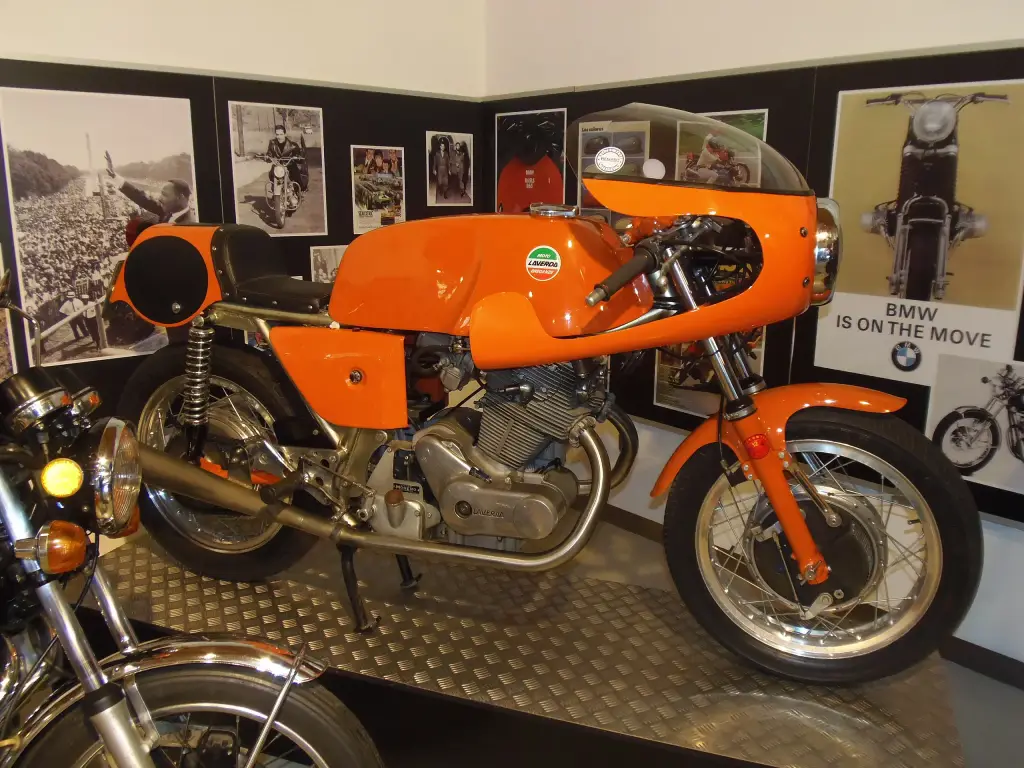
At first sight the SFC looks completely different from the SF, and only the engine seems to be carried over. In fact it kept the SF frame, with extra inserts to stiffen it, and the same braking system. Beyond the obvious bodywork changes, the competition version was much like its parent, except that the engine — outwardly similar — was thoroughly reworked inside, with redesigned inlet and exhaust valves, pistons, cylinder head, barrels, gearbox and clutch. Its finest part was the crankshaft, made of seven parts pressed together and weighing only 15 kg, 4 kg less than the SF’s. Its main weakness was a high centre of gravity which, with the considerable weight, made it unwieldy and not well suited to twisty or mountain courses. For the second series the frame was completely redesigned, lowering the seat by 5 cm without solving the problem entirely, which came mainly from the engine’s height and its mounting system. Each SFC was supplied with megaphone exhausts and alternative final drive ratios so that owners could switch between road and race use; many riders of the day rode to the circuit on the machine they would race.
Why orange
All three series were painted the same orange. Legend has it that the colour was adopted by accident after a mix-up in paint supplies forced the factory to use the orange meant for agricultural machinery — one of the many stories that surround motorcycle racing. In fact orange was chosen to give Laverda a racing colour of its own, following the post-war move by European makers away from national colours, and it also made the machines easy to spot, especially during the night hours of the endurance races the SFC was built for. Its high price and, above all, its very limited production kept it rare, and many owners gave their SFs a home-made SFC look with tanks, screens, seats and footrests from accessory firms.
The batches
In the first months of 1971 twenty-three pre-series machines, the ‘5000 lot’, were assembled for works riders only and used as mobile laboratories to test the changes; they are recognisable by their aluminium alloy tanks. The results came at once: Brettoni won at Zeltweg, Angiolini and Hutten won the 24 hours of Oss, and Brettoni and Angiolini won the 24 hours of Barcelona at Montjuich. With victory following victory the Reparto esperienze, led by Massimo Laverda and Luciano Zen, convinced the founder and the board to start small-series production. At the end of 1971 the first customer SFCs went on sale, homologated for road use as well: 78 machines in the ‘8000 lot’, followed in 1972 by 58 in the ‘11000 lot’, 55 of them built that year and three in 1973. The first series can be recognised by its glassfibre tank with knee recesses, drum brakes and fork sliders painted in the body colour; the only differences between the two lots were detail improvements to the headlamp and exhausts. In 1971 the SFC cost L. 1,410,000, rising to L. 1,549,000 in 1972. Production continued in further series until 1977, with about 549 machines built in all.
Design and features
- Hand-built racer: assembled in numbered batches, with a reworked engine inside standard-looking cases.
- Light crankshaft: a seven-piece pressed assembly of 15 kg, 4 kg lighter than the SF’s.
- Racing colour: orange, chosen as Laverda’s own colour and easy to spot at night.
- Road and race: supplied with megaphones and alternative gearing so owners could convert it for the road.
Laverda 750 SFC versions
- Pre-series (1971): 23 machines of the ‘5000 lot’ with aluminium alloy tanks, for works riders.
- First series, ‘8000 lot’ (1971): 78 customer machines, glassfibre tank, drum brakes.
- First series, ‘11000 lot’ (1972–1973): 58 machines with detail changes to lights and exhausts.
- Second series: completely new frame, seat 5 cm lower.
- Later series (to 1977): continuously updated with the latest racing technology.
The SFC was developed from the road-going Laverda 750 SF, and the later Laverda 1000 triple took over as the factory’s big machine. The smaller racing twin is covered with the Laverda 500, and more machines are in the Laverda collection.
Sources
- Laverda 750 SFC, Italian Wikipedia: racing history, batches, series, prices, colour
- Laverda 750, English Wikipedia: production total, half fairing, colour