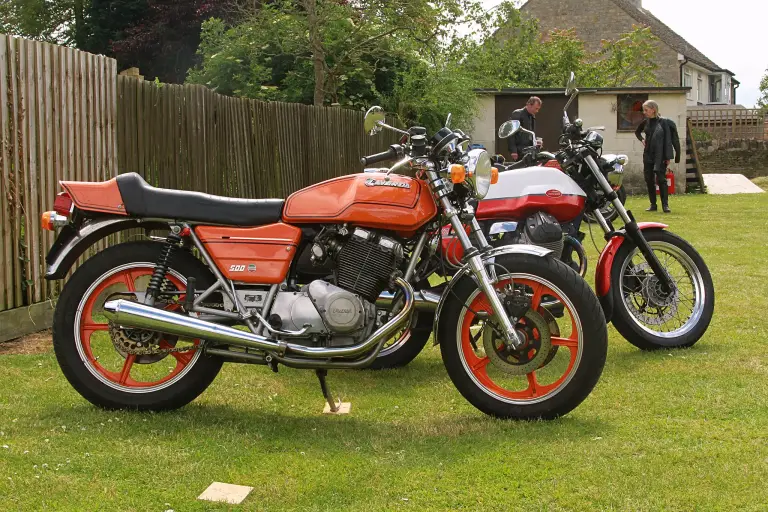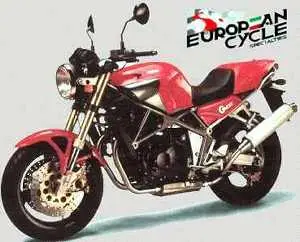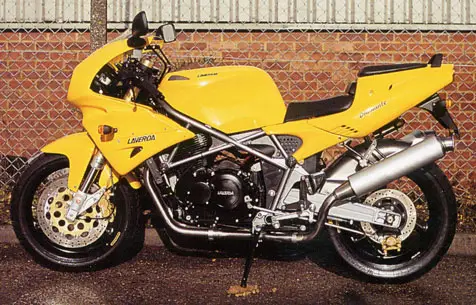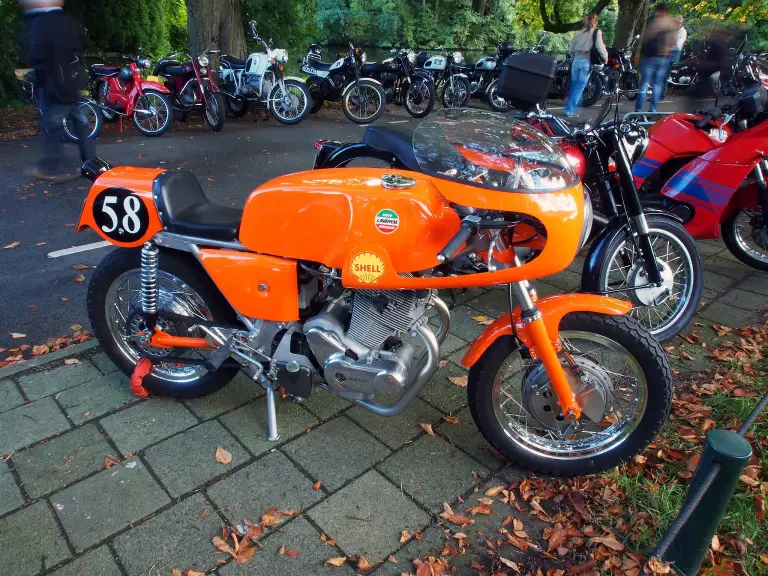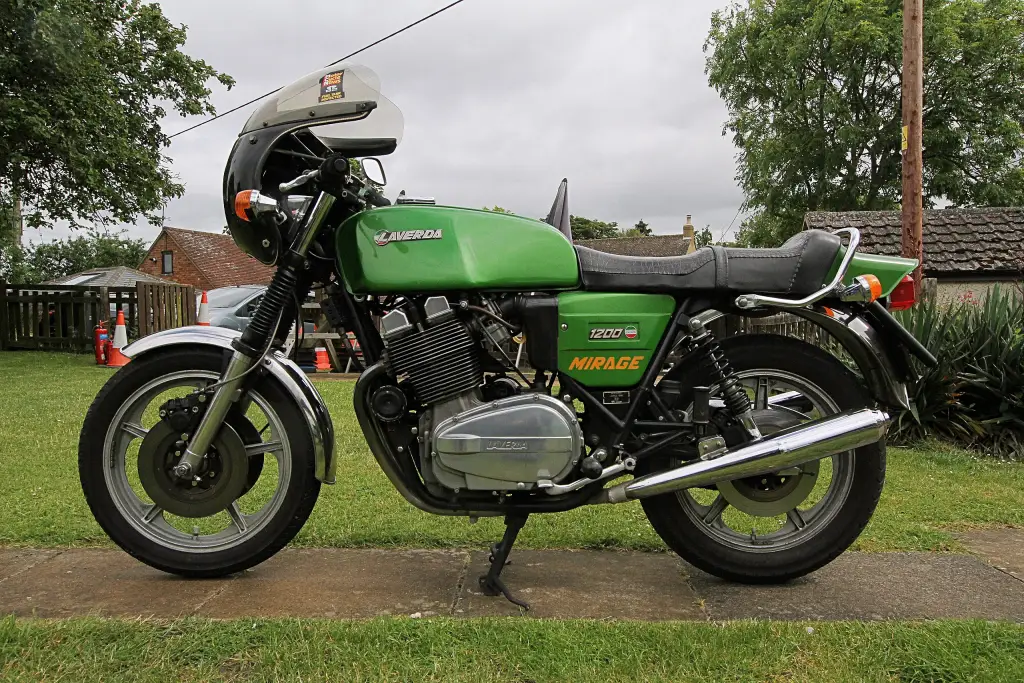
The Laverda 1200 is a 1,116 cc air-cooled double-overhead-camshaft triple produced by the Italian manufacturer Laverda between 1977 and 1982. It was developed from the Laverda 1000, and although it was sold as a 1200 its real capacity was 1,116 cc. The most sought-after version today is the green Mirage built for the British importer.
Laverda 1200 at a glance
| Engine | 1,116 cc air-cooled DOHC triple |
|---|---|
| Production | 1977–1982 |
| Developed from | Laverda 1000 / 3CL |
| Bore and stroke | 80 × 74 mm (1000: 75 × 74 mm) |
| Carburettors | three 32 mm Dell’Orto |
| Gearbox | five-speed, chain final drive |
| Front brakes | two 280 mm Brembo discs |
| Rear brake | one 280 mm Brembo disc |
| Forks | Ceriani 38 mm, Marzocchi 38 mm from early 1978 |
| Ignition | Bosch, BTZ electronic from early 1978 |
| Colours at launch | red or blue with orange flashes |
| Main versions | 1200T, Jota America, Mirage, 30th Anniversary, 1200TS |
The Italian page adds detail on the engine layout and on the US-market Jota America; the rest of the article follows the English page.
History of the Laverda 1200
Why a bigger triple
By the mid-1970s noise and pollution legislation, especially in the United States, forced restrictive inlets and exhausts, softer camshafts and lower compression ratios on the big Laverda triple. To win back the lost performance the factory turned to capacity. The Austrian importer Werner Sulzbacher had already raced triples over-bored to 1,172 and 1,116 cc with some success, and he pressed Breganze to build a 1200 cc version.
The 1200T
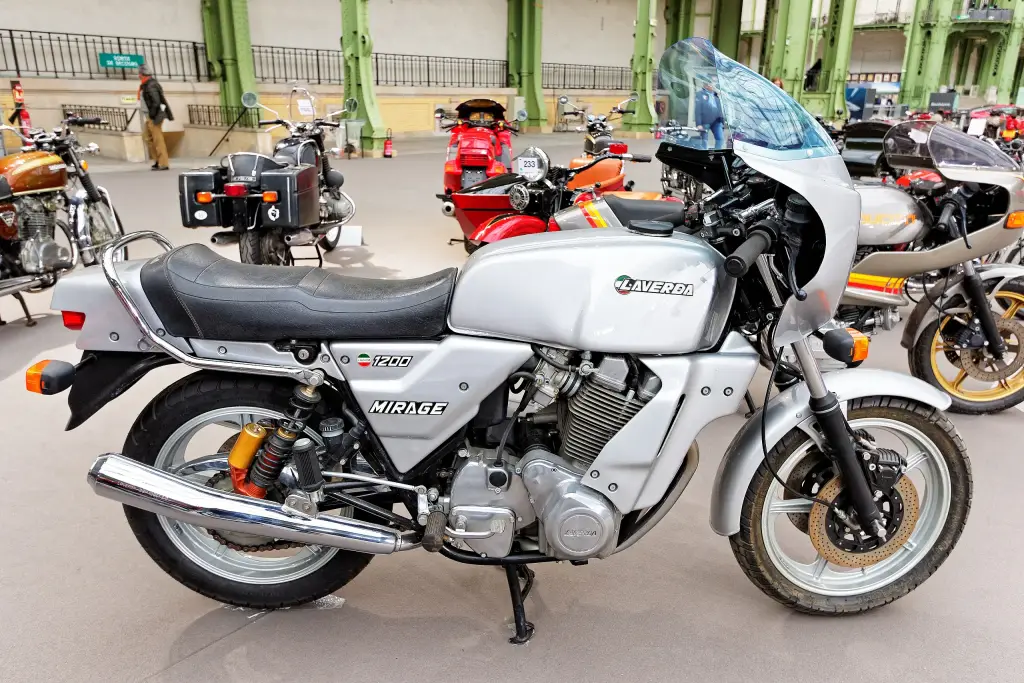
Based on the 3CL, the 1200T was introduced in 1977. The bore grew by 5 mm, from 75 to 80 mm, while the stroke stayed at 74 mm, giving 1,116 cc; the ‘1000’ cast into the primary chaincase was machined off. The existing twin-downtube frame was modified with the rear shock absorbers moved forward, a frame later used on the 1000 cc models too. Ceriani 38 mm forks were fitted, with twin 280 mm Brembo discs at the front and one at the rear, and the cast wheels were made by Laverda itself. Early machines were finished in red or blue with orange flashes. In early 1978 a second series brought 38 mm Marzocchi forks and yokes, BTZ electronic ignition in place of the Bosch unit, and badges instead of transfers on the tank.
Jota America and the Mirage
The 1200 Jota America was built to meet US-DOT regulations, which brought a left-side gearchange; the crossover linkage and rear brake master cylinder pushed the footrests into less than ideal positions. The Mirage was the idea of the British importers Slater Bros, who had already created the Jota: 4C camshafts and a Jota exhaust were specified, and the machines left the factory without exhausts and nameplates, which were fitted in Britain. The name was suggested by Laverda’s sales manager Luciano Zucarelli. From July 1978, at Slater’s request, Mirages were painted metallic green; universally known as the ‘Green Mirage’, this is now the most sought-after 1200. A handful of higher-performance Formula Mirages, estimated at between 14 and 17, were built by Slaters with a higher compression ratio, 7C endurance racing camshafts, one-piece fibreglass seat and tank and a matching fairing; as fibreglass tanks were outlawed in some places, a 2.5 gallon metal tank sat underneath.
The 30th Anniversary
To mark thirty years of motorcycle production Laverda announced in 1979 a limited edition 30th Anniversary 1200. Two hundred were produced, but fewer than 50 were sold to the public; the rest went to the Libyan police force. The model brought the first hydraulic clutch and drilled discs on a Laverda, larger inlet valves as used on the Jota, black and gold paint with black chrome, a handlebar fairing and a unique seat cover, and even a gold-plated steering nut. Each buyer received a personal letter from Massimo Laverda and a gold medal etched with his photograph.
The 1200TS and the Austrian specials
Continuing the Gran Turismo idea, the 1200TS appeared in 1979 with a handlebar fairing, fibreglass lowers hugging the engine and a new tail section; most were silver with maroon coachlines. Larger inlet valves came in 1980 and a bigger Nippon Denso alternator in 1981, when the ignition pick-ups moved to the primary side. American machines used softer touring camshafts, more restrictive exhausts and noise-cancelling baffles in the airbox. A 1200TS Mirage was also sold worldwide, sanitised by the factory for international legislation. In Austria, Sulzbacher and the engineer Franz Laimboeck built tuned café-racer versions, including the 1,172 cc 1200SC and the 1,290 cc 1300SC.
Design and features
- Capacity instead of tuning: a 5 mm larger bore made up for the power lost to emissions and noise rules.
- Brembo all round: two 280 mm front discs and one at the rear on Laverda’s own cast wheels.
- The Green Mirage: Slater’s 4C-cam, Jota-exhaust version in metallic green, now the most valuable 1200.
- Rarities: the 200 30th Anniversary machines and the 14 to 17 Formula Mirages.
Laverda 1200 versions
- 1200T (1977–): the original model, red or blue with orange flashes, Ceriani forks.
- Second series (1978–): Marzocchi forks, BTZ ignition, tank badges.
- 1200 Jota America: US-market version with left-side gearchange.
- Mirage (1978–): British high-performance version, metallic green from July 1978.
- Formula Mirage: about 14–17 racing-specification machines built by Slaters.
- 30th Anniversary (1979): 200 built, black and gold, hydraulic clutch, drilled discs.
- 1200TS (1979–): touring version with handlebar fairing and fibreglass lowers; also sold as the 1200TS Mirage.
The 1200 was developed from the Laverda 1000 triple and shared its frame with the later Jota. The ancestor of the whole line is the 750 twin, and more Laverdas are in the collection.
Video: Laverda 1200 starting up
Video on YouTube.
Sources
- Laverda 1200, English Wikipedia: development, versions, specifications
- Laverda 1200, Italian Wikipedia: engine layout, Jota America details