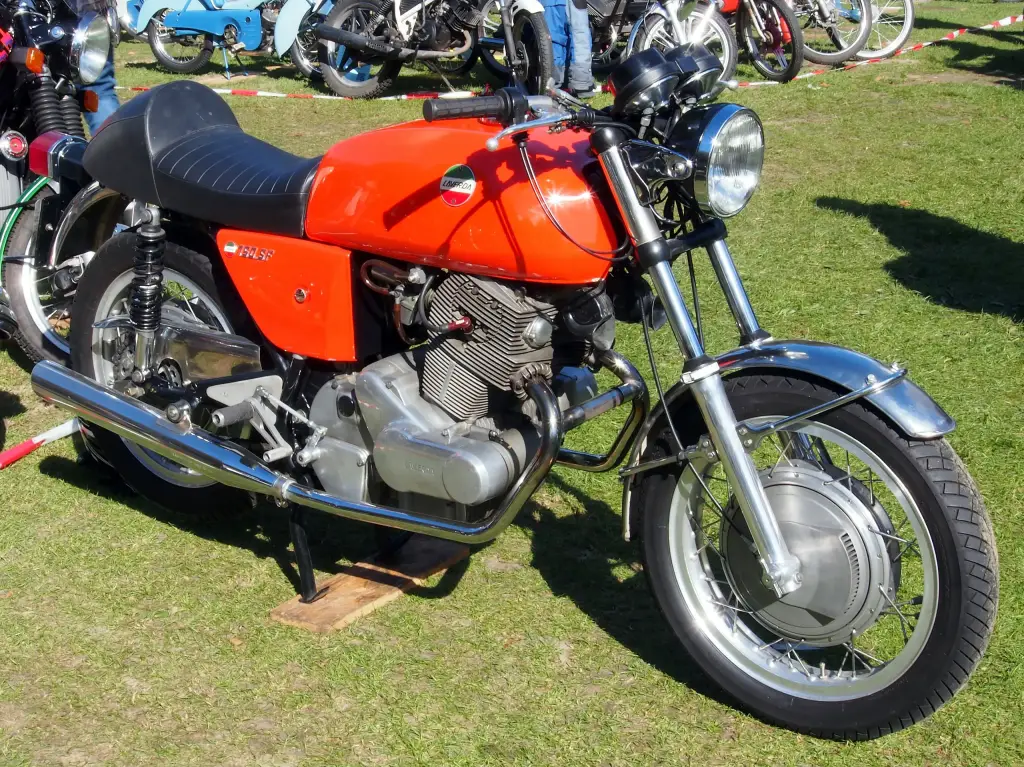
The Laverda 750 is a 744 cc air-cooled single-overhead-camshaft parallel twin produced by the Italian manufacturer from 1968 to 1976. It was developed from the company’s 650, and its engine design drew heavily on the Honda CB77. Around 18,000 machines were built, in a long line of versions from the touring GT to the sporting SF3.
Laverda 750 at a glance
| Engine | 744 cc air-cooled SOHC parallel twin |
|---|---|
| Production | 1968–1976 (available into 1977) |
| Developed from | Laverda 650 |
| Design influence | Honda CB77 |
| Total built | about 18,000 |
| Models | 750GT, 750S, 750SF, SF1, SF2, SF3, 750GTL |
| 750GT power | 52 bhp |
| SF1 power | 66 bhp at 7,300 rpm |
| SF front brake | 230 mm twin-leading-shoe drum by Francesco Laverda |
| SF2 | Brembo front disc, soon twin discs, dualseat |
| SF3 | rear disc, cast wheels, glassfibre seat cowl |
| American brand | American Eagle, 1968–1970 |
The English page covers the whole 1968–1976 range; the Italian page on the SF adds the Italian market figures and the details of the SF1 update.
History of the Laverda 750
A twin for the American market
Laverda had built small-capacity singles and twins. In 1964 general manager Massimo Laverda went to the United States to study the market, and on his return persuaded his father Francesco, the founder, that a larger twin was needed to succeed there. Massimo brought back a Honda CB77, a Norton 650SS and a BMW R69S, which were stripped and examined; the 650 cc engine designed by Luciano Zen took elements from all three but was heavily based on the Honda, with Bosch electrics chosen for reliability. The spine frame and Ceriani suspension gave the bike handling that set it apart. A prototype was shown at the Earls Court Show in London in November 1966, and soon afterwards the crankshaft phasing was changed from 180° to 360° to improve torque. In 1967 the American Jack McCormack rode the prototype and, believing US buyers wanted more capacity, persuaded the factory to enlarge the twin. Laverda entered a 650 and three 750s in the Giro d’Italia in May 1968: the 650 won its class and all three 750s finished in the top ten.
GT and S
The 750GT went into production in late 1968 as the first of the line, producing 52 bhp and lasting until 1974, when the GTL replaced it. In 1969 came the 750S, a more sporting model with a higher compression ratio that produced an extra 8 bhp and used a new, stronger frame. On the Italian market the 750 took over from the 650 GT in 1968 and the S arrived the following year, and exports to the United States began under the American Eagle brand.
The SF and its successors
The 750SF was introduced in 1970, the letters standing for Super Freni, or super brakes. It used a new, lower frame with a less steeply raked steering head and a 230 mm twin-leading-shoe front drum designed by Francesco Laverda instead of the Grimeca item used before, with a balance pipe between the exhaust downpipes, and it was sold in a wide range of metallic colours. British buyers got their SFs from Slater Bros in kit form to avoid Purchase Tax. The model was a commercial success: 1,096 were sold in Italy in 1970, 1,915 in 1971 and 3,082 in 1972, when it was the best-selling large motorcycle in the country, at a little over one million lire against 1,280,000 for a Honda CB750 Four. Owners complained of a heavy clutch and of indifferent handling in corners.
The SF1 of 1973, known in Italy as the SF 73, took the frame and cylinder head of the SFC racer with larger valves and 36 mm Dell’Orto pumper carburettors in place of the 30 mm items, lifting output to 66 bhp at 7,300 rpm. It also brought Nippon Denso instruments instead of Smiths, a stronger crankshaft, and a new exhaust with a large collector box under the engine that often grounded in corners. The SF2 of 1974 added a Brembo front disc, soon doubled, and a dualseat as standard; in 1975 the gearshift moved to the left for the American market and roller bearings replaced the swinging-arm bush. The SF3 of 1976, the last of the line, had a rear disc, cast wheels and a new seat with a glassfibre cowl, and its brakes were praised in road tests. Production ended in 1976, though the model was available into 1977, after about 18,500 SF-family machines in all.
GTL and the American Eagles
The 750GTL of 1974 combined the GT engine with SF cycle parts, a large tank and touring handlebars, and stayed in production until 1977; several police forces used it, including the Italian Polizia Urbana. The American Eagle models sold in the United States had ‘buckhorn’ handlebars, a glassfibre tank and a restyled seat. The first was the 750 Classic with a 60 bhp engine, renamed the 750 Road Sport when the 68 bhp 750 Super Sport joined it. To publicise the brand McCormack sponsored the stunt rider Evel Knievel, who used 750 Eagles until 1970. American Eagle folded in 1970 after selling fewer than 100 twins, including 20 to 30 with a duplex frame by Leopardo Tartarini, and the West Coast Husqvarna importer Edison Dye took over, importing the models under the Laverda name and without the American changes.
Design and features
- Honda-derived twin: a single-camshaft 744 cc engine with horizontally split crankcases, four main bearings and double-row roller big ends.
- Handling: a spine frame and Ceriani suspension gave the 750 a reputation for roadholding.
- Super Freni brakes: the SF’s own 230 mm twin-leading-shoe drum, later replaced by Brembo discs.
- Steady evolution: GT, S, SF, SF1, SF2 and SF3 followed one another with more power, better brakes and cast wheels.
Laverda 750 versions
- 750GT (1968–1974): the original 52 bhp touring twin.
- 750S (1969–1970): higher compression, 8 bhp more, stronger frame.
- 750SF (1970–): Super Freni drum brake, new frame, balance pipe, many metallic colours.
- SF1 (1973–): SFC-derived head, 36 mm carburettors, 66 bhp, Nippon Denso instruments.
- SF2 (1974–): Brembo front disc, dualseat, left-side gearchange for the US in 1975.
- SF3 (1976–): rear disc, cast wheels, glassfibre seat cowl.
- 750GTL (1974–1977): GT engine in SF cycle parts with a large tank and touring bars.
- American Eagle 750 Classic, Road Sport and Super Sport: US-market versions, 1968–1970.
The 750 was enlarged into the 1000 triple, and its racing descendant is described in the Laverda SFC article. The smaller relative is the Laverda 500, and more machines are in the Laverda collection.
Video: Restoration of a 1971 Laverda 750 SF
Video on YouTube.
Sources
- Laverda 750, English Wikipedia: development, GT, S, SF range, American Eagle, specifications
- Laverda SF, Italian Wikipedia: Italian sales figures, SF1 changes, end of production