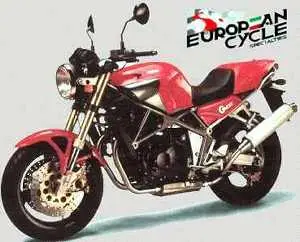
The Laverda Ghost was one of the roadsters planned in the late 1990s as part of the brand’s revival under Francesco Tognon. It was shown at international motorcycle shows as a 750 cc roadster variant, alongside the Strike, but the relaunch ran out of money before the plan could become a lasting model range.
Laverda Ghost at a glance
| Type | 750 cc roadster, with the Strike |
|---|---|
| Engine family | derived from the 668 cc twin |
| Shown | international motorcycle shows of the late 1990s |
| Status | planned model, shown as a mockup |
| Company | I.Mo.La. SpA, Zanè |
| Ownership | Francesco Tognon from 1993 |
| Also planned | 900 cc three-cylinder, Lynx, 800TTS |
| End of the venture | after five years; Aprilia bought Laverda in 2000 |
The English Wikipedia article on Laverda mentions the Ghost in a single sentence, among the mockups shown at the shows; this short article is based on that sentence and on the surrounding history of the same page, and the source gives no free photographs of the model.
History of the Laverda Ghost
The plan
After Francesco Tognon bought Laverda in 1993 the company made a fresh start, building sports twins on a reworked 650 cc engine enlarged to 668 cc. Alongside the machines that reached the shops, the factory showed the shape of a wider range. At successive international motorcycle shows Laverda displayed mockups of models it planned to build: an all-new 900 cc liquid-cooled three-cylinder engine, the 750 roadster variants Ghost and Strike, the Lynx, a small naked roadster using a Suzuki 650 cc V-twin, and the 800TTS trail and enduro bike, aimed at the Cagiva Gran Canyon and the Honda Transalp.
A modern roadster
The Ghost belongs to the 750 roadster side of that plan, the practical naked counterpart to the fully faired sports twins. It sat on the same engine family, a 668 cc double-overhead-camshaft parallel twin enlarged to 750 cc for the roadsters, with the modern equipment of the revival models: electronic fuel injection, Brembo brakes and quality suspension. Like the rest of the plan, it was a small factory’s attempt to cover several market sectors at once with one engine.
Why it did not last
The venture failed after five years. Laverda was bought by Aprilia in 2000, and when Piaggio absorbed Aprilia in 2004 it quietly closed all activities connected with the Laverda brand, saying it would be willing to sell the rights to anyone who appeared. Since then laverda.com has shown the history of the company between 1873 and 2004 rather than a range of new models. The Ghost remains a footnote of that last attempt to keep the name alive, remembered more for the plan it belonged to than for the numbers built.
Design and features
- Roadster counterpart: a naked 750 in a plan dominated by fully faired sports twins.
- One engine, many models: the 668-derived twin was meant to power roadsters, trail bikes and more.
- Show bike: presented as a mockup at international motorcycle shows of the late 1990s.
- End of an era: part of the last Laverda range before Aprilia and then Piaggio closed the brand.
Laverda Ghost versions
- Ghost: the 750 roadster variant, shown with the Strike.
- Strike: the second 750 roadster variant of the same plan.
- Related projects: the 900 cc triple, the Lynx with a Suzuki V-twin and the 800TTS trail bike.
The Ghost used the engine family described in the Laverda 668 article, which itself came from the Laverda 500. The older roadsters of the marque are covered by the Laverda 750, and more machines are in the Laverda collection.
Sources
- Laverda, English Wikipedia: models shown at the shows, end of the venture, brand closure