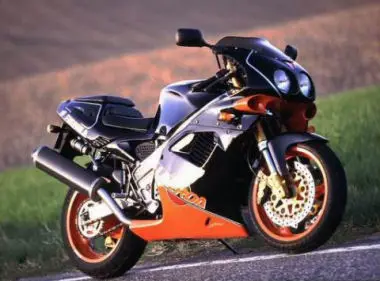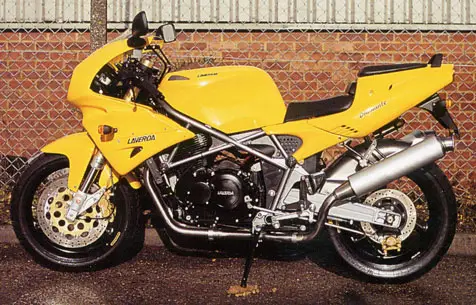
The Laverda 668 is the sports twin on which the brand’s 1990s relaunch was built. After Francesco Tognon bought the company in 1993, Laverda reworked its old double-overhead-camshaft 650 cc parallel twin, took it out to 668 cc and wrapped it in contemporary superbike bodywork. The engine then fathered a whole family of sports models built at Zanè.
Laverda 668 at a glance
| Type | air-cooled DOHC parallel twin |
|---|---|
| Capacity | 668 cc |
| Era | from the 1993 relaunch to about 2000 |
| Base engine | 650 cc twin of the Alpino, reworked |
| Fuel system | Weber-Marelli electronic fuel injection |
| Brakes | Brembo Gold Line |
| Suspension | fully adjustable Paioli; White Power on some models |
| Wheels | hollow-spoke Marchesini |
| Built at | Zanè, near Breganze |
| Developed into | the 750 twins of 1997–2001 |
The 668 is not covered by its own Wikipedia page: it appears in the English article on Laverda and in the engine-family history of the Italian article on the 350-500, which are the only sources used here. The material is thin, so the article is shorter than usual.
History of the Laverda 668
A company saved
In 1993 the millionaire Francesco Tognon bought everything, saving the company and setting up what looked like the first serious attempt in a decade to relaunch the Laverda brand. Over the following five years the factory launched a small selection of new sports models built on a thorough reworking of the double-overhead-camshaft 650 cc parallel twin derived from the old Alpino, enlarged to 668 cc and clothed in contemporary superbike livery.
Modern parts on an old layout
These machines were fitted with Weber-Marelli electronic fuel injection, Brembo Gold Line brakes, fully adjustable Paioli suspension (White Power on some models) and hollow-spoke Marchesini wheels. Production moved from Breganze to Zanè, about six miles to the west, and the name of the company became I.Mo.La. SpA, International Moto Laverda.
An engine with a past
The 668 was not a new design but the last chapter of a long line. The half-litre twin of the 1970s had already been the base for Laverda’s 650, 668 and 750 engines; enlarged to 600 cc it powered the Atlas enduro of 1986, and the same family produced the El Cid 700 enduro prototype of 1989, with a 668 cc engine and electronic injection, and the Hidalgo 668 custom of the same year, neither of which reached series production. The sports twins built at Zanè in the 1990s were the final flowering of that engine family.
From 668 to 750 — and the end
In 1997 Laverda began building a 750 derived from the 668, keeping almost all of its chassis and frame but enlarging the engine to create more interest among mid-range buyers. The 750’s retro-styled nose recalled the big headlamps of the Laverdas that won endurance races such as the Bol d’Or in the 1970s and 1980s, while its parallel twin echoed the 750 SF. It was sold in several forms, from the 750 S of 1997–1998 to the 750 Sport, 750 SS and 750 Formula of 1999–2001, with or without fairing and a long list of accessories. The revival did not last: Aprilia bought Laverda in 2000, and when Piaggio absorbed Aprilia in 2004 it quietly closed all activities connected with the Laverda brand.
Design and features
- Injection and modern cycle parts: Weber-Marelli fuel injection, Brembo Gold Line brakes and Marchesini wheels.
- Adjustable suspension: fully adjustable Paioli units, White Power on some models.
- Old engine, new clothes: a reworked 650 cc twin enlarged to 668 cc in superbike bodywork.
- Foundation of the range: the 668 led directly to the 750 twins of 1997–2001.
Laverda 668 versions
- 668 sports twins (from 1993): the relaunch models on the reworked engine.
- Laverda 750 (1997–2001): enlarged development sharing the 668 chassis, in S, S Formula, Sport, SS and Formula forms.
- Earlier relatives: the Atlas 600 enduro of 1986, and the El Cid 700 and Hidalgo 668 prototypes of 1989 that never entered production.
The 668 came from the Laverda 500 engine family and led to the later 750 twins. The 1990s plan also included the Laverda Ghost, and more machines are in the Laverda collection.
Sources
- Laverda, English Wikipedia: 1993 relaunch, engine, equipment, company history
- Laverda 350-500, Italian Wikipedia: engine family, El Cid 700 and Hidalgo 668 prototypes