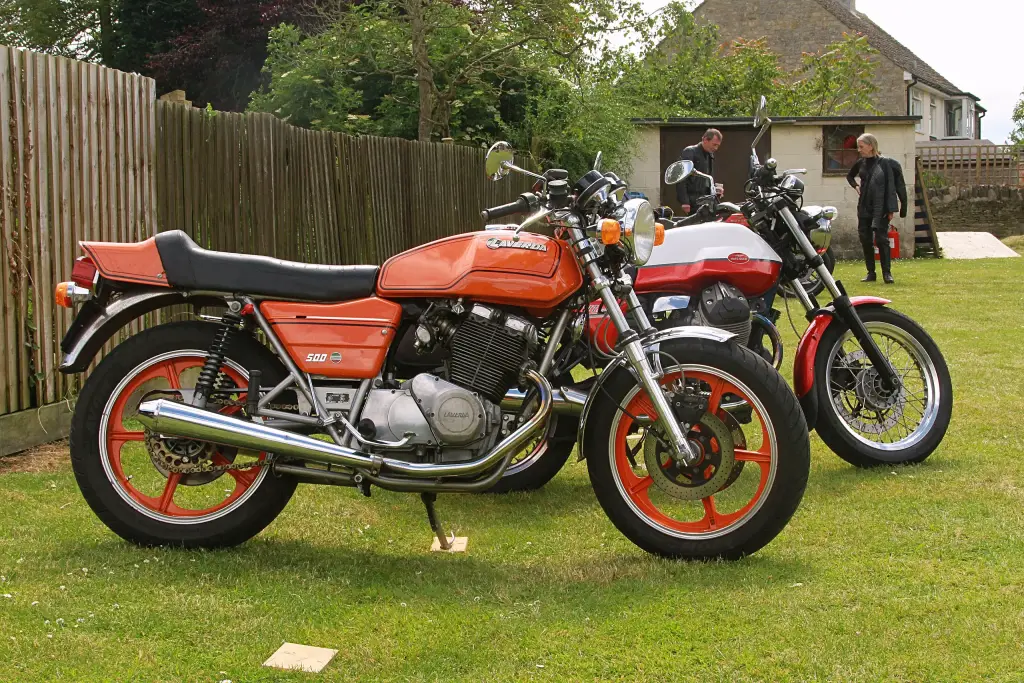
The Laverda 500 is a 497 cc air-cooled double-overhead-camshaft parallel twin built by the Italian factory in several versions between 1977 and 1983, alongside a smaller 350. It filled the middleweight gap in the range, became the basis of a one-make racing trophy, and its engine went on to power the twins that Laverda sold into the 1990s.
Laverda 500 at a glance
| Engine | 497 cc air-cooled DOHC parallel twin, eight valves |
|---|---|
| Production | 1977–1983 |
| Bore and stroke | 72 × 61 mm |
| Power | 44 PS (32 kW) |
| Gearbox | six-speed, chain final drive |
| Frame | double cradle, Ceriani fork with 120 mm travel |
| Brakes | three 260 mm Brembo discs |
| Weight | 175 kg |
| Top speed | about 170 km/h |
| Total built, 500 | about 5,000 |
| 350 version | 1978–1981, about 3,000 built |
| Other names | Alpino in Britain, Zeta in the United States |
The German and Italian pages describe the same range from different angles; the racing detail and the engine family history come mainly from the Italian page.
History of the Laverda 500
Filling a gap
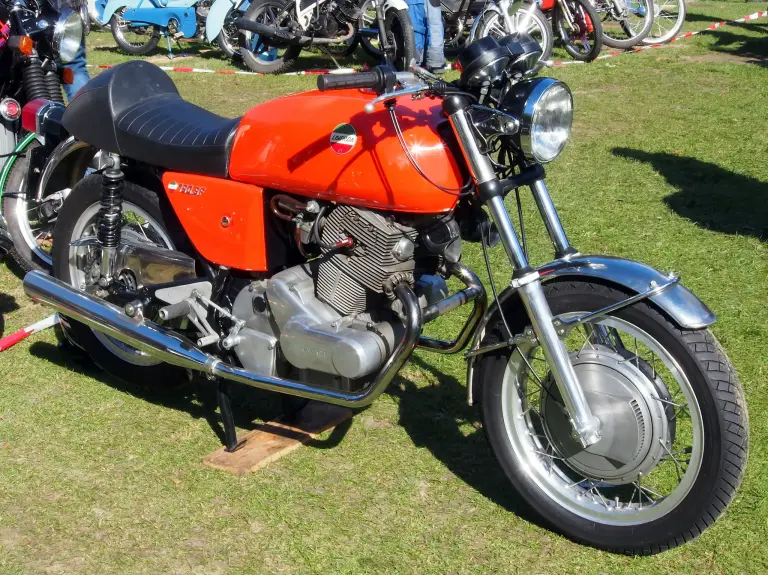
The 500 was created to cover a market sector where Breganze was absent: the middleweights. The design borrowed features from the larger SF and 1000, with a double-overhead-camshaft 500 cc twin with an eight-valve head, a six-speed gearbox, three Brembo discs, cast alloy wheels, electronic ignition and electric starting. The public saw it at the Milan Show in 1975, but technical and logistical problems delayed production, which began only in 1977. In Germany it appeared in 1976 with a light and powerful half-litre engine of 72 × 61 mm producing 44 PS, a double-cradle frame, a Ceriani fork with 120 mm of travel, a swinging arm with 80 mm, cast alloy wheels on 3.50–18 tyres and 260 mm Brembo discs.
What it was like
The 500 had a harmonious, pleasing line, weighed only 175 kg and was well braked, with a short gearbox ratio spread that made it lively. Its engine, though, needed careful maintenance — neglected, it could drop valves — and it vibrated around 6,000 rpm. Top speed was only about 170 km/h, it had the worst fuel consumption in the half-litre class and was one of the most expensive machines in it. On the Italian market it was also handicapped by a ban on riding it at eighteen and by purchase tax at 35 per cent. British buyers knew it as the Alpino, Americans as the Zeta.
The 350
To answer those last problems Laverda presented a 350 in 1978, with the bore reduced from 72 to 60 mm, a balance shaft, smaller valves and carburettors, a lower compression ratio, a larger tank and different front and rear tyre sizes. The balance shaft, tank and tyres were soon adopted on the 500 as well. The 350 was as stable and handy as the 500, and its engine was willing and free of vibration, though it carburated unevenly. Its 155 km/h, acceleration, consumption and weight matched its rivals, but its price did not: 2,277,000 lire including tax, when a Moto Morini 3½ or a Moto Guzzi V35 cost a little under 1,900,000. Production of the 350 ended in 1981 after about 3,000 machines; the 500 continued to 1983 with about 5,000 sold.
Racing and the Formula
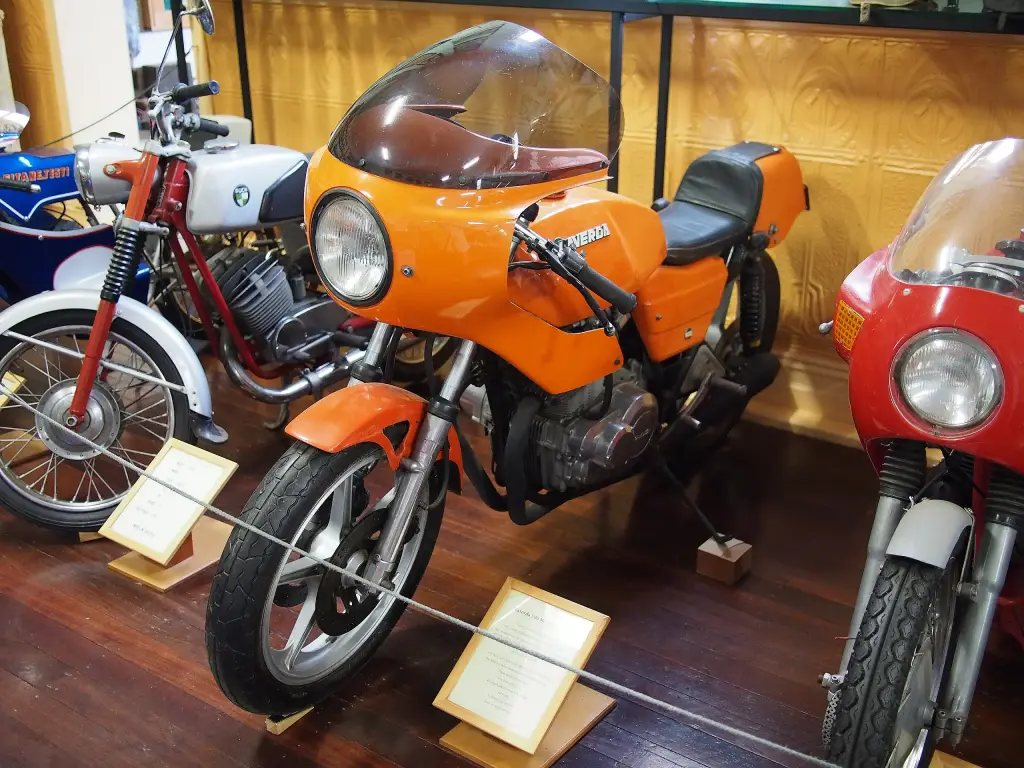
In 1978 Laverda promoted a one-make trophy, the Trofeo Formula Laverda 500, one of the first in Italy, sponsored by the FMI and open to riders under thirty with no podium finishes. For it the factory built the 500 Formula, lighter and more powerful than the road bike, its output raised from 42 to 60 PS. The trophy was a success and for 1979 the Formula gained a glassfibre fairing and mechanical revisions. The series ran until 1981 and launched riders such as Valter Cussigh, Paolo Ferretti, Corrado Tuzii, Fausto Ricci and Massimo Broccoli, with similar championships in Belgium and Germany. A fully faired, lightened 1978 racing version, the Formula 1 or Montjuic, made 52 PS (38 kW) at 9,500 rpm at 154 kg; the Formula 2 built from 1979 made 60 PS (44 kW) and passed 200 km/h, and 100 were built for the Formula 500 championship until 1981.
The Montjuic and the SFC
The 500 also did well in endurance racing, winning its class and finishing eighth overall at the 24 Hours of Montjuich in 1978 with Brettoni and Davies, and again first in class and ninth overall in 1979 with the same crew. At the 1979 Milan Show Laverda presented a special edition, the Montjuic, with a wilder camshaft, sports exhaust, single seat and screen, built in 250 examples. In the Formula TT, where it first appeared in 1978 in Formula 2, seven Laverdas finished in the first fourteen at the 1980 Isle of Man. For the Italian TT2 championship Laverda built ten specially prepared machines in 1982 with capacity raised to 596 cc, 72 PS and 230 km/h, magnesium wheels, a glassfibre tank and purpose-made bodywork. Encouraged by the German importer Witt, a small series of 50 Laverda 500 SFC machines was developed in 1981 for Germany, recalling the racer with a half fairing, rearset footrests and a humped seat; the engine was almost unchanged but the cycle parts used Marzocchi fork and shocks and 100/90–18 and 110/90–18 tyres, and the model stayed on sale until 1983 at 8,590 DM.
The engine’s long life
The 500 twin was the base for future Laverda models of 650, 668 and 750 cc. Enlarged to 600 cc it powered the Atlas enduro sold from 1986, and from the Atlas came the El Cid 700 of 1989, a prototype enduro with a 668 cc engine and electronic injection that never reached production; the Hidalgo 668 custom of 1989 and the CR 600 Cruiser of 1987 shared the same fate or the same origin. The whole 668 and 750 sports range built at Zanè in the 1990s came from the same engine family.
Design and features
- Eight-valve twin: a double-camshaft 497 cc engine with a six-speed gearbox and electric start.
- Good chassis: light at 175 kg, with a double-cradle frame, Ceriani fork and three Brembo discs.
- Racing pedigree: a one-make trophy, class wins at Montjuich and a strong Isle of Man showing.
- Engine family: the basis of the 650, 668 and 750 twins Laverda built into the 1990s.
Laverda 500 versions
- 500 (1977–1983): the standard road twin, Alpino in Britain and Zeta in the US.
- 350 (1978–1981): shorter-stroke smaller version with a balance shaft, about 3,000 built.
- 500 Formula 1 / Montjuic (1978): fully faired racer, 52 PS at 9,500 rpm, 154 kg.
- 500 Formula 2 (1979–1981): 60 PS, over 200 km/h, 100 built.
- Montjuic (1979): road special of 250 examples marking the Montjuich wins.
- 500 SFC (1981–1983): 50 machines for Germany with half fairing and Marzocchi suspension.
The 500 sat below the 750 twin and the 1000 triple, and its engine grew into the 668. The racing twin is covered in the SFC article, and more machines are in the Laverda collection.
Video: Laverda 500 on a short ride
Video on YouTube.
Sources
- Laverda 500, German Wikipedia: production years, specifications, Formula versions, 500 SFC
- Laverda 350-500, Italian Wikipedia: design, road behaviour, 350, racing, engine family