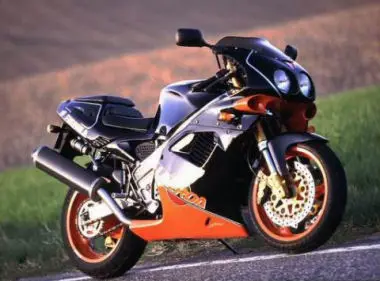
The Laverda 650 was the parallel twin with which the Italian factory at Breganze entered the big-bike market at the end of the 1960s. A prototype was shown in London in 1966 and production began in 1968, but the model was quickly overtaken by the 750 that grew out of it, and only a few dozen were built.
Laverda 650 at a glance
| Type | air-cooled parallel twin |
|---|---|
| Prototype shown | Earls Court, London, November 1966 |
| Production | from 1968 |
| Developed into | Laverda 750 |
| Built | between 52 and 200 (numbers uncertain) |
| Racing | class win in the 1968 Giro d’Italia |
| Instruments | Smiths |
| Suspension | Ceriani |
| Pistons | Mondial |
| Electrics | Bosch, with a Nippon Denso starter |
The 650 is described in a section of the English Wikipedia article on Laverda; this page is based on that section alone, and the source gives no free photographs of the model.
History of the Laverda 650
A new kind of Laverda
By the late 1960s Francesco Laverda and his brothers were sketching out a new breed of large motorcycles to be built around an all-new 650 cc parallel twin. The brand was already well known for small machines, and Francesco’s son Massimo had just returned from the United States, where sales were dominated by large-capacity British and American machines made for long-distance travel. Above all there was a wish to build something that could take on Moto Guzzi, BMW and the rapidly emerging Japanese makers.
Earls Court, 1966
In November 1966 Laverda showed the result at the Earls Court show in London. It was not an extreme sports bike in any sense, but it carried all the virtues the marque had become known for, and its appearance upset the idea that a big parallel twin had to be British. After that first showing Luciano Zen and Massimo Laverda went back to work until April 1968 to prepare the machine for production; by then they had also developed a 750 cc version.
The Giro d’Italia and production
Laverda was confident enough to enter four examples in the Giro d’Italia: two 650s and two 750s. The 650 won its class, three of the four machines finished in the first six and all of them were in the top ten. Two weeks after that victory the first 650 cc production models left the factory.
How it was made
The bikes carried the finest components available at the time: British Smiths instruments, Pankl con-rods, Ceriani suspension, Mondial pistons, Bosch electrical parts and, revolutionary at the time, a Japanese Nippon Denso starter. That last item removed the problem that plagued nearly all contemporary British and Italian motorcycles, their electrical unreliability. The 650 offered superior comfort and stability, with handling at least the equal of the competition, and of course it also carried a high price.
A short life
It is difficult to say how many were built, because frame numbering was shared with the 750 that was launched in May 1968: estimates run from as few as 52 to as many as 200 Laverda 650s. The true birth of Laverda as a serious big-bike brand came with the 750, whose arrival halted sales of the 650 that had just been introduced. The 750 was identical to the 650 apart from a lower compression ratio and re-jetted carburettors, so the earlier model survives mainly as the first step of a family that ran for a decade.
Design and features
- First big twin: the model that moved Laverda from small singles and twins into the large-capacity market.
- International components: Smiths, Ceriani, Mondial, Pankl and Bosch parts, with a Japanese starter.
- Comfort and stability: long-distance manners with handling equal to its rivals.
- Rare: between 52 and 200 built, with frame numbers shared with the 750.
Laverda 650 versions
- Prototype (1966): the Earls Court show machine.
- Production 650 (1968): the road model, built in small numbers before the 750 took over.
- Laverda 750: the enlarged development that replaced it, with lower compression and different carburation.
The 650 grew directly into the Laverda 750, which in turn led to the 1000 triple. More machines are in the Laverda collection.
Sources
- Laverda, English Wikipedia: prototype, Giro d’Italia, components, production numbers