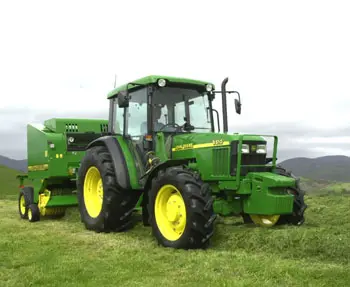
John Deere has built tractors for more than a century, but the firm began as an implement maker. This is the story of its first tractors, from the experimental Dain of 1918 to the letter series that established the green machines across American farms.
John Deere tractors at a glance
| Tractor business | entered in 1876, according to John Deere’s own account |
|---|---|
| First tractor | Dain all-wheel drive, about 100 built in 1918–1919 |
| Dain purchase | 1911, the Dain Manufacturing Company of Ottumwa, Iowa |
| Waterloo Boy | Waterloo Gasoline Engine Company bought in March 1918 |
| Waterloo Boy sales | continued under that name until 1923 |
| Model D | from 1923, longest run of the two-cylinder tractors |
| Model GP | 1928, renamed from Model C |
| Model A | April 1934, 25 hp, 309 cu in |
| Model B | June 1934, shorter frame than the A |
| Model G | 1937, 36 hp and 425 cu in |
| GM | the modernized G, 1942–1947 |
| Tractor types | standard tread and row-crop, many special versions |
This page is an overview based on a single source, the English Wikipedia article John Deere tractors.
History of the John Deere tractors
Deere & Company, the firm founded by John Deere, began to expand its range of equipment to include the tractor business in 1876. The company briefly experimented with building its own tractor models, the most successful of which was the Dain all-wheel drive.
The Dain all-wheel drive
The Dain all-wheel drive was the first tractor produced by John Deere, and it had only a single rear wheel. In 1911 Deere bought the Dain Manufacturing Company of Ottumwa, Iowa. The next year Deere decided to design its own tractor, and Dain’s founder, Joseph Dain Sr., was told to design it. After several prototypes the design was finalised in 1917 and 100 production units were ordered. By 1919, when that run was complete, Deere had bought the Waterloo Boy Company. Although the Dain AWD was ahead of its time, with features such as a shift-on-the-fly transmission, Deere halted production in late 1919, partly because the Dain cost twice as much as the Waterloo Boy and partly because of the death of Dain Sr.
The Waterloo Boy and the Model D
The predecessor of the Waterloo Boy came about in 1892 and was made by the thresher-man John Froelich; it is called the Froelich tractor. In March 1918 Deere & Company decided to continue its move into the tractor business by buying the Waterloo Gasoline Engine Company, which made the popular Waterloo Boy tractor at its works in Waterloo, Iowa. Deere continued to sell tractors under the Waterloo Boy name until 1923. Despite a severe depression in the farm economy, management then decided in 1923 to build the Model D prototype, designed by Muir L. Frey, father of the Ford Mustang designer Donald N. Frey. The Model D was produced from 1 March 1923 to 3 July 1953, the longest production span of all the two-cylinder John Deere tractors. The first Model D rode on steel wheels, with a two-cylinder hand-cranked engine rated from 15 to 27 hp.
GP, A, B and G
On 20 June 1928 the model designation was changed from “C” to “GP”, to avoid confusion with the “D” when dealers phoned in orders to the factory; GP stands for general purpose, and the new model had the same power, capacity, weight and three-speed transmission as the C. The GP was built in five distinct versions: the standard-front GP, the tricycle-front GP of which twenty-three were built, the GP wide-tread or GPWT, the GP wide-tread Series P for potato rows, and the general purpose orchard tractor known as the GPO, some of which were fitted with crawler undercarriages by the Lindeman Brothers of Yakima, Washington.
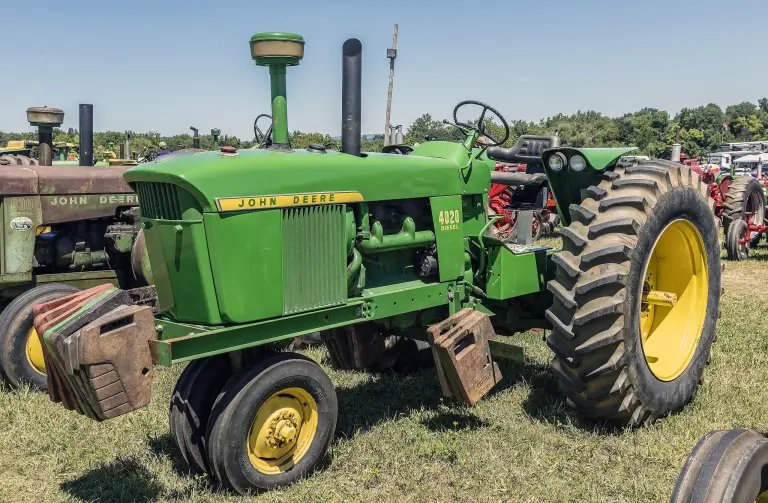
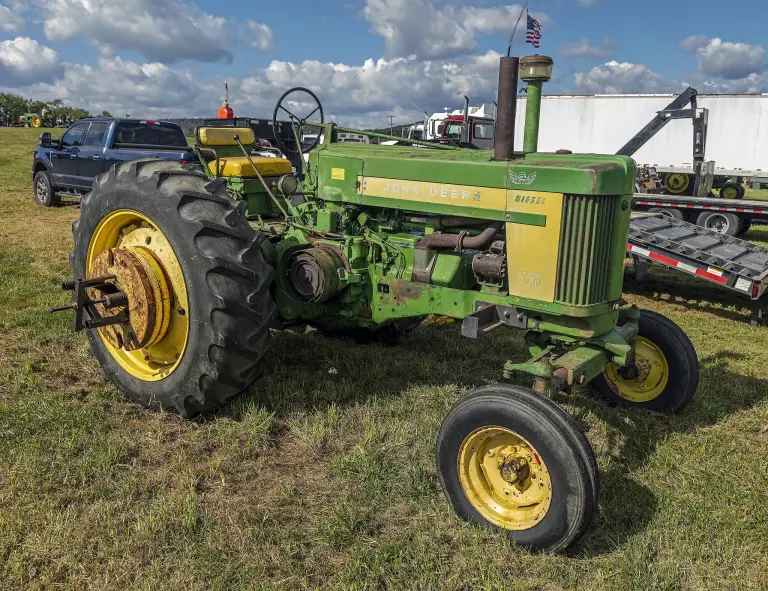
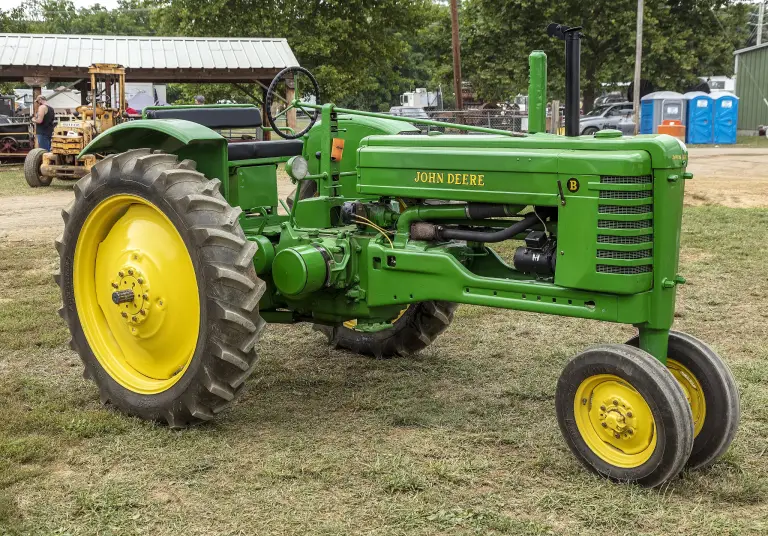
The Model A came off the assembly line in April 1934: 25 hp, 309 cubic inches and a four-speed transmission, with eight different variations including tricycle, hi-crop, orchard, single front tyre and industrial models. The tricycle layout, patterned after the Farmall, reduced steering effort and greatly increased manoeuvrability. The Model B followed in June 1934 with a shorter frame, later lengthened so that it could use some of the equipment of the larger A and G. The much larger G arrived in 1937 with a 36 hp, 425 cubic inch engine and a four-speed transmission; Deere publicised it as a three-plough tractor and built it until 1941, when the GM, or modernized G, replaced it. The GM was made from 1942 to 1947, its drawbar power rose to 38 hp, a new six-speed transmission was added, and electric starting and lighting became options. During its life the G was available as a hi-crop, as a single front wheel model and with the new styling.
Design and features
- Dain all-wheel drive: the first John Deere tractor, with a single rear wheel.
- Waterloo Boy: the 1918 purchase that gave Deere a ready-made tractor and factory.
- Model D: the first mass-produced John Deere, built from 1923 to 1953.
- GP: the general purpose model renamed from C in 1928.
- Letter series: the A and B of 1934 and the larger G of 1937.
John Deere tractors versions
- Dain all-wheel drive: about 100 built in 1918–1919.
- Waterloo Boy: sold by Deere until 1923.
- Model D: standard tread, later also industrial and tracked.
- GP family: standard, tricycle, GPWT, Series P and GPO.
- Letter series: A and B from 1934, G from 1937 and the GM from 1942.
Individual machines from this history have their own pages: the Model D, the Model GP, the Model A and the Model G. More tractors are in the John Deere collection.
Sources
- John Deere tractors, English Wikipedia: Dain, Waterloo Boy, Model D, GP, letter series, G and GM