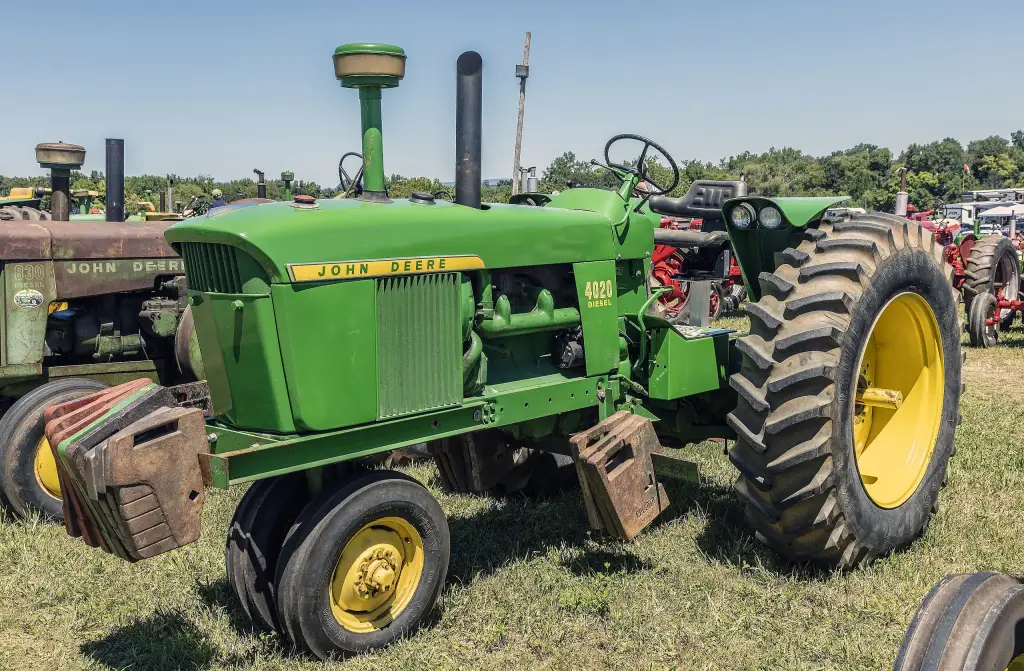
The John Deere 4020 replaced the near-identical 4010 and became the most popular tractor of its time. Between 1963 and 1972 nearly 185,000 were built at Waterloo, Iowa, and in 1966 it was the first John Deere of its power class sold in Europe.
John Deere 4020 at a glance
| Maker | John Deere, Waterloo, Iowa |
|---|---|
| Production | 1964–1972 (French source: 1963–1972) |
| Replaced | John Deere 4010 |
| Replaced by | John Deere 4230 of 1972 |
| Engine | 6,637 cc six-cylinder; diesel, petrol or LP gas |
| Power | 106 hp SAE at 2,400 rpm |
| Drawbar and PTO | 84 hp drawbar and 91 hp PTO in the diesel tests |
| Gearbox | Synchro Range 8 forward and 2 reverse, or Powershift 8 and 4 |
| Power take-off | independent, 540 and 1,000 rpm |
| Weight | 3.750 tonnes unladen |
| Four-wheel drive | optional from 1969, with a front axle driven by two hydraulic motors |
| Built | 184,879, of which 168,311 diesel |
History of the John Deere 4020
The 4020 replaced the 4010, which had opened the New Generation series in 1960, and brought more power, heavier rear axles and a differential lock. It was offered with diesel, petrol or LP gas engines; the diesel was a six-cylinder of 6,637 cc that gave 106 hp SAE at 2,400 rpm and was tested at 84 hp at the drawbar and 91 hp at the power take-off. Two transmissions were available: a fully synchronised manual gearbox with eight forward and two reverse speeds, or a Powershift with eight forward and four reverse. With the Powershift the parking brake was built into the gearbox control, so that no gear could be engaged while the brake was on. An independent rear power take-off ran at 540 or 1,000 rpm.
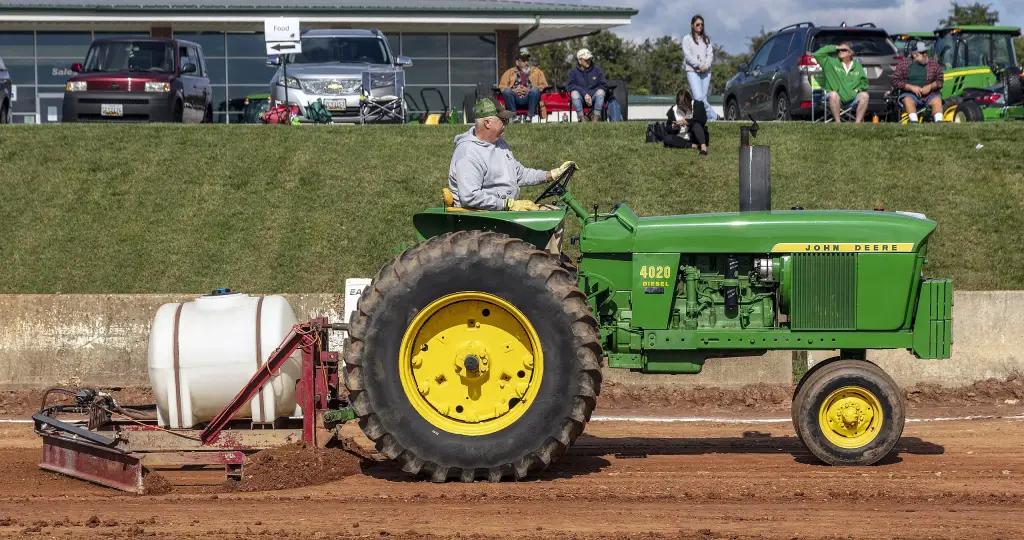
At first the 4020 was sold only in North America. From 1966 it was exported to Europe, where it was the first John Deere in that power class, and in that same year it was the best-selling tractor in the United States, where its only rival was the Farmall 806. It is often described as a legend. Between 1963 and 1972, 184,879 were built, 168,311 of them diesel. The tractor weighed 3.750 tonnes unladen and could be ballasted with weights at the front or in the rear wheel discs.
Versions and four-wheel drive
At the start of production the 4020 had two-wheel drive only. Only in 1969 did John Deere offer a four-wheel-drive option, with a front axle driven by two hydraulic motors. The front axle could be adjustable in width, which was the only possibility on four-wheel-drive tractors, or a close-set Row-Crop type for work in rows, and a Hi-Crop version with extra ground clearance served tall crops such as sugar cane, cotton and maize. All the controls were hydraulic, which gave a smoothness of driving unknown before but worried early buyers, who doubted the reliability of the tractor and of the men who would repair it; in service it proved very reliable. The criticism most often heard in Europe concerned the weak hydraulic lift, a weakness shared by all American-built John Deeres up to the 1980s, because American farmers mostly pulled trailed implements.
The 4000 and the end of the line
In 1969 John Deere introduced the 4000, based on the 4020. With the same engine but almost 1,000 lb lighter, it was designed as a “runner” rather than a “lugger”: Deere claimed it could pull a four-furrow plough fast enough to cover the same acreage as a 4020 with five furrows in the same time. It was also cheaper, with fewer features and smaller rear axles, but most buyers still chose the 4020 and only 7,987 Model 4000s were built. When the Generation II tractors arrived in 1972, the 4020 was replaced by the 100 hp 4230. Britains made a 1:32 scale model of the 4020.
Design and features
- Best seller: 184,879 built, the most popular tractor of its time.
- Six-cylinder power: 106 hp SAE from 6,637 cc.
- Two gearboxes: Synchro Range manual or eight-speed Powershift.
- Optional four-wheel drive: a front axle driven by two hydraulic motors from 1969.
- Row-Crop and Hi-Crop: versions for row crops and tall crops.
John Deere 4020 versions
- Diesel, petrol and LP gas: three engine options.
- Row-Crop: close-set front axle for work in rows.
- Hi-Crop: greater ground clearance for sugar cane, cotton and maize.
- Four-wheel drive: optional from 1969.
- John Deere 4000: the lighter, cheaper derivative of 1969, 7,987 built.
The 4020 succeeded the John Deere 4010 and shared its New Generation engineering with the four-cylinder John Deere 3020. More tractors are in the John Deere collection.
Video: John Deere 4020 plowing
Video by manbowv8 on YouTube.
Sources
- John Deere 4020, English Wikipedia: engines, transmissions, production, the 4000 and the 4230
- John Deere 4020, French Wikipedia: technical data, European export, versions, hydraulic controls