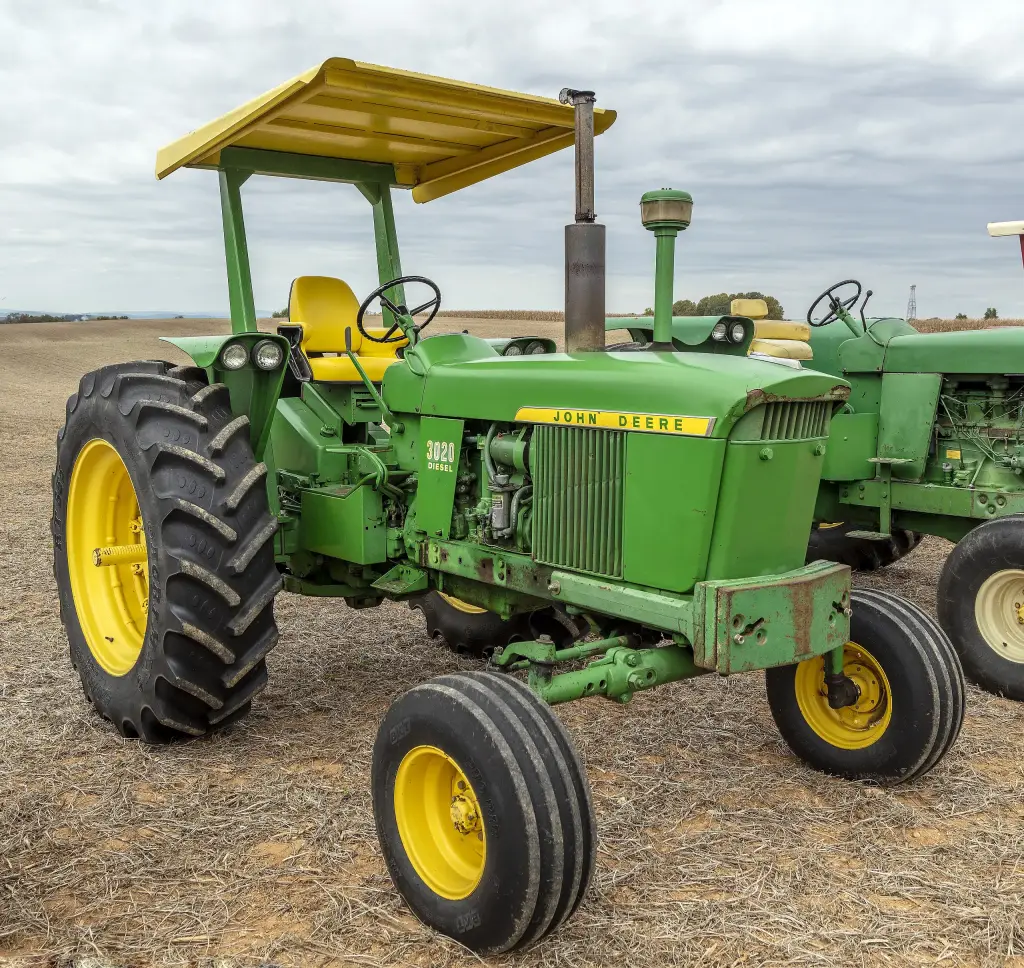
The John Deere 3020 was the four-cylinder tractor of the New Generation series, in production from 1964 to 1972. It replaced the 3010, which it closely resembled, and was built at Waterloo in Iowa.
John Deere 3020 at a glance
| Maker | John Deere, Waterloo, Iowa |
|---|---|
| Production | 1964–1972 (French source: 1963–1972) |
| Replaced | John Deere 3010 |
| Engines | 3.7-litre four-cylinder petrol or LP gas; 4.4-litre four-cylinder diesel |
| Power | 71 hp rated (75 hp DIN in the French source) |
| Wheelbase | 90 inches |
| Fuel tank | 29 US gallons |
| Gearbox | Synchro Range, 8 forward and 2 reverse; Powershift, 8 forward and 4 reverse |
| Power take-off | independent, 540 and 1,000 rpm |
| Front axles | adjustable, Row-Crop, Row-Crop Utility or Orchard |
| Built | more than 80,000 at Waterloo |
| Industrial version | John Deere 500, 1964–1969, painted yellow |
History of the John Deere 3020
Since 1923 and the Model D, John Deere had built tractors with horizontal two-cylinder engines. That layout, and features such as the hand clutch, were out of date after the Second World War, but the company kept to it, apparently because the head of the design office was attached to it. Only on 30 August 1960 did the firm present its first modern models with vertical multi-cylinder engines, the 3010, 4010 and 5010. Three years later they were replaced by the 3020, 4020 and 5020, whose lines, like those of the tractors that followed, were drawn by the stylist Henry Dreyfuss.
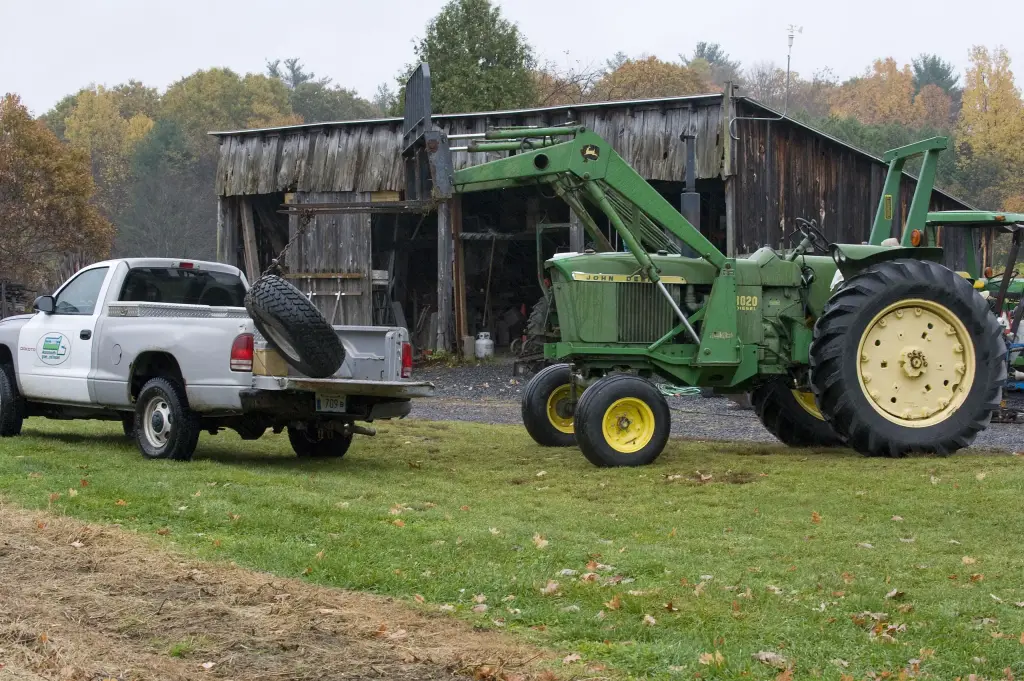
The 3020 was assembled at Waterloo, Iowa. More than 80,000 were built in all versions between 1963 and 1972. It was offered with three engines: a 3.7-litre four-cylinder petrol unit, the same engine on LP gas, and a 4.4-litre four-cylinder diesel. The diesel produced a maximum of 75 hp DIN at 2,400 rpm, and an ether injector in the inlet manifold helped cold starting. A parking brake built into the gearbox control prevented a gear being engaged while the brake was on.
Transmissions and controls
Two transmissions were available: an eight-speed Powershift with four reverse ratios, and a fully synchronised manual gearbox with eight forward and two reverse speeds. The independent rear power take-off ran at 540 or 1,000 rpm. All the main controls — braking, steering, the power take-off — were hydraulic. The “all-hydraulic” layout gave a smoothness of driving that was new at the time, but it worried early customers, who doubted the reliability of the tractor and the ability of repairmen to deal with it; in service the 3020 proved very reliable.
Versions and reputation
The front axle could be adjustable in width or a close-set Row-Crop type for work in row crops, and a Hi-Crop version with greater ground clearance was offered for tall crops such as sugar cane, cotton and maize. An Orchard version had bodywork partly enclosing the driving position and the rear wheels to keep them clear of low branches. Unlike the 4020, the 3020 was never made with four-wheel drive. The complaint most often made in Europe against this tractor, and against all American-built John Deeres up to the 1980s, was the weakness of the hydraulic lift: in America tractors mostly pulled trailed implements, so a powerful lift was not essential. From 1964 to 1969 an industrial version was built in yellow paint as the John Deere 500.
Design and features
- Three fuels: petrol, LP gas and diesel engines in the same chassis.
- Two gearboxes: Synchro Range manual or eight-speed Powershift.
- All-hydraulic controls: brakes, steering and power take-off.
- Row-crop choice: adjustable, Row-Crop, Hi-Crop and Orchard versions.
- Industrial twin: the yellow John Deere 500 of 1964–1969.
John Deere 3020 versions
- Standard and Row-Crop: adjustable or close-set front axle.
- Hi-Crop: extra ground clearance for sugar cane, cotton and maize.
- Orchard: shielding around the driver and rear wheels.
- John Deere 500: yellow industrial version built from 1964 to 1969.
- Powershift and Synchro Range: two transmission choices.
The 3020 was the four-cylinder sister of the six-cylinder John Deere 4020 and the successor of the John Deere 4010. More tractors are in the John Deere collection.
Sources
- John Deere 3020, English Wikipedia: engines, gearboxes, versions, industrial 500
- John Deere 3020, French Wikipedia: history, production at Waterloo, hydraulic controls, European criticism