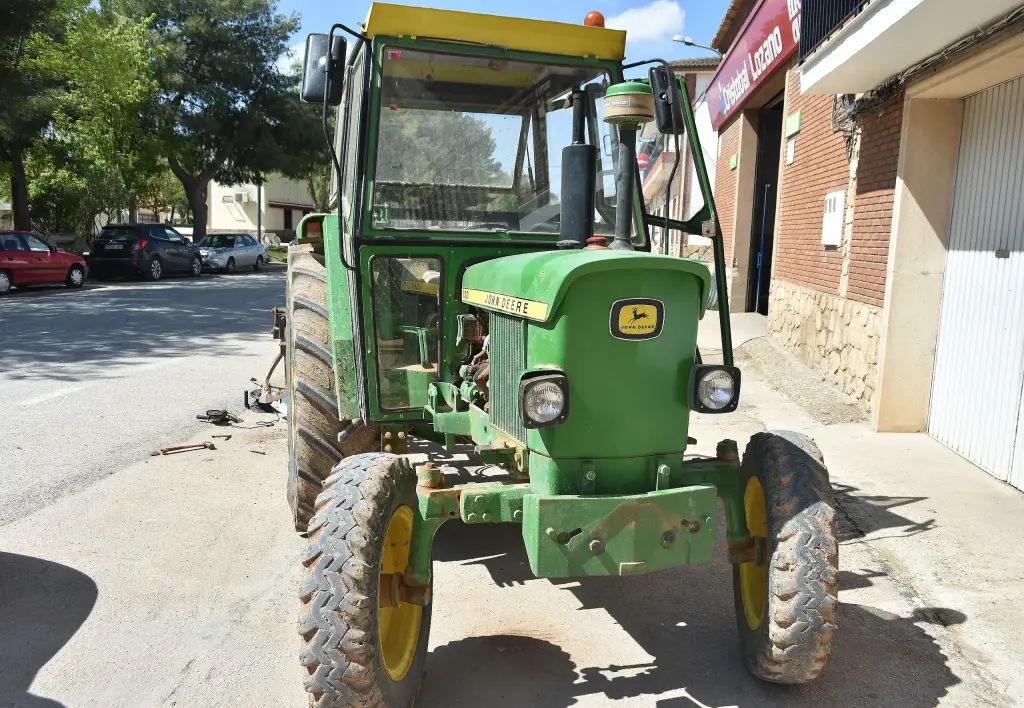
The John Deere 2130 was an agricultural tractor built in the former Lanz works at Mannheim in Germany. It belonged to the lower and middle part of the “30” range, whose more powerful members were still made in the United States.
John Deere 2130 at a glance
| Maker | John Deere, Mannheim, Germany |
|---|---|
| Production | 1973–1979 |
| Replaced | John Deere 2120 |
| Engine | 3,900 cc four-cylinder diesel, direct injection, made at Saran, France |
| Bore and stroke | 106 × 110 mm |
| Power | 73.8 hp DIN at 2,660 rpm |
| Gearbox | 8 forward and 4 reverse; 16 and 8 with the Hi-Low option |
| Top speed | 24.6 km/h |
| Power take-off | rear, independent, 540 rpm |
| Steering | hydrostatic, the first fitted as standard by John Deere |
| Drive | two-wheel drive; hydraulic front axle from 1974, mechanical from 1978 |
| Weight | 2,710 kg |
| Cab | soundproofed PPI cab by Sekura, available from 1975 |
This page is based on a single source, the French Wikipedia article on the John Deere 2130.
History of the John Deere 2130
The 2130 was part of the “30” range, which replaced the “20” range; some of the older models stayed in production until 1975. The lower and middle power models of the 30 range were built in Germany at Mannheim, in the old Lanz factories that John Deere had bought in 1956, while the more powerful tractors continued to come from the American plant. The 2130 replaced the 2120, whose production ended in 1972, and was itself built from 1973 to 1979.
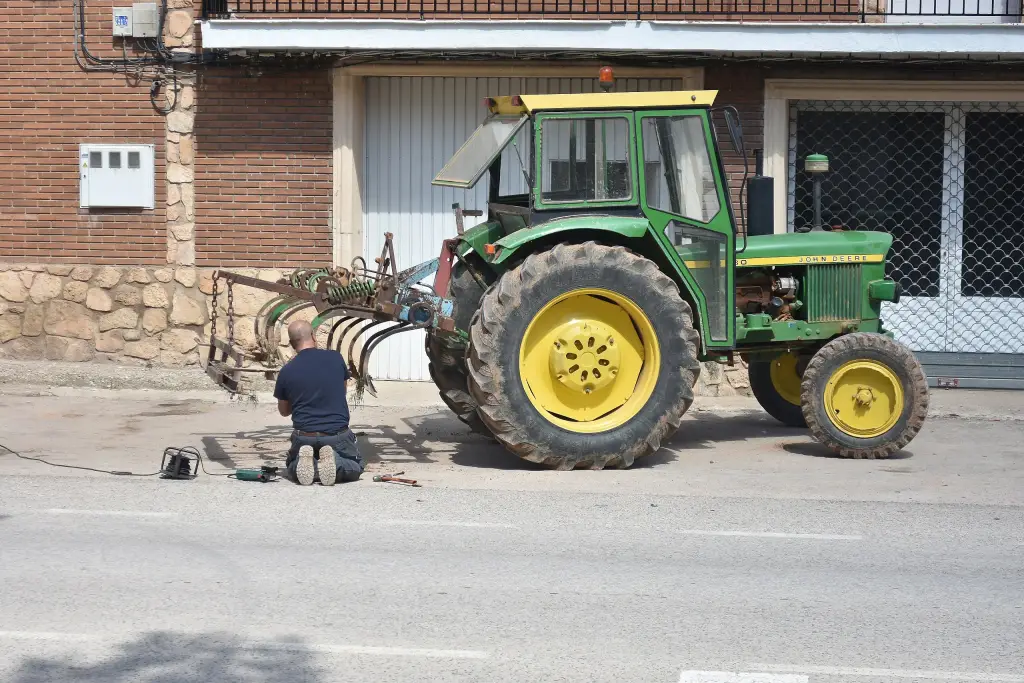
Engine and transmission
The diesel engine was made in the French John Deere factory at Saran. It was a four-cylinder in-line unit with direct injection, a bore of 106 mm and a stroke of 110 mm, giving 3,900 cc, and it developed 73.8 hp DIN at 2,660 rpm. The gearbox offered eight forward and four reverse speeds; with the “High-Low” torque amplifier the number of ratios was doubled to sixteen forward and eight reverse, and top speed was limited to 24.6 km/h. A 540 rpm independent rear power take-off was standard.
Updates during production
The 2130 was the first John Deere tractor to be fitted with hydrostatic steering as standard equipment. From the beginning of 1975 it could be ordered with the spacious, soundproofed PPI cab, designed for John Deere by the Danish firm Sekura to meet the noise limits that Britain imposed in 1976. In September 1975 the bonnet and front end were restyled to match the smoother lines of the American-built 30 Series tractors, giving the whole range a common look. The first tractors had two-wheel drive only; a hydraulically driven front axle was offered from 1974 and a mechanically driven one from 1978. The unladen weight in working order was 2,710 kg.
Design and features
- Mannheim-built: part of the European 30 range produced in the former Lanz works.
- French engine: the 3.9-litre four-cylinder diesel came from the Saran plant.
- Hydrostatic steering: the first John Deere to have it as standard.
- PPI cab: a Sekura-designed soundproofed cab from 1975.
- Growing four-wheel drive option: hydraulic front drive from 1974, mechanical from 1978.
John Deere 2130 versions
- 2130 two-wheel drive: the original version of 1973.
- 2130 with hydraulic front axle: optional from 1974.
- 2130 with mechanical front axle: optional from 1978.
- 1975 restyled tractors: new bonnet and front end shared with the American 30 Series.
- Hi-Low tractors: sixteen forward and eight reverse speeds instead of eight and four.
The 2130 was the middle model of the European range that also included the three-cylinder John Deere 820. Its later Mannheim relatives include the John Deere 3650. More tractors are in the John Deere collection.
Video: JOHN DEERE 2130 – Vintage tractor
Video by gattopardes on YouTube.
Sources
- John Deere 2130, French Wikipedia: production, engine, transmission, cab, front axles, weight